Wire rod (drawing stock)
Continuously cast and rolled rod, typically 9.5 mm diameter, with 12 mm and larger sizes for heavy wire. Supplied in coils for drawing at the customer's plant.



1070 aluminium wire is drawn from 99.70 % pure aluminium, giving electrical conductivity of about 61 – 62 % IACS together with excellent ductility for drawing, stranding and forming. It is used for bare and insulated conductors, winding wire, copper-clad aluminium cores and cold-headed parts. Metline supplies 1070 wire and rod in soft, half-hard and hard tempers to cable makers and manufacturers worldwide.
1070 is a commercially pure aluminium in the 1xxx series. The last two digits mean the aluminium content is at least 99.70 %, so impurities total no more than 0.30 %. That purity is what gives 1070 its high electrical and thermal conductivity, low strength and very high ductility.
For wire, 1070 sits between the general-purpose 1050/1060 grades and the dedicated electrical-conductor grade 1350. 1350 has a slightly lower aluminium minimum (99.50 %) but tighter limits on the transition elements titanium, vanadium, chromium and manganese, which depress conductivity far more than iron or silicon do. A well-made 1070 wire with low titanium and vanadium reaches the same 61 % IACS class as 1350 and is often specified under national standards that list 1070 or its equivalents for conductors, winding wire and cable cores.
Because it work-hardens slowly and anneals easily, 1070 rod can be drawn through many dies without intermediate annealing, and finished wire can be supplied anywhere from fully soft to full hard. That flexibility is why the same alloy appears in overhead conductor strands, building cable, enamelled winding wire and cold-headed rivets.
Limits are the registered Aluminum Association values for 1070; EN AW-1070A under EN 573-3 is almost identical. For conductor use, ask for actual titanium and vanadium results on the certificate, since together they govern conductivity.
| Element | 1070 (max) | 1350 (max) for comparison | Effect on wire |
|---|---|---|---|
| Silicon (Si) | 0.20 | 0.10 | Small effect on conductivity |
| Iron (Fe) | 0.25 | 0.40 | Raises strength slightly; limited effect on conductivity |
| Copper (Cu) | 0.04 | 0.05 | Trace strengthening |
| Manganese (Mn) | 0.03 | 0.01 | Strongly lowers conductivity |
| Magnesium (Mg) | 0.03 | — | Trace |
| Zinc (Zn) | 0.04 | 0.05 | Minor |
| Titanium (Ti) | 0.03 | V + Ti 0.02 | Strongly lowers conductivity |
| Vanadium (V) | 0.05 | V + Ti 0.02 | Strongly lowers conductivity |
| Others, each | 0.03 | 0.03 (total 0.10) | |
| Aluminium (Al) | ≥ 99.70 | ≥ 99.50 |
Producers of conductor-grade 1070 commonly add a small boron treatment to the melt, which ties up titanium and vanadium as borides and restores conductivity.
Wire strength depends strongly on temper and on final diameter, because fine wire receives more cold work. The ranges below are typical for drawn 1070 wire; specified limits come from the order standard.
| Temper | Tensile strength | Elongation | Typical use |
|---|---|---|---|
| O (annealed) | 60 – 95 MPa | 20 – 35 % | Flexible conductors, winding wire, cold heading |
| H14 / H24 (half hard) | 100 – 130 MPa | 4 – 10 % | Insulated cable cores, general wire, rivet stock |
| H18 / H19 (hard drawn) | 140 – 190 MPa | 1 – 3 % | Bare stranded overhead conductors |
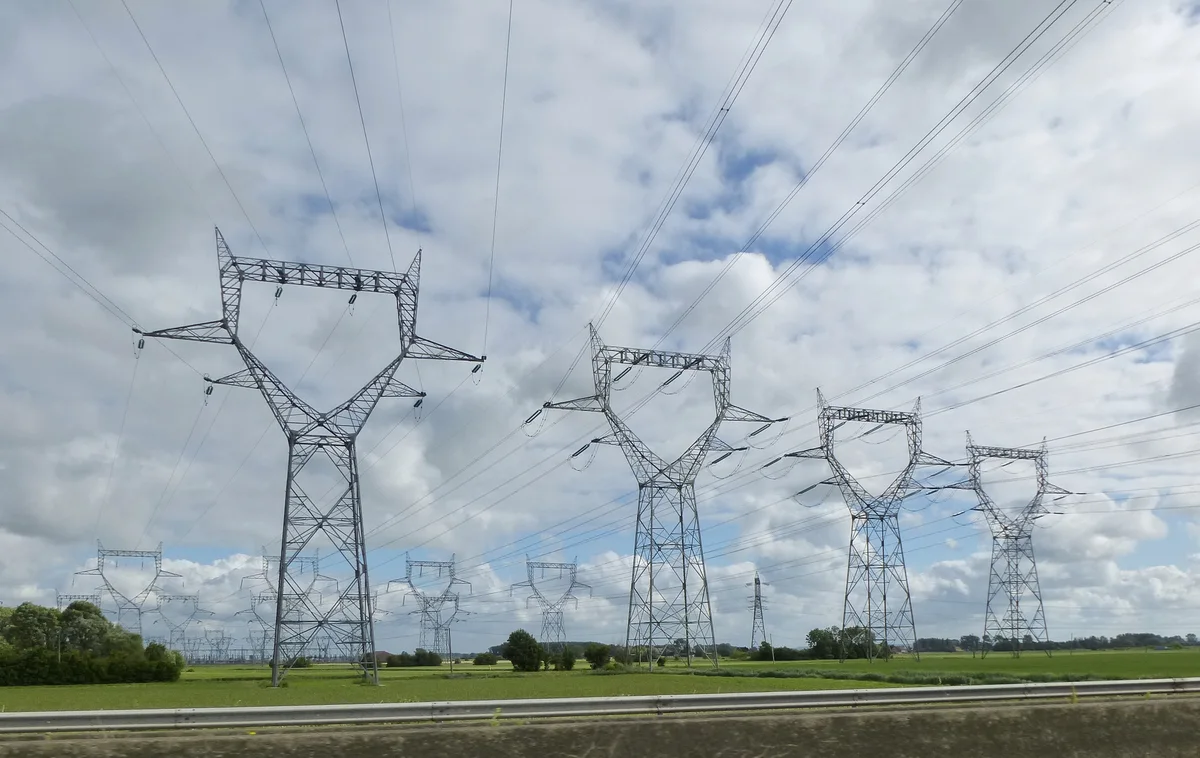
By volume, 61 % IACS aluminium needs about 1.6 times the cross-section of copper for the same resistance, but that conductor still weighs only about half as much as the copper. This is the basic reason aluminium carries most of the world's overhead power.
Continuously cast and rolled rod, typically 9.5 mm diameter, with 12 mm and larger sizes for heavy wire. Supplied in coils for drawing at the customer's plant.
Drawn to diameters from fine sizes up to about 5 mm for conductors, in hard, half-hard or annealed temper on spools or in coils.
Concentric-lay strands of 7 to 61 wires for low-voltage overhead lines and as the conductor of insulated cables. For overhead spans needing more strength, see ACSR and ACAR.
Solid or stranded conductors for PVC- or XLPE-insulated power and control cables, where national codes permit pure aluminium conductors.
Soft, smooth wire as the base for enamelled winding wire in motors, transformers and coils, such as acetal enamelled aluminium wire.
Annealed or lightly drawn wire for rivets, screws and formed parts that need high ductility and good conductivity.
| System | Designation or standard | Notes |
|---|---|---|
| Aluminum Association / UNS | 1070 / A91070 | Chemistry registration |
| European | EN AW-1070A (Al99.7) | EN 573-3 chemistry; EN 1715 for drawing stock |
| International wire standard | IEC 62641 (wire type A1) | Hard-drawn wire for overhead conductors; any 99.5 % Al wire meeting its resistivity and strength limits qualifies |
| ISO | Al99.7 | ISO 209 chemistry |
| China | 1070 / 1A70 family | GB/T 3190 chemistry; GB/T 3954 electrical rod |
| Japan | A1070 | JIS H4040 rod and wire |
US practice uses 1350 for bare conductors (ASTM B230 and B609) and 8000-series alloys for building wire, so 1070 is more common in projects specified to IEC, EN, GB or JIS standards. When a project names 1350, we supply 1350; when it names a wire type such as A1 under IEC 62641, either grade can be offered provided the certificate shows the required resistivity and tensile values.
Where a conductor must also carry high tension on long spans, or where building codes require creep-resistant alloys at terminals, look at 6201 alloy wire or 8000-series alloy rod instead of pure aluminium.
About 61 – 62 % IACS in the annealed condition, equivalent to a resistivity of roughly 0.0280 – 0.0283 Ω·mm²/m at 20 °C. Conductor orders normally require at least 61.0 % IACS, which the certificate should confirm.
1070 has a higher aluminium minimum (99.70 %), while 1350 (99.50 %) puts tighter limits on titanium, vanadium, chromium and manganese, the elements that hurt conductivity most. In practice both reach about 61 % IACS; 1350 is the norm under ASTM, 1070 under several IEC, EN, GB and JIS based specifications.
Hard (H18/H19) for bare stranded overhead conductors, half hard (H14/H24) for general insulated cable cores and rivet stock, and annealed (O) for flexible conductors, winding wire and cold heading.
It depends on the electrical code. Some codes accept pure aluminium conductors in larger sizes; the US National Electrical Code requires 8000-series aluminium alloys for building wire, for better creep behaviour at terminals. Check your local code before specifying.
Wire rod is commonly 9.5 mm and 12 mm in coils. Drawn wire is supplied from fine sizes up to about 5 mm for conductors, with larger diameters for cold-heading wire, on reels or in coils.
Yes. Metline ships 1070 wire and rod worldwide from Mumbai with EN 10204 3.1 certificates, on EXW, FOB, CIF or DAP terms.
Send the diameter, temper, conductivity requirement and quantity. We will reply with availability, certification and a delivered price.






