Cutting
Cut with carbide-tipped saws at high speed; mitre cuts are common in frames. Deburr the inside edges for safety and fit.



Aluminium rectangular tube is a hollow section with two unequal pairs of flat sides, sized by height × width × wall thickness. It gives high bending stiffness about its deeper axis at low weight, which makes it the standard section for frames, trailers, façades and machine guards. Metline supplies extruded and drawn rectangular tube in 6063, 6061, 6082 and 5052, cut and certified, worldwide.
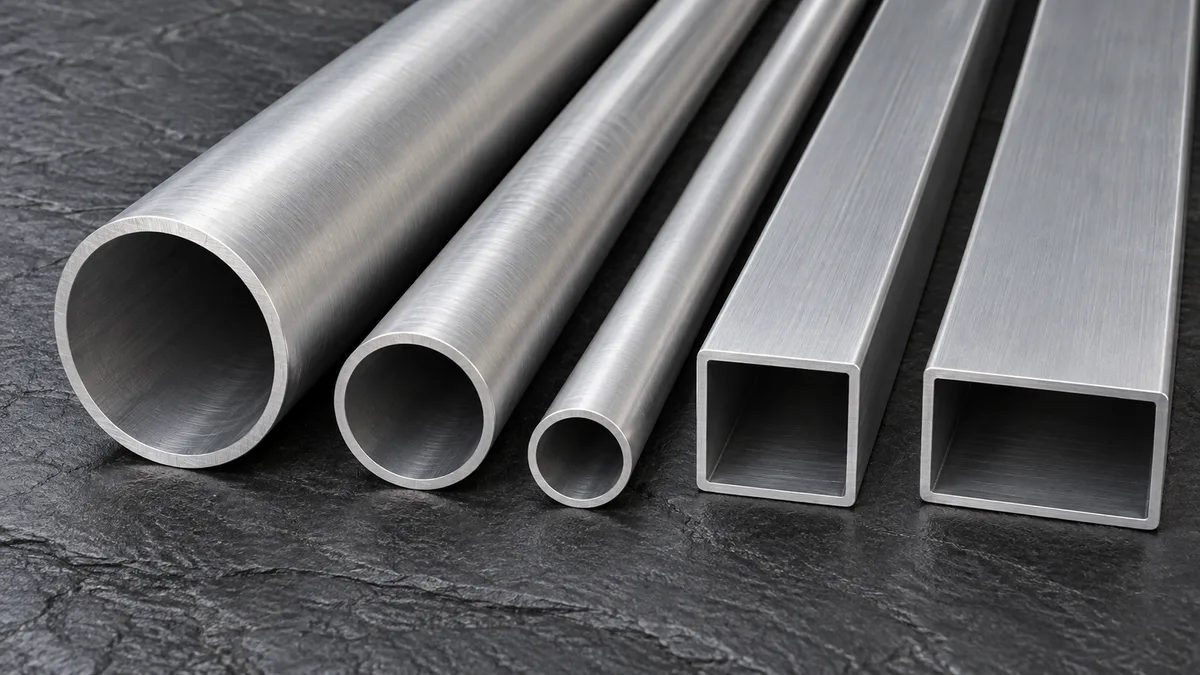
A rectangular tube is a closed hollow section, usually extruded, with flat walls of uniform thickness. Because more metal sits far from the neutral axis in the deeper direction, a rectangular tube resists bending in that direction much better than a square tube of the same weight. The closed section also gives good torsional stiffness, which open channels and angles lack.
Most aluminium rectangular tube is extruded through a porthole (bridge) die, which splits the billet around a mandrel and welds it together again inside the die. The resulting longitudinal seam welds are solid-state bonds and perform well in structural service. Seamless rectangular tube and precision cold-drawn rectangular tube exist for pressure and precision uses, and thin-wall rectangular tube is also roll-formed and welded from strip.
Order rectangular tube by the outside height, outside width and wall thickness, plus the corner style. Say which face is "height" if orientation matters, for example for straightness or surface finish on a visible face, and state the alloy and temper together.
6063 gives the best surface finish and the most economical extrusion, so it dominates architectural and general-purpose tube. 6061 and 6082 are stronger and are used for load-bearing structures. 5052 and 3003 are used in drawn or welded tube where formability and corrosion resistance matter more than strength.
| Alloy / temper | Tensile strength | Yield strength (0.2 %) | Basis | Typical use |
|---|---|---|---|---|
| 6063-T5 | 186 MPa | 145 MPa | Typical | Windows, façades, furniture, fences |
| 6063-T6 | 241 MPa | 214 MPa | Typical | Architectural frames, handrails, light structures |
| 6061-T6 | 310 MPa | 276 MPa | Typical | Trailers, machine frames, structural members |
| 6061-T6 | 260 MPa | 240 MPa | ASTM B221 minimum | Design value for most wall thicknesses |
| 6082-T6 | 310 MPa | 260 MPa | EN 755-2 minimum, walls 5 – 25 mm | European structural tube |
| 5052-H32 | 230 MPa | 195 MPa | Typical | Drawn and welded tube, marine fittings |
| 3003-H14 | 150 MPa | 145 MPa | Typical | Formable tube, ducting, ladders |
EN 755-2 minimums for 6082-T6 are slightly lower for walls of 5 mm and below. The governing values are those of your order standard and wall thickness, reported on the certificate. 6005A-T6 is a common alternative to 6082 for thin-walled hollow sections.
The metal area of a sharp-cornered rectangular tube is 2t(H + W) − 4t², with H, W and wall t in mm; multiply by 0.0027 for kg/m in 6xxx alloys. Radiused corners reduce the area slightly. Values below assume sharp corners and 2.70 g/cm³.
| H × W × t (mm) | Area (mm²) | Weight (kg/m) |
|---|---|---|
| 20 × 40 × 2 | 224 | 0.60 |
| 25 × 50 × 2 | 284 | 0.77 |
| 25 × 50 × 3 | 414 | 1.12 |
| 30 × 60 × 2 | 344 | 0.93 |
| 30 × 60 × 3 | 504 | 1.36 |
| 40 × 80 × 3 | 684 | 1.85 |
| 40 × 80 × 4 | 896 | 2.42 |
| 50 × 100 × 3 | 864 | 2.33 |
| 50 × 100 × 4 | 1136 | 3.07 |
| 50 × 150 × 4 | 1536 | 4.15 |
| 60 × 120 × 4 | 1376 | 3.72 |
| 75 × 150 × 5 | 2150 | 5.81 |
| 100 × 200 × 6 | 3456 | 9.33 |
| Standard | Scope |
|---|---|
| ASTM B221 / B221M | Extruded bars, rods, wire, profiles and tubes; properties |
| ASTM B429 | Extruded structural pipe and tube |
| ANSI H35.2 | Dimensional tolerances for ASTM orders |
| EN 755-2 | Extruded tube and profiles: mechanical properties |
| EN 755-8 / EN 755-9 | Tolerances for porthole tubes and for profiles |
| EN 754-2 / EN 754-8 | Drawn tube: properties and porthole tube tolerances |
| Aluminum Design Manual / Eurocode 9 (EN 1999-1-1) | Structural design of aluminium members |
Tolerance standards control outside dimensions, wall thickness, corner radii, straightness, twist, convexity or concavity of the flat faces and squareness of cut ends. Convexity and concavity can be significant on wide, thin walls, so if a face must lie flat against glass, panels or seals, state a flatness requirement on the drawing.
For structural design, use the minimum properties of the specified alloy and temper and the reduced heat-affected-zone strength near welds. Thin, wide walls can buckle locally before the section yields; design codes handle this with width-to-thickness limits.
Cut with carbide-tipped saws at high speed; mitre cuts are common in frames. Deburr the inside edges for safety and fit.
6061, 6063 and 6082 weld readily by MIG or TIG with 4043 or 5356 filler. The heat-affected zone loses strength, so place welds away from peak stress where possible.
Rectangular tube wrinkles or collapses on the inner wall if bent without support. Use mandrel bending, bend the softer T4 or O temper and age afterwards, or choose larger radii.
Mechanical joints with corner cleats, inserts, rivets and bolts avoid weld softening and suit modular frames and façades.
6063 gives the most uniform anodised finish; 6061 and 6082 anodise well but may show more surface variation.
Common for architectural and outdoor tube. Pre-treat with a chromate-free conversion coating for adhesion and corrosion resistance.
| Section | Bending stiffness | Torsional stiffness | Best for |
|---|---|---|---|
| Rectangular tube | High about the deep axis | High | Beams and frames loaded mainly in one direction |
| Square tube | Equal in both axes | High | Columns and frames loaded in both directions |
| Channel | Good about the major axis | Low | Edge members, attachment surfaces, cost-sensitive frames |
| I-beam | Highest per kg about the major axis | Low | Long-span beams with lateral restraint |
Rectangular tube is often the best compromise when a member must resist bending, twisting and occasional side loads, and when a clean, closed appearance matters. For two-way loading see square tube.
By outside height × outside width × wall thickness, for example 50 × 100 × 3 mm. Corner radius and length are specified separately.
For sharp corners, weight in kg/m = [2t(H + W) − 4t²] × 0.0027 with dimensions in mm. A 50 × 100 × 3 mm tube weighs about 2.33 kg/m, and a 40 × 80 × 3 mm tube about 1.85 kg/m.
6063-T5 or T6 for architectural and general use with a fine finish, and 6061-T6 or 6082-T6 for structural members such as trailers and machine frames. 5052 suits drawn or welded tube that must be formed.
Usually not. Most rectangular tube is extruded through a porthole die, which creates solid-state seam welds along the length. These are sound for structural use. Seamless tube is available when pressure service requires it.
Yes, with mandrel support or in a softer temper, and with a generous radius. Without support the inner wall buckles. Bend 6061 in T4 and age to T6 afterwards if full strength is needed.
Yes. Metline supplies rectangular tube in standard or cut lengths, mill finish, anodised or powder coated, with certificates, to customers worldwide.
Send the size, wall, alloy, length and quantity. We will reply with availability, finish options, certification and a delivered price.





