Need strength and welding
5083 or 7020. 5083 keeps most of its strength in the weld zone; 7020 partly recovers strength by natural ageing after welding.



A high-precision rectangular tube is a hollow aluminium section held to tighter size, wall, twist and corner-radius limits than ordinary structural tube, usually in a strong heat-treatable or high-magnesium alloy. This guide explains how such tube is made, which alloys and tempers to specify, what "precision" actually means in tolerance terms, and how to order it. Metline supplies seamless and porthole rectangular tube worldwide, cut and certified to your drawing.
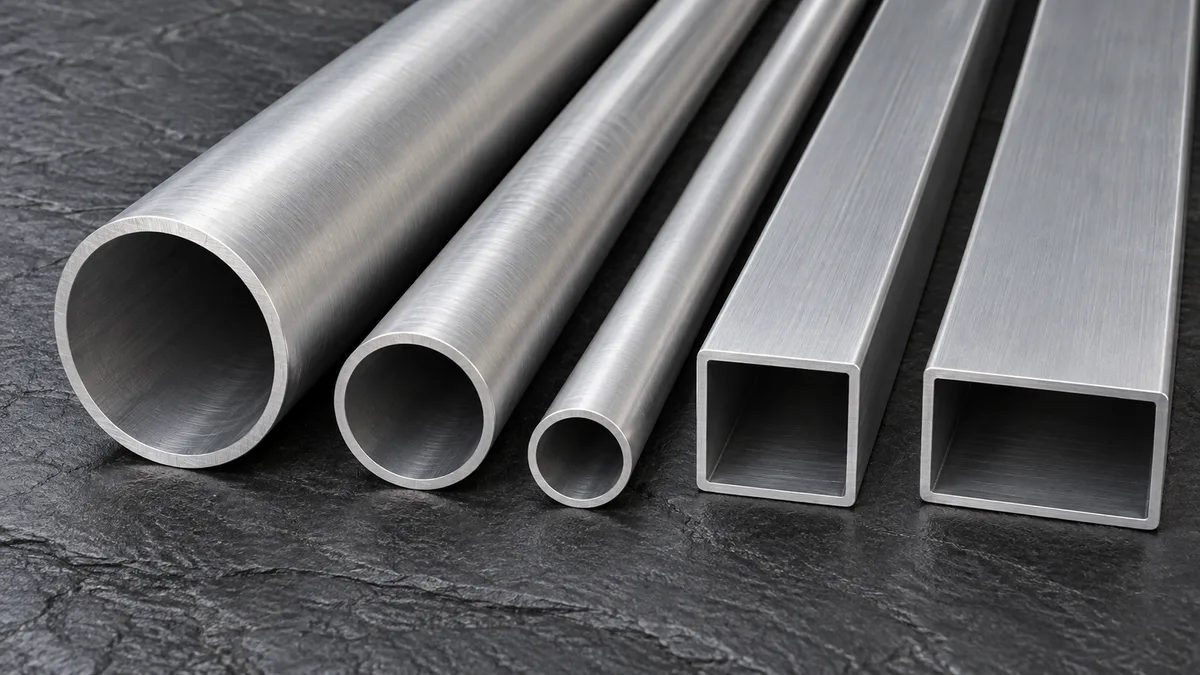
Most rectangular aluminium tube is bought for frames and handrails, where a millimetre of variation does not matter. Precision tube is different: it is specified when the outside or inside faces locate other parts, slide in guides, carry seals, or must be stacked and joined without shimming.
Precision is not one property but a bundle of controlled characteristics: outside width and height, wall thickness and its uniformity around the section, corner radii (inside and outside), flatness of each face (convexity and concavity), squareness of adjacent sides, twist along the length, straightness, and length after cutting. Ordinary extruded tube meets the standard tolerance tables for these; precision tube is held to a fraction of them, either by cold drawing after extrusion, by straightening and stretching more carefully, or by machining critical faces.
"High strength" usually means the tube is made in a heat-treatable alloy (2024, 6061, 7020, 7075) or a high-magnesium alloy (5083, or 5A06 in Chinese GB designations), rather than the soft 6063 used for architectural sections. The two demands pull in opposite directions, because the harder the alloy, the more difficult it is to extrude thin walls and sharp corners. That trade-off is the central engineering decision when you specify this product.
The way a rectangular tube is produced decides how strong, how accurate and how expensive it is. There are three main routes, and many precision tubes combine two of them.
| Route | How it works | Precision | Alloys | Best for |
|---|---|---|---|---|
| Porthole (bridge-die) extrusion | Billet splits around a mandrel bridge and re-welds inside the die | Standard extrusion tolerances | 6063, 6061, 6082, 6005A, 3003, some 7020 | Most commercial tube; long lengths at low cost |
| Seamless extrusion | Hollow billet extruded over a mandrel; no weld seams | Standard, with better wall uniformity in strong alloys | 2024, 5083, 7075, 6061 and all others | Pressure-bearing and high-strength tube; required by aerospace specs |
| Cold drawing | Extruded tube pulled through a die over a plug or mandrel, often in several passes | Tight: typically several times tighter than extruded | 1100, 3003, 5052, 6061, 2024, 7075 | Small and medium sections where size and surface matter |
| Machined from extrusion or plate | Faces milled or bore machined after extrusion | Very tight, local to machined faces | Any | Short parts with datum faces or very thick walls |
Porthole tube contains longitudinal weld lines where the metal re-joins. In 6xxx alloys these welds are sound and invisible after anodising in most cases, but some aerospace and pressure specifications (for example ASTM B241 for seamless pipe and tube) require seamless material. The high-strength 2xxx, 7075 and high-magnesium 5xxx alloys generally do not weld well in a porthole die, so they are produced seamless.
Cold drawing work-hardens the metal and sizes it accurately. For heat-treatable alloys the tube is then solution treated and aged (for example to T6) and straightened, so the final tolerances depend on how well distortion from quenching is controlled. Very large sections, such as the 300 × 120 mm and larger tubes used for launcher supports and military shelters, are extruded seamless on large presses and cannot be drawn.
Values below are typical properties published by the Aluminum Association and ASM for wrought product; they show what the alloy usually achieves. Design to the specified minimums of your order standard (ASTM B221, B210, B241 or EN 755-2 / EN 754-2), which depend on form and wall thickness and appear on the mill certificate.
| Alloy and temper | Typical tensile | Typical yield (0.2 %) | Character |
|---|---|---|---|
| 1100-O | 90 MPa | 35 MPa | Pure aluminium; very formable, conductive, low strength |
| 3003-H14 | 150 MPa | 145 MPa | Moderate strength, excellent corrosion resistance, drawable |
| 6063-T6 | 241 MPa | 214 MPa | Best surface and anodising; sharp corners possible |
| 6061-T6 | 310 MPa | 276 MPa | General engineering tube; weldable and machinable |
| 5083-O | 290 MPa | 145 MPa | Marine-grade; strong without heat treatment, weld-friendly |
| 2024-T3 / T4 | 470 – 485 MPa | 325 – 345 MPa | High strength and fatigue resistance; needs corrosion protection |
| 7075-T6 | 572 MPa | 503 MPa | Highest common strength; poor weldability |
7020-T6 (EN AW-AlZn4,5Mg1) is a weldable Al-Zn-Mg alloy common in European structural and defence tube; its EN 755-2 minimums sit well above 6082-T6. Chinese GB grades sometimes appear on drawings: 2A12 is the near equivalent of 2024, 7A04 belongs to the 7075-type Al-Zn-Mg-Cu family, and 5A06 is an Al-Mg alloy with about 6 % magnesium that has no exact ASTM or EN counterpart. We confirm the closest standard grade before quoting.
5083 or 7020. 5083 keeps most of its strength in the weld zone; 7020 partly recovers strength by natural ageing after welding.
6061-T6 for general parts; 2024-T3 or 7075-T6 where weight is critical and the tube is mechanically fastened.
6063-T6 drawn or extruded tube gives the cleanest anodised finish and the sharpest corners.
In North America, extruded and drawn tube tolerances come from ANSI H35.2 (published by the Aluminum Association) and are invoked by ASTM B221, B210 and B241. In Europe, EN 755-7 and EN 755-8 cover seamless and porthole extruded tube, and EN 754-7 and EN 754-8 cover the cold-drawn equivalents; ISO 6362 and ISO 6363 follow the same structure. A precision order states which limits must be tighter than these tables, and by how much.
| Characteristic | What it controls | How precision is achieved |
|---|---|---|
| Width and height | Fit into mating parts and fixtures | Cold drawing, or tight die design and press control |
| Wall thickness and eccentricity | Strength, weight and bore size | Seamless extrusion over a fixed mandrel, then drawing |
| Corner radii | Clearance for nested parts and sealing | Die design; sharp inside corners are easier in soft alloys |
| Convexity / concavity | Flatness of each face | Drawing, controlled quench, roller straightening |
| Twist | Rotation of the section along its length | Stretching after quench; measured over a set length |
| Straightness (bow) | Deviation along the length | Stretch straightening, roller straightening |
| Squareness of sides and cut ends | Assembly accuracy | Die accuracy; precision saw or CNC cutting |
| Length | Ready-to-assemble parts | CNC sawing to ±0.1 – 0.5 mm, or machining of ends |
Drawn rectangular tube is typically held to a small fraction of the extruded size tolerance, and its surface is smoother because the die burnishes the outside. As a rule of thumb, ask for drawn tube when outside dimensions must be held within a few hundredths of a millimetre on small sections, and for seamless extruded tube with machined faces when the section is large or the alloy is too strong to draw.
Write precision limits on the drawing as numbers, not as words such as "high precision". State which faces are critical, how twist and straightness will be measured (over the full length or per metre), and whether the inside dimension or the outside dimension is the controlled one. That avoids rejected deliveries and keeps cost down, because only the features that matter are tightened.
Feasible sizes depend on alloy and wall: strong alloys need thicker minimum walls and larger corner radii than 6063.
Weight per metre is cross-sectional area × density. The table uses 2.70 g/cm³ and sharp corners, so real tubes with corner radii weigh slightly less; 2024 and 7075 are about 3 – 4 % heavier because their density is 2.78 – 2.81 g/cm³. Use the rectangular tube weight calculator for other sizes.
| Size (mm) | Wall (mm) | Section area (mm²) | kg per metre |
|---|---|---|---|
| 40 × 20 | 2 | 224 | 0.60 |
| 50 × 25 | 2 | 284 | 0.77 |
| 50 × 30 | 3 | 444 | 1.20 |
| 60 × 40 | 3 | 564 | 1.52 |
| 80 × 40 | 3 | 684 | 1.85 |
| 100 × 50 | 4 | 1136 | 3.07 |
| 120 × 60 | 5 | 1700 | 4.59 |
| 150 × 100 | 6 | 2856 | 7.71 |
| 200 × 100 | 8 | 4544 | 12.27 |
| 300 × 120 | 6 | 4896 | 13.22 |
| 300 × 200 | 10 | 9600 | 25.92 |
2024, 6061 and 7075 in T-tempers cut cleanly with sharp carbide tools. Clamp thin-wall tube with internal support to stop chatter and distortion.
5083 and 6061 weld by MIG and TIG; 7020 is weldable with 5xxx filler. 2024 and 7075 are not considered weldable for structures and should be bolted, riveted or bonded.
Rectangular tube wrinkles on the inside of a bend. Bend in soft temper (O or T4) with mandrels and age afterwards where the alloy allows.
6063 gives the most uniform appearance. 2024 and 7075 anodise to a darker, less even colour; hard anodising suits wear faces.
Powder, PVDF and electrophoretic coatings give colour and UV resistance for outdoor and architectural use.
5083 and 6xxx tube resist marine and industrial atmospheres; 2024 and 7075 need anodising, primer or sealing in humid service.
Common mistakes include asking for sharp inside corners in 7075 (a radius of at least the wall thickness is far easier and stronger), over-specifying tolerances on non-functional faces, and forgetting that heat treatment after drawing can move dimensions unless straightening is included.
Extruded tube is pushed through a die once and meets the standard extrusion tolerance tables. Drawn tube is extruded first and then pulled through a sizing die over a mandrel, which tightens size and wall tolerances, improves the surface and adds strength through cold work.
7075-T6 has the highest common strength (typical tensile about 570 MPa), followed by 2024-T3. Both are hard to weld, so 7020 or 5083 is chosen when the structure must be welded.
Seamless tube has no extrusion weld lines, so it is required for many pressure, aerospace and high-strength applications and is the only route for alloys such as 2024 and 7075. For 6063 and 6061 in general structural use, porthole tube is sound and cheaper.
Drawn small sections can be held to a few hundredths of a millimetre on outside size. Large or high-strength sections are extruded to standard tolerances and critical faces are machined. Specify numeric limits for each critical feature.
Yes. Large seamless square and rectangular sections with thick walls are produced to order for defence, rail and machinery projects; feasibility depends on alloy, wall and section size, so send the drawing for review.
We can supply to the drawing grade or offer the nearest ASTM/EN grade (for example 2024 for 2A12) with a mill certificate showing the actual chemistry and properties.
Send your section drawing, alloy, critical tolerances and quantity. Metline will propose the right route and reply with certification and a delivered price.





