Round tube
Equal stiffness in every direction and the best shape for torsion and columns. Used for handrails, truss chords, masts and space frames. Supplied by OD and wall, from small drawn tube up to large extruded sizes.



Structural aluminium tubing is hollow round, square or rectangular extrusion used to carry load in frames, trusses, railings, racks and vehicle structures rather than to carry fluid under pressure. The usual grades are 6061-T6, 6063-T5/T6, 6082-T6 and 6005A-T6, made to ASTM B221 or B429 in North America and EN 755 in Europe. This guide covers the alloys, section data, design codes and buying details; Metline supplies all of these tubes worldwide.
"Structural" describes the job, not a special alloy. A structural tube is selected for bending, buckling and torsional stiffness, connection details and weight, whereas a pressure pipe is selected for burst strength and leak-tightness. The same 6061-T6 can be either; what changes is the standard, the tolerances and the inspection.
ASTM B429 makes this distinction explicit: it covers 6061 and 6063 extruded pipe and tube for structural uses such as highway and bridge rails, fence posts, handrails, sign structures, awning supports and lighting brackets, and it permits tube produced through bridge or porthole dies. It excludes pressure service, for which the buyer should use seamless tube to ASTM B210 or B241.
Closed sections are the most efficient shapes for members loaded in compression or torsion. A square tube has far higher torsional stiffness than an open channel or angle of the same weight, and a round tube buckles evenly in every direction. That is why tubes dominate machine frames, space frames, stage trusses, solar racks, boat T-tops and vehicle subframes.
Values below are typical properties from Aluminum Association and ASM data; design must use the specified minimums of the governing standard, which are lower and depend on wall thickness.
| Alloy / temper | Typical tensile | Typical yield | Strengths | Typical uses |
|---|---|---|---|---|
| 6061-T6 | 310 MPa | 276 MPa | Best all-round strength, weldability and machinability | Machine frames, trailers, truss chords, EV frames, marine T-tops |
| 6063-T6 | 241 MPa | 214 MPa | Superb surface, easy to anodise, lower cost | Railings, display frames, architectural framing, light structures |
| 6063-T5 | 186 MPa | 145 MPa | Press-quenched, economical | Solar racking, non-critical frames, enclosures |
| 6082-T6 | 310 – 340 MPa | 260 – 300 MPa | Highest strength of common 6xxx alloys in thick walls | European structures, scaffolding, cranes, heavy frames |
| 6005A-T6 | ≈ 285 MPa | ≈ 240 MPa | Extrudes complex hollows well | Rail vehicles, bridges, large multi-cell sections |
| 5083-O / H111 | 290 MPa | 145 MPa | No strength loss when welded, seawater resistant | Marine structures, offshore walkways, cryogenic frames |
| 7075-T6 | 572 MPa | 503 MPa | Very high strength; poor weldability | Aerospace, motorsport, drone and high-load members |
| 2024-T3 | 483 MPa | 345 MPa | High strength, good fatigue resistance | Aircraft structures, machined fittings |
Minimum values: for example, ASTM B221 gives 6061-T6 extrusions 260 MPa tensile and 240 MPa yield; EN 755-2 gives 6082-T6 tube up to 5 mm wall 290 / 250 MPa. Check the mill certificate for the exact figures of your lot.
Equal stiffness in every direction and the best shape for torsion and columns. Used for handrails, truss chords, masts and space frames. Supplied by OD and wall, from small drawn tube up to large extruded sizes.
Flat faces make joints, drilling and bolting simple. Strong in both axes and very good in torsion. The default for machine bases, frames and racks.
More material away from the neutral axis in one direction, so it is efficient for beams loaded mostly in one plane, such as floor joists and trailer cross-members.
Used where appearance, grip or anti-rotation matter: handles, tool frames and decorative structures.
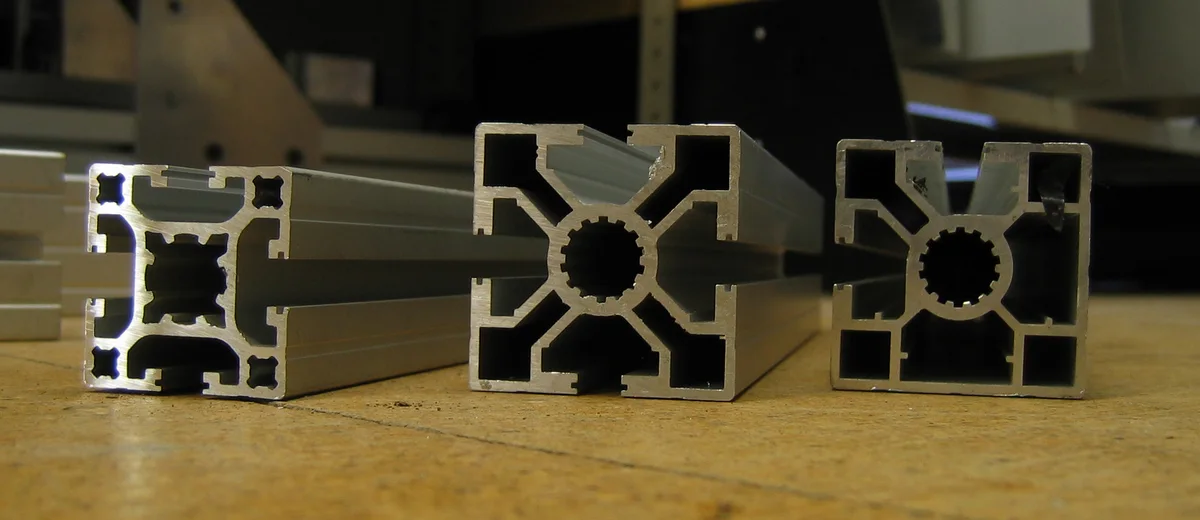
Extruded with internal webs, slots, screw bosses or flanges to cut assembly steps. Custom dies make sense when volumes justify tooling.
Angles, channels, I-beams and T-bars are cheaper per kg and easier to connect, but much weaker in torsion than a closed tube of equal weight.
Values are calculated from geometry with sharp corners and a density of 2.70 g/cm³. Real extrusions have corner radii, so mass and properties are slightly lower; use the supplier drawing for final design. More sizes are in the square tube weight calculator.
| Size (mm) | Wall (mm) | Mass (kg/m) | Area (cm²) | Moment of inertia I (cm⁴) | Section modulus Z (cm³) |
|---|---|---|---|---|---|
| 25.4 × 25.4 | 1.6 | 0.41 | 1.52 | 1.4 | 1.14 |
| 38.1 × 38.1 | 3.2 | 1.21 | 4.47 | 9.1 | 4.80 |
| 50.8 × 50.8 | 3.2 | 1.65 | 6.09 | 23.1 | 9.10 |
| 50.8 × 50.8 | 6.35 | 3.05 | 11.29 | 37.9 | 14.94 |
| 76.2 × 76.2 | 3.2 | 2.52 | 9.34 | 83.1 | 21.82 |
| 76.2 × 76.2 | 6.35 | 4.79 | 17.74 | 145.5 | 38.18 |
| 101.6 × 101.6 | 6.35 | 6.53 | 24.19 | 367.5 | 72.33 |
| 152.4 × 152.4 | 6.35 | 10.02 | 37.10 | 1321.3 | 173.40 |
Two rules of thumb follow from the numbers. First, doubling the outside size of a square tube at the same wall raises its stiffness about seven to eight times while only doubling weight, so go bigger before going thicker. Second, because aluminium is about one third as stiff as steel, an aluminium member replacing steel usually needs a deeper section rather than the same section in a stronger alloy; no aluminium alloy is stiffer than another by any useful margin.
| Route | How it is made | Best for | Standard |
|---|---|---|---|
| Porthole (bridge-die) extrusion | Metal splits around a mandrel and re-welds in the die, leaving longitudinal weld seams that are solid-state bonded | Most square, rectangular and custom structural tube; economical in 6063, 6061, 6005A, 6082 | ASTM B221 / B429; EN 755-2 with tolerances to EN 755-8 |
| Seamless extrusion | Hollow billet extruded over a mandrel with no seams | Highly stressed, pressure-adjacent or fatigue-critical parts; 2xxx and 7xxx alloys | ASTM B241 / B221; EN 755-2 with tolerances to EN 755-7 |
| Cold drawn tube | Extruded tube drawn through a die over a plug for tighter size and finer surface | Small diameters, telescoping parts, precision frames | ASTM B210; EN 754 |
| Seam-welded tube | Strip roll-formed and HF welded | Thin-wall, low-cost frames and furniture | Supplier specification; EN 1592 |
For ordinary structures porthole tube is fully acceptable: properly made extrusion welds have strength close to the parent metal, which is why ASTM B429 allows it. Specify seamless when a design code, a pressure duty or your customer requires it.
Thin walls buckle before the material yields. Codes limit width-to-thickness ratios (b/t) for each element; a 100 × 100 × 2 mm tube may be governed by buckling, not strength.
Heat-affected zones of 6xxx T6 tube fall to roughly half strength. Place welds at low-stress points or use bolted or riveted joints in highly stressed members.
With a modulus near 69 GPa, check deflection limits early. Many aluminium frames are stiffness-governed.
Isolate steel bolts and brackets with washers, sleeves or coatings, especially outdoors and in marine service.
| Sector | Typical members | Common choice |
|---|---|---|
| Building and architecture | Railings, canopies, sunroom and facade sub-frames, glass balustrade posts | 6063-T6 / 6061-T6 |
| Industrial automation | Machine frames, conveyor supports, guarding, test rigs | 6061-T6, 6082-T6 square tube |
| Transport | Trailer cross-members, bus frames, EV battery frames, roof racks | 6061-T6, 6082-T6, 6005A-T6 |
| Solar and energy | PV mounting rails, purlins, inverter frames | 6063-T5 / 6005A-T6 |
| Events and display | Stage trusses, exhibition stands, lighting rigs | 6082-T6, 6061-T6 round tube |
| Marine | T-tops, rails, gangways, floating pontoon frames | 6061-T6, 5083 / 5086 |
| Aerospace and motorsport | Roll structures, drone frames, ground support equipment | 7075-T6, 2024-T3, 6061-T6 |
A typical light-industrial machine base uses 50 × 50 × 3 mm or 80 × 80 × 4 mm 6061-T6 square tube, bolted with corner brackets so that the frame keeps full T6 strength. A typical pedestrian handrail uses 42.4 mm or 48.3 mm OD 6063-T6 round tube, chosen for its surface and anodising response rather than strength.
7075-T6 is the strongest common grade, but it is difficult to weld and costs more. For welded structures 6061-T6 and 6082-T6 are the practical high-strength choices.
For light structures, railings, frames and racks, yes: 6063-T6 has a typical yield strength of about 214 MPa. For heavily loaded or welded members, 6061-T6 or 6082-T6 gives roughly 30 % more strength.
B221 is the general specification for extruded bar, rod, profiles and tube in many alloys. B429 is specific to 6061 and 6063 structural pipe and tube, allows porthole-die tube, and is not for pressure service.
Yes. Porthole tube has solid-state extrusion welds that are close to parent-metal strength, and structural standards accept it. Seamless tube is preferred for pressure, severe fatigue or where a specification demands it.
Often, with a lighter result. Because aluminium is about one third as stiff, the replacement usually needs a deeper or wider section to match deflection. Check buckling and welded strength as well.
Round tube from small drawn sizes to large extruded diameters, and square and rectangular tube from about 20 mm up to 150 mm or more, in walls from about 1.2 mm to over 6 mm. Non-standard sizes can be extruded to drawing.
Send your alloy, sizes, quantities and destination. We will confirm availability, certification and a delivered price.





