7050-T7451 (AMS 4050)
Solution heat-treated, stretched about 1.5 – 3 % and overaged. The usual temper for thick plate, giving good stress-corrosion resistance in the short-transverse direction. Covers plate across a very wide thickness range.



7050-T7451 is the standard thick plate for machined aircraft structure: wing spars and ribs, fuselage frames and bulkheads, and large fittings cut from plates up to about 150 mm thick and more. It combines high strength with good fracture toughness and stress-corrosion resistance through the full thickness. Metline supplies 7050 plate in T7451 (AMS 4050) and T7651 (AMS 4201), cut to size and certified, to aerospace buyers worldwide.
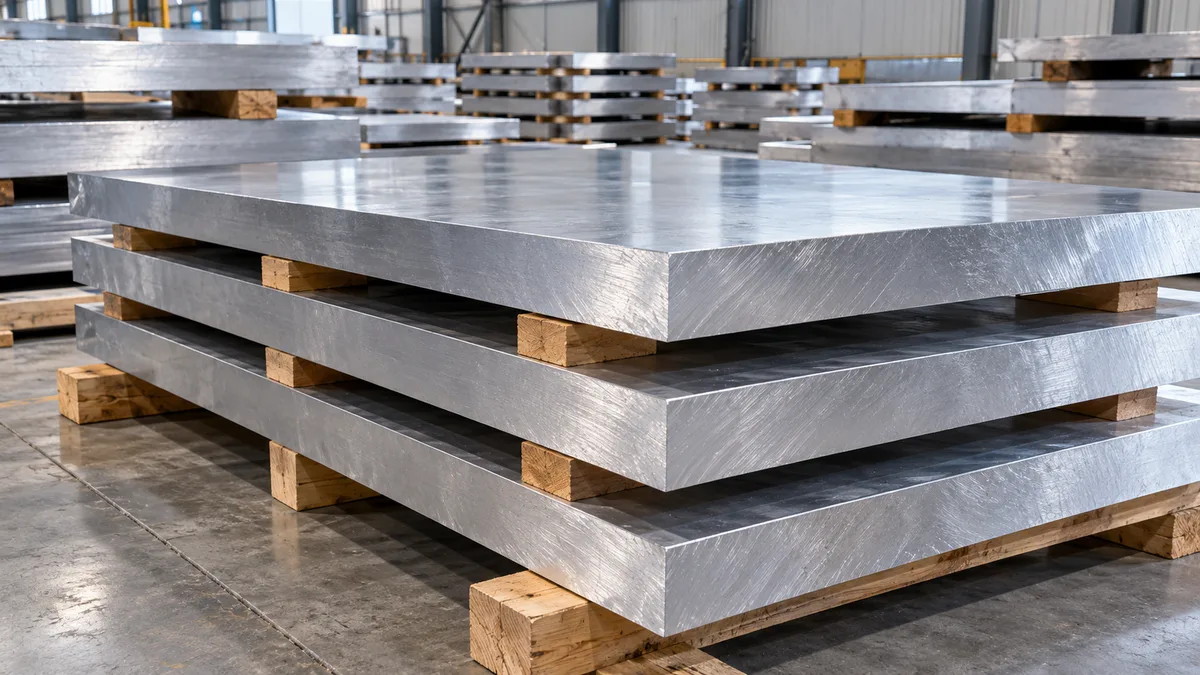
Modern airframes are increasingly machined from solid plate: a single wing rib or fuselage frame can start as a plate weighing hundreds of kilograms and end as a part weighing a tenth of that. The plate must be strong in the centre as well as at the surface, stay flat as most of it is machined away, and resist stress-corrosion cracking across its thickness. 7050-T7451 was designed to do all three.
Two features make it work. Zirconium, in place of the chromium used in 7075, forms fine dispersoids that keep the grain structure unrecrystallised and make the alloy far less sensitive to quench rate, so the centre of a thick plate still reaches high strength. The T7451 temper then stretches the plate to remove quench stresses and overages it to a condition that balances strength against resistance to stress corrosion and exfoliation.
Low iron and silicon limits (0.15 % and 0.12 % maximum) give 7050 better fracture toughness and fatigue performance than 7075. For these reasons 7050-T7451 plate is used on most current commercial and military aircraft for machined internal structure, while 7075 plate is now chosen mainly for thinner, less critical parts or where cost dominates.
Limits are the registered Aluminum Association values used by AMS 4050, AMS 4201, ASTM B209 and EN 573-3 (EN AW-7050). The mill certificate gives the actual analysis for each cast.
| Element | Minimum | Maximum | Role in the alloy |
|---|---|---|---|
| Silicon (Si) | — | 0.12 | Held very low for fracture toughness |
| Iron (Fe) | — | 0.15 | Held very low; fewer coarse intermetallics |
| Copper (Cu) | 2.0 | 2.6 | Raises strength and stress-corrosion resistance in T7 tempers |
| Manganese (Mn) | — | 0.10 | Residual |
| Magnesium (Mg) | 1.9 | 2.6 | Forms MgZn2 with zinc |
| Chromium (Cr) | — | 0.04 | Deliberately low; zirconium replaces it |
| Zinc (Zn) | 5.7 | 6.7 | Main strengthening element |
| Titanium (Ti) | — | 0.06 | Grain refiner |
| Zirconium (Zr) | 0.08 | 0.15 | Controls grain structure and lowers quench sensitivity |
| Others, each / total | — | 0.05 / 0.15 | |
| Aluminium (Al) | Remainder | About 87.3 – 90.3 % |
7050 is about 5 % denser than 6061 (2.83 against 2.70 g/cm³). Allow for this when estimating plate weights.
Typical values describe material of moderate thickness. AMS 4050 and AMS 4201 set minimum tensile, yield and elongation values in the longitudinal, long-transverse and short-transverse directions, and those minimums fall as plate thickness rises. Design allowables come from those specified values, not from typical data.
| Temper | Tensile strength (typical) | Yield strength (typical) | Elongation | Hardness |
|---|---|---|---|---|
| T7451 (AMS 4050) | 524 MPa / 76 ksi | 469 MPa / 68 ksi | About 11 % | About 140 HB |
| T7651 (AMS 4201) | About 550 MPa / 80 ksi | About 490 MPa / 71 ksi | About 10 % | About 145 HB |
Short-transverse properties matter most for thick plate. Strength and ductility through the thickness are lower than in the rolling direction, so parts with loads across the plate thickness (lugs, fittings, frames with integral attachments) are designed to short-transverse allowables, and the T7451 temper is chosen to keep stress-corrosion risk low in that direction.
Solution heat-treated, stretched about 1.5 – 3 % and overaged. The usual temper for thick plate, giving good stress-corrosion resistance in the short-transverse direction. Covers plate across a very wide thickness range.
Stretched and moderately overaged for higher strength with good exfoliation resistance. AMS 4201 covers plate 6.35 – 76.2 mm (0.250 – 3.000 in) thick. Often used for wing skins and parts loaded in the plane of the plate.
F and O are supply conditions for later heat treatment. T7452 belongs to hand forgings rather than plate, and older designs may call T73 or T7351 in other alloys.
| System | Designation / standard | Scope |
|---|---|---|
| SAE AMS | AMS 4050 | 7050-T7451 plate, solution heat-treated, stress-relieved and overaged |
| SAE AMS | AMS 4201 | 7050-T7651 plate, 0.250 – 3.000 in |
| ASTM / ASME | ASTM B209 | Aluminium and aluminium-alloy sheet and plate |
| Inspection | AMS-STD-2154 / ASTM B594 | Ultrasonic inspection, Class A or AA as ordered |
| Heat treatment | AMS 2772 | Heat treatment of aluminium-alloy raw materials |
| UNS | A97050 | — |
| European | EN AW-7050 (AlZn6CuMgZr) | EN 485, EN 573-3 |
| German Werkstoff | 3.4144 | — |
| Japan | A7050P | JIS H4000 |
Aircraft manufacturers add their own plate specifications with extra requirements, typically on fracture toughness, ultrasonic class, residual stress and grain structure. Quote the specification and revision from your drawing or purchase order so we can supply material certified against it.
Thick 7050 plate is a high-value product. Cutting blanks close to the part envelope saves material and freight.
Weight is 2.83 kg per square metre for every millimetre of thickness. The plate weight calculator gives other sizes; set the density to 2.83 g/cm³.
| Thickness (mm) | kg per m² | 1220 × 2440 mm (kg) | 1525 × 3660 mm (kg) |
|---|---|---|---|
| 6.35 | 17.97 | 53.5 | 100.3 |
| 10 | 28.30 | 84.2 | 158.0 |
| 12.7 | 35.94 | 107.0 | 200.6 |
| 20 | 56.60 | 168.5 | 315.9 |
| 25.4 | 71.88 | 214.0 | 401.2 |
| 30 | 84.90 | 252.7 | 473.9 |
| 40 | 113.20 | 337.0 | 631.8 |
| 50.8 | 143.76 | 428.0 | 802.4 |
| 60 | 169.80 | 505.5 | 947.7 |
| 76.2 | 215.65 | 641.9 | 1203.6 |
| 100 | 283.00 | 842.4 | 1579.6 |
| 127 | 359.41 | 1069.9 | 2006.0 |
| 150 | 424.50 | 1263.7 | 2369.3 |
| 200 | 566.00 | 1684.9 | 3159.1 |
Machines very well with sharp carbide tools at high spindle speeds. Large pocketing operations are routine; the stretched temper keeps distortion low, though removing more than about 90 % of the plate from one side may still need balanced roughing.
Rough both faces symmetrically, leave stock for a finishing pass after a rest period, and clamp lightly on the final cut. These steps matter more as part thickness falls.
Not suitable for arc welding. Assemblies are fastened, riveted or bonded. Friction stir welding is used in some aerospace and space structures after qualification.
Limited cold formability in T7451. Creep forming or age forming is used for curved wing panels; small bends should use generous radii.
Chromic, sulphuric or boric-sulphuric anodising, or conversion coating and primer. Shot peening is often added to fatigue-critical surfaces.
Keep service temperature below about 120 °C to avoid further overageing and loss of strength.
A typical example is a machined wing rib: a 100 mm 7050-T7451 plate is ultrasonically inspected, nested and saw-cut into blanks, then high-speed machined to a pocketed part with webs a few millimetres thick, shot peened and anodised before assembly.
| Property | 7050-T7451 | 7075-T7351 | 7075-T651 | 7055-T7751 | 2024-T351 |
|---|---|---|---|---|---|
| Typical tensile strength | 524 MPa | 505 MPa | 570 MPa | About 640 MPa | 470 MPa |
| Typical yield strength | 469 MPa | 435 MPa | 505 MPa | About 610 MPa | 325 MPa |
| Thick-plate strength retention | Very good | Poor–fair | Poor–fair | Good | Fair |
| Stress-corrosion resistance | Good–very good | Very good | Poor | Good | Fair |
| Fracture toughness | Good | Moderate | Moderate | Moderate | Good |
| Typical role | Thick machined structure | Fittings, legacy parts | Thin plate, tooling | Upper wing skins | Lower wing, fuselage skin |
7050-T7451 is the best general choice for thick, machined airframe parts. 7055 or 7150 are chosen for compression-dominated upper wing structure where higher strength pays off, and 2024 or 2324 for tension-dominated, damage-tolerant lower wing skins.
The plate has been solution heat-treated, stretched to relieve quench stresses (the 51) and overaged (the T74) to balance strength against stress-corrosion resistance. It is the standard temper for thick 7050 plate.
In thin plate, 7075-T651 is slightly stronger. In thick plate, and against the corrosion-resistant 7075-T7351 temper, 7050-T7451 is stronger and tougher because it is much less quench sensitive.
AMS 4050. AMS 4201 covers T7651 plate and ASTM B209 covers sheet and plate in general. Aircraft manufacturers often add their own specifications on top.
Not by conventional arc welding. It is joined by fasteners, rivets or bonding. Friction stir welding is used in some structures after qualification.
About 2.83 kg per m² per millimetre of thickness. A 1525 × 3660 × 50.8 mm plate weighs about 802 kg.
Yes. Plate can be saw-cut into blanks to your nesting, with ultrasonic inspection and full certification, and shipped worldwide in export cases.
Send thickness, blank sizes, specification and quantity. Our team will reply with availability, certification and a delivered price.





