1070-O and 1060-O
Best for small, deep cans with high draw ratios, such as radial and SMD electrolytic capacitors. The softest option, with the lowest risk of splitting.



The aluminium can that houses an electrolytic, film or supercapacitor is deep drawn from thin strip, usually 0.26 – 0.50 mm thick in 1050, 1060, 1070, 1100 or 3004. The strip must draw without tearing, with low earing, a clean oil-free surface and tight thickness tolerance. Metline supplies capacitor case strip in coil to can makers worldwide.
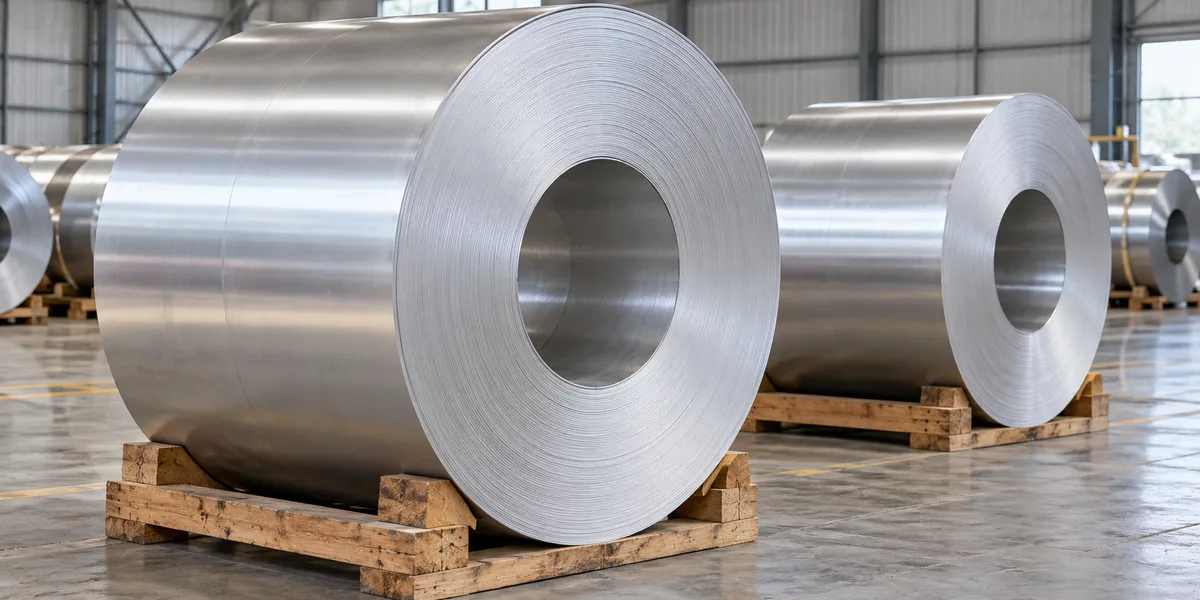
An aluminium electrolytic capacitor is a wound roll of anode foil, separator paper and cathode foil soaked in electrolyte. That roll is sealed inside a seamless aluminium can, called the case, shell or crust, closed with a rubber bung or a terminal disc. The can is made from strip in a multi-stage transfer press that blanks a disc, draws it into a cup and redraws it to the final diameter and height.
Aluminium is used because it is the same metal as the electrodes, so there is no galvanic reaction with the electrolyte, and because it draws into deep, thin-walled cans easily. The can wall often doubles as the negative connection, and many cans carry a scored safety vent in the base that opens if internal pressure rises.
The same strip is used for supercapacitor (EDLC) cans, film capacitor housings, motor-run capacitor cans and small battery cases. Can diameters run from about 4 mm for SMD chip capacitors to more than 90 mm for screw-terminal power capacitors, and the strip grade is chosen to suit the draw ratio and wall strength each one needs.
| Alloy | Tempers | Thickness (mm) | Width (mm) | Coil ID (mm) |
|---|---|---|---|---|
| 1050, 1060, 1070 | O | 0.26 – 0.50 | 300 – 600 | 150, 200, 300 |
| 1100 | O, H12, H22, H14, H24 | 0.26 – 0.50 | 300 – 600 | 150, 200, 300 |
| 3004 | O | 0.26 – 0.50 | 300 – 600 | 150, 200, 300 |
Limits follow the Aluminum Association registrations used by ASTM B209 and EN 573-3. Higher-purity 1070 gives the softest, most ductile strip; 3004 adds manganese and magnesium for a stronger, stiffer can.
| Element | 1050 | 1060 | 1070 | 1100 | 3004 |
|---|---|---|---|---|---|
| Si | 0.25 | 0.25 | 0.20 | Si + Fe 0.95 | 0.30 |
| Fe | 0.40 | 0.35 | 0.25 | (with Si) | 0.70 |
| Cu | 0.05 | 0.05 | 0.04 | 0.05 – 0.20 | 0.25 |
| Mn | 0.05 | 0.03 | 0.03 | 0.05 | 1.0 – 1.5 |
| Mg | 0.05 | 0.03 | 0.03 | — | 0.8 – 1.3 |
| Zn | 0.05 | 0.05 | 0.04 | 0.10 | 0.25 |
| V | 0.05 | 0.05 | 0.05 | — | — |
| Ti | 0.03 | 0.03 | 0.03 | — | — |
| Others each / total | 0.03 | 0.03 | 0.03 | 0.05 / 0.15 | 0.05 / 0.15 |
| Al (min) | 99.50 | 99.60 | 99.70 | 99.00 | Remainder |
Standard tensile ranges for thin strip are shown below. Can makers often agree a narrower band with the supplier so that every coil behaves the same in the press.
| Alloy and temper | Tensile strength (MPa) | Elongation, min (%) | Notes |
|---|---|---|---|
| 1070-O | about 60 – 90 | ≈ 25 (strip > 0.2 mm) | Softest, for the deepest draws |
| 1060-O | about 55 – 95 | ≈ 25 | High purity, very ductile |
| 1050-O | about 65 – 95 | ≈ 22 – 25 | Most common general grade |
| 1100-O | about 75 – 105 | ≈ 20 – 25 | Slightly stronger than 1050 |
| 1100-H12 / H22 | about 95 – 130 | ≈ 3 – 5 | Stiffer cans, shallow draws |
| 1100-H14 / H24 | about 110 – 145 | ≈ 1 – 2 | High rigidity, limited draw |
| 3004-O | about 150 – 200 | ≈ 15 | Strongest; large or thin-wall cans |
Ranges summarised from ASTM B209 and EN 485-2 for thin gauges; actual limits depend on thickness band and the agreed purchase specification.
Earing is the wavy rim that forms when a round blank is drawn into a cup, caused by directional (anisotropic) grain texture in the rolled strip. Ears must be trimmed off, so high earing wastes metal and causes uneven wall thickness. It is measured by drawing a test cup and comparing peak and valley heights, as described in EN 1669.
| Alloy and temper | Earing, ordinary (%) | Earing, high precision (%) |
|---|---|---|
| 1050, 1060, 1070 – O | ≤ 6.0 | ≤ 5.0 |
| 1100 – O, H12, H22 | ≤ 6.0 | ≤ 5.0 |
| 1100 – H14, H24 | ≤ 5.0 | ≤ 3.0 |
| 3004 – O | ≤ 5.0 | ≤ 3.0 |
Best for small, deep cans with high draw ratios, such as radial and SMD electrolytic capacitors. The softest option, with the lowest risk of splitting.
The general-purpose choice for radial and snap-in cans, balancing drawability and cost.
A little more strength for cans that must resist denting or that are grooved and crimped hard during sealing.
Shallow housings and lids where stiffness matters more than draw depth.
Large-diameter screw-terminal, motor-run and supercapacitor cans, or thinner walls for the same strength.
Cans are normally insulated with a PVC or PET sleeve after drawing; ask if you need lacquer-coated strip instead.
Weight in kilograms per metre of strip for common thicknesses and widths (density 2.70 g/cm³). Use it to estimate metres per coil: coil weight divided by kg/m.
| Thickness (mm) | 300 mm wide | 400 mm wide | 500 mm wide | 600 mm wide |
|---|---|---|---|---|
| 0.26 | 0.211 | 0.281 | 0.351 | 0.421 |
| 0.30 | 0.243 | 0.324 | 0.405 | 0.486 |
| 0.35 | 0.283 | 0.378 | 0.473 | 0.567 |
| 0.40 | 0.324 | 0.432 | 0.540 | 0.648 |
| 0.45 | 0.364 | 0.486 | 0.608 | 0.729 |
| 0.50 | 0.405 | 0.540 | 0.675 | 0.810 |
The electrodes of an electrolytic capacitor are aluminium, so an aluminium can avoids galvanic reactions with the electrolyte. Aluminium also draws easily into seamless cans, is light and conducts heat away from the winding.
Most cans are drawn from 0.26 – 0.50 mm strip. Small radial and SMD cans use the thinner end; large snap-in and screw-terminal cans use the thicker end or 3004 for extra strength.
Earing is the uneven, scalloped rim on a drawn cup caused by grain texture in the strip. Lower earing means less trim scrap and more uniform walls. It is measured with the EN 1669 cup test.
1050-O is softer and suits deep draws; 1100 contains a little copper and is slightly stronger, which helps cans resist denting and grooving forces. Either works for most radial cans.
Yes. Strip is slit to the width your press feeds, with 150, 200 or 300 mm coil IDs and coil weights to suit your decoiler.
Send your alloy, gauge, width and earing limits. We will reply with availability, certification and a delivered price.





