3003 (Al-Mn)
The standard battery-shell alloy. About 1.0 – 1.5 % manganese raises strength by roughly 20 – 30 % over pure aluminium while keeping excellent drawability and laser weldability. Used in O, H12 and H14 for most prismatic cans and covers.



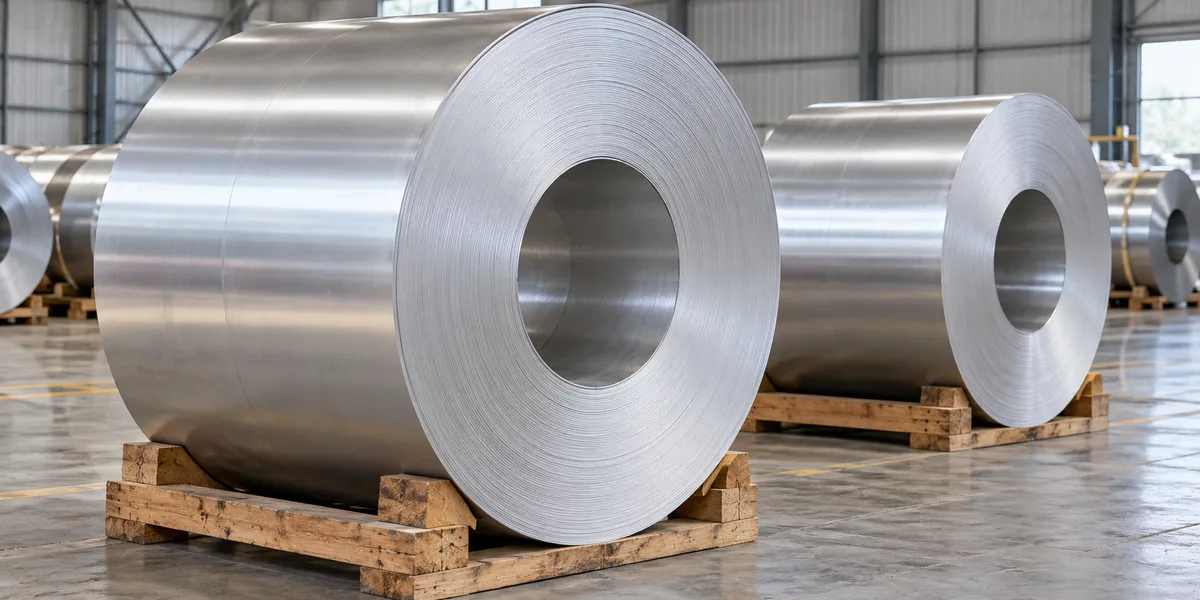
Prismatic lithium-ion cells are housed in deep-drawn aluminium cans, and most of those cans start as 3003 coil, with 1050 and 3005 used where conductivity or extra strength matter. The strip must draw deep without tearing or earing, hold a tight thickness tolerance and laser weld to the cover without porosity. This guide sets out the grades, properties and checks that battery-shell makers specify.
A prismatic cell shell is a thin-walled rectangular can, open at one end, that contains the electrode stack and electrolyte. A cover plate carrying the terminals and safety vent is laser welded on top. Aluminium has largely replaced steel for this part because it saves weight in every cell of the pack, conducts heat out of the cell, does not rust and welds well with lasers.
The shell is typically formed from flat strip in several deep-drawing (or drawing and ironing) stages, sometimes after an impact-extrusion step, and then trimmed, cleaned and inspected. Every one of those steps puts demands on the coil: uniform thickness so the wall does not thin locally, a fine and even grain so the can does not orange-peel or ear, a clean surface for welding, and consistent properties from coil to coil so the press line can run without constant adjustment.
Non-heat-treatable alloys are used because they keep their properties after the welding heat and because their strength can be tuned by cold work (the H tempers). Heat-treatable 6xxx alloys and magnesium-rich 5xxx alloys are generally avoided for cans: 5xxx alloys tend to produce porosity in laser welds as magnesium vaporises, and 6xxx alloys are prone to weld cracking without filler.
The standard battery-shell alloy. About 1.0 – 1.5 % manganese raises strength by roughly 20 – 30 % over pure aluminium while keeping excellent drawability and laser weldability. Used in O, H12 and H14 for most prismatic cans and covers.
Highest conductivity and ductility of the three. Used for very deep draws, inner lining parts and covers where electrical and thermal conductivity matter more than strength.
Adds 0.2 – 0.6 % magnesium to 3003 for higher strength and stiffness, allowing thinner walls. The magnesium slightly increases laser-weld sensitivity, so weld parameters need confirming.
The choice usually comes down to wall thickness and cell size. Large-format cells with thin walls need the strength of 3003-H14 or 3005 to resist swelling pressure, while small cells or very deep draws favour softer O-temper 3003 or 1050. Many shell makers buy O temper for the drawing stages, because the cold work of drawing itself hardens the can wall.
| Element | 1050 | 3003 | 3005 |
|---|---|---|---|
| Silicon (Si) | 0.25 | 0.6 | 0.6 |
| Iron (Fe) | 0.40 | 0.7 | 0.7 |
| Copper (Cu) | 0.05 | 0.05 – 0.20 | 0.30 |
| Manganese (Mn) | 0.05 | 1.0 – 1.5 | 1.0 – 1.5 |
| Magnesium (Mg) | 0.05 | — | 0.20 – 0.6 |
| Chromium (Cr) | — | — | 0.10 |
| Zinc (Zn) | 0.05 | 0.10 | 0.25 |
| Titanium (Ti) | 0.03 | — | 0.10 |
| Aluminium (Al) | 99.50 min | Remainder | Remainder |
Registered Aluminum Association limits, matching EN 573-3. Battery-grade coil is often produced to tighter internal limits on Fe and Si to control grain size and earing; agree these with the supplier if your process is sensitive.
Values below are the standard sheet ranges from EN 485-2 for thin gauges. Battery-shell specifications commonly narrow the tensile band and set elongation and earing limits so that every coil draws the same way.
| Alloy and temper | Tensile strength (MPa) | 0.2 % yield (MPa, min) | Typical use in battery shells |
|---|---|---|---|
| 1050 O | 65 – 95 | 20 | Very deep draws, lining parts |
| 1050 H14 | 105 – 145 | 85 | Covers, flat conductive parts |
| 3003 O | 95 – 135 | 35 | Multi-stage deep-drawn cans |
| 3003 H12 | 120 – 160 | 90 | Moderate draws, higher can stiffness |
| 3003 H14 | 145 – 185 | 125 | Covers and shallow-drawn cans |
| 3005 O | 115 – 165 | 45 | Thin-wall cans needing more strength |
General-purpose sheet standards allow wider thickness bands than a deep-drawing press can tolerate. Battery-shell coil is therefore usually ordered to tighter agreed tolerances. The table shows a typical tightened specification; your drawing or supplier agreement takes precedence.
| Thickness (mm) | Typical agreed tolerance |
|---|---|
| 0.60 – 2.00 | ±0.02 mm |
| > 2.00 – 3.00 | ±0.03 mm |
| > 3.00 – 4.00 | ±0.04 mm |
Width tolerance on slit coil is typically about ±0.5 mm for narrow strip and ±1.5 mm for wider coil. Also specify coil inner diameter, maximum coil weight and edge condition (burr-free slit edges), since burrs can crack during drawing.
The cover-to-can seam is the most critical joint in a prismatic cell: it must be hermetic for the life of the battery. Fibre and disc lasers weld 1xxx and 3xxx alloys well, but results depend on the material as much as on the laser.
| Factor | Effect on weld quality | What to specify |
|---|---|---|
| Alloy | 1050 and 3003 weld most consistently; 3005 slightly more sensitive because of Mg | Match alloy to the weld procedure qualified for the cell |
| Surface oil and oxide | Cause porosity and spatter | Degreased surface; controlled storage to limit oxide growth |
| Hydrogen content | Dissolved hydrogen forms pores in the weld | Melt treated with degassing and filtration |
| Thickness variation | Changes penetration depth around the seam | Tight thickness tolerance on can and cover |
| Fit-up | Gaps cause underfill or blow-holes | Can and cover dimensional tolerance |
Cell makers usually test weld acceptance by checking the rate of weld-pool defects, porosity, cracks and spatter on trial welds, followed by helium leak testing of finished cells. Ask for sample coil to run this trial on your own equipment before approving a new material source.
Coating adhesion depends on the cleanliness of the drawn can, so the coil surface and the drawing lubricant should be chosen with the later cleaning and coating steps in mind.
3003 is the most widely used, because it balances drawability, strength and laser weldability. 1050 suits very deep draws and conductive parts, and 3005 is chosen when thinner, stronger walls are needed.
O temper is usual for multi-stage deep drawing, because the drawing operation work-hardens the wall. H12 or H14 is used for covers and shallow parts that need more stiffness as supplied.
Magnesium vaporises in the laser weld pool and tends to cause porosity and spatter, which threatens the hermetic seal. 1xxx and 3xxx alloys give more consistent welds.
Tighter than general sheet standards. A typical agreed tolerance is ±0.02 mm for 0.6–2.0 mm strip, because thickness variation changes wall thinning in drawing and penetration in welding.
No. Metline supplies the aluminium coil, strip and blanks in 1050, 3003 and 3005, slit to width with mill test certificates. The drawing, welding and coating of shells are done by cell and component manufacturers.
Send alloy, temper, gauge, width and volume. We will propose matching material, arrange samples and quote delivered to your plant.





