4104 / 6951 / 4104
Three-layer, double-side clad for vacuum brazing. Lower cost where silicon diffusion and corrosion are less critical.



6951 brazing sheet is a roll-bonded composite with a heat-treatable 6951 core, an aluminium-silicon filler alloy on the outside and, in the five-layer version, a 3003 interlayer between filler and core. The interlayer slows silicon diffusion into the core during brazing, which protects post-braze strength and corrosion life in demanding heat exchangers. This guide explains the construction, chemistry, brazing window and how to specify it.
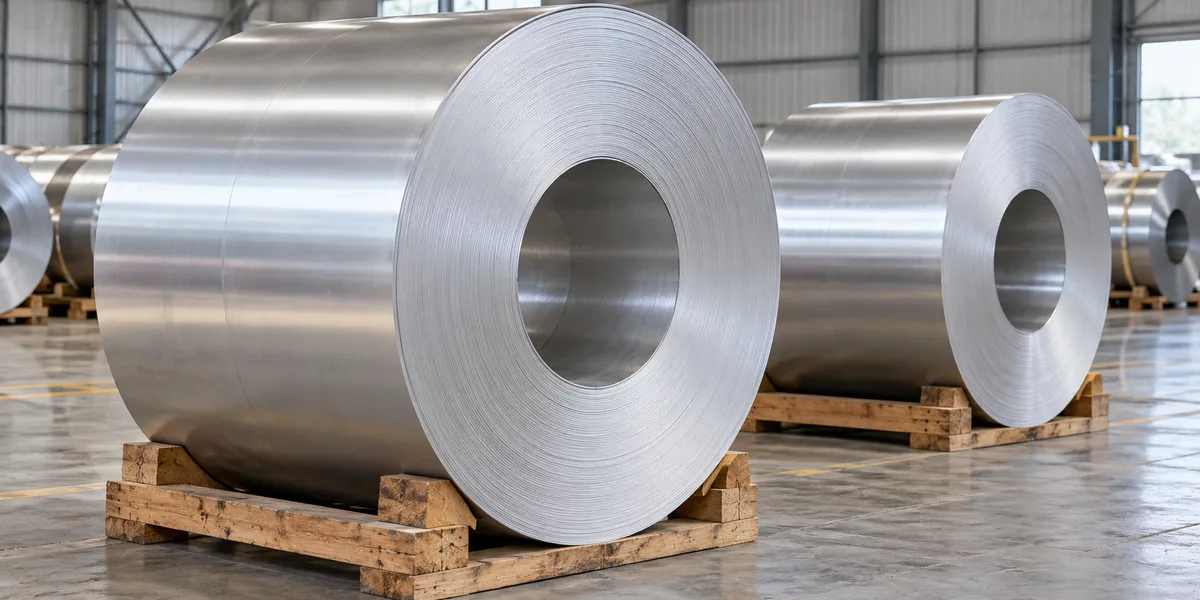
Brazing sheet is aluminium sheet with a thin skin of low-melting Al-Si filler metal bonded to one or both faces. When an assembly of plates, fins and tubes is heated in a furnace, the skin melts, flows by capillary action into every joint and solidifies, so hundreds of joints are made in one cycle without separate filler wire.
Most brazing sheet uses a 3003 or modified 3xxx core. 6951 is chosen instead when the heat exchanger needs more strength after brazing. It is a lean Al-Mg-Si-Cu alloy with a solidus around 615 °C, high enough to survive a brazing cycle near 600 °C, yet it still contains enough magnesium and silicon to respond to precipitation hardening. After brazing, the furnace cycle acts as a solution treatment; natural or artificial ageing then restores much of the strength that a 3003 core would simply lose.
The five-layer construction (filler / interlayer / core / interlayer / filler) adds a 3003 barrier on each side. During brazing, silicon from the molten filler diffuses into whatever metal sits beneath it. With a 6951 core that diffusion can lower the local melting point, cause erosion of thin sections and leave a band that corrodes preferentially. The 3003 interlayer absorbs this silicon and keeps the core chemistry intact.
| Layer | Alloy | Function | Typical share of total thickness (each side) |
|---|---|---|---|
| Outer filler | 4104 (Al-10Si-1.5Mg-Bi) | Melts at about 560 – 590 °C and forms the joints; Mg and Bi help break up oxide in vacuum | About 10 – 18 % |
| Interlayer | 3003 (Al-Mn) | Diffusion barrier that limits Si penetration and acts as a sacrificial band | About 8 – 12 % |
| Core | 6951 (Al-Mg-Si-Cu) | Carries the load; age-hardens after the brazing cycle | Balance, usually 50 – 70 % |
Clad ratios are agreed per order. Ratios above are common starting points, not a standard requirement; the right value depends on gauge, joint design and how much filler the assembly needs.
Clad ratio is always quoted as a percentage of total sheet thickness per side. On 0.5 mm sheet, a 12 % filler layer is only 60 µm thick, which is why thin-gauge brazing sheet needs very consistent rolling. Too little filler leaves gaps in fillets; too much causes excess flow, erosion of fins and blocked channels.
Three-layer sheet (filler / core / filler) is cheaper and is perfectly adequate for many 3003-core parts. With a 6951 core, however, the five-layer build is the more robust route, because the core is more sensitive to silicon pick-up and its magnesium can migrate toward the surface. Single-side variants (filler on one face only, sometimes with a water-side liner on the other) are used where only one face makes joints.
Limits follow the Aluminum Association registrations. Single values are maxima. Every coil should be certified with the cast analysis of core and cladding.
| Element | 6951 core | 3003 interlayer | 4104 filler |
|---|---|---|---|
| Silicon (Si) | 0.20 – 0.50 | 0.6 | 9.0 – 10.5 |
| Iron (Fe) | 0.8 | 0.7 | 0.8 |
| Copper (Cu) | 0.15 – 0.40 | 0.05 – 0.20 | 0.25 |
| Manganese (Mn) | 0.10 | 1.0 – 1.5 | 0.10 |
| Magnesium (Mg) | 0.40 – 0.80 | — | 1.0 – 2.0 |
| Zinc (Zn) | 0.20 | 0.10 | 0.20 |
| Bismuth (Bi) | — | — | 0.02 – 0.20 |
| Others, each / total | 0.05 / 0.15 | 0.05 / 0.15 | 0.05 / 0.15 |
| Aluminium | Remainder | Remainder | Remainder |
Two details matter for brazing. First, 4104 contains magnesium on purpose: in a vacuum furnace, Mg evaporates from the filler and reacts with residual oxygen and water vapour, which disrupts the oxide film and lets the filler wet the joint without flux. Second, the 6951 core also contains up to 0.8 % Mg. That is helpful for strength but is a problem for flux brazing, because magnesium reacts with standard potassium fluoroaluminate flux and degrades it.
Brazing sheet is normally delivered in an annealed (O) or partially annealed (H2x) temper so that it can be stamped, drawn or bent into plates and cups. The brazing cycle then resets the microstructure of the core. What matters to the designer is therefore the post-braze, post-aged strength, which must be confirmed on brazed coupons from the actual furnace cycle.
| Condition | What happens | Practical guidance |
|---|---|---|
| As delivered (O / H2x) | Soft, formable; filler and interlayer intact | Order the temper that suits the forming severity; confirm bend radius |
| Immediately after brazing | Core is effectively solution treated; filler has flowed into joints | Quench rate from the furnace affects how much strength can be recovered |
| Naturally aged | Mg2Si clusters form over days at room temperature | Gives a useful gain without extra process steps |
| Artificially aged | Precipitation hardening at moderate temperature (typically 160 – 180 °C) | Highest post-braze strength; validate time and temperature on coupons |
Clad sheet is weaker than bare 6951 in proportion to the softer clad layers, and brazed properties depend heavily on the furnace cycle and quench rate. Design to values measured on brazed coupons from your own process, not to handbook figures for the bare alloy.
The 4104 filler is designed for vacuum brazing. Assemblies are degreased, fixtured and heated in a vacuum furnace, typically held at around 10-5 mbar or better, to a peak of roughly 590 – 605 °C for a short soak. The filler melts, the magnesium getter does its work and the joints form without flux residues, which is important for aerospace, defence and electronics cooling parts where flux contamination is unacceptable.
Controlled atmosphere brazing (CAB) in nitrogen with fluoride flux is the volume process for automotive heat exchangers. A 6951 core can be brazed this way, but its magnesium content reduces flux activity, so results depend on flux type and loading, clad design and furnace profile. If CAB is the intended route, discuss it before ordering: an Mg-free filler such as 4343 or 4045 and a well-designed interlayer are normally preferred, and trials on the production line are essential.
Temperatures here are typical ranges published for Al-Si vacuum brazing. Each furnace and part needs its own qualified profile.
Plates for bar-and-plate and drawn-cup heat exchangers are stamped and often deep-drawn, so formability before brazing is part of the specification. A common way to define it is a 180° bend test with a minimum inside radius tied to thickness:
| Nominal thickness | Typical minimum bend radius (180°) | Comment |
|---|---|---|
| Up to 0.48 mm | 1 × t | Thin plates and fins |
| 0.48 – 1.27 mm | 2 × t | Most heat exchanger plates |
| 1.27 – 2.87 mm | 3 × t | Side plates, headers, cover plates |
| Over 2.87 mm | By agreement | Thick end plates and manifolds |
Exact availability depends on gauge, width and clad design; send your drawing or specification for confirmation.
Three-layer, double-side clad for vacuum brazing. Lower cost where silicon diffusion and corrosion are less critical.
Filler on one face only, for side plates and parts brazed on one face.
Al-7.5Si filler with a narrower melting range; used where a lower-fluidity filler and lower Mg are wanted.
Al-10Si filler with higher fluidity, usually for flux brazing trials; filler choice must match the furnace process.
The construction described on this page; best for strength retention and corrosion life.
Different interlayers, water-side liners or clad ratios for specific corrosion or erosion problems.
Choosing the core alloy. The table compares 6951 with the two cores it is most often weighed against.
| Factor | 3003 core | 6951 core | 6061 core |
|---|---|---|---|
| Role | Standard brazing core | Higher-strength brazing core | Structural alloy, rarely used as brazing core |
| Heat treatable | No | Yes | Yes |
| Solidus (approx.) | About 640 °C | About 615 °C | About 580 °C |
| Margin above Al-Si filler | Large | Adequate | Very small; high risk of melting |
| Post-braze strength | Low to medium | Medium to high after ageing | High if it survives brazing, but process window is tiny |
| Flux (CAB) compatibility | Good | Limited by Mg; needs care | Poor |
| Typical use | Radiators, condensers, HVAC coils | High-pressure plates, aerospace and military coolers | Machined parts, structures |
The key number is the solidus. Al-Si fillers melt from about 577 °C, so the core must stay solid while the filler flows. 3003 gives a large margin, 6951 a workable one, and 6061 almost none, which is why 6061 is used for machined manifolds and brackets rather than as a brazing-sheet core.
A typical bar-and-plate oil cooler pairs 6951 five-layer separator plates with 3003 fins and 3003 or 6063 bars. The fins do not need the strength; the plates do, because they contain the pressure. For full material sets see our fin stock and heat exchanger tube pages.
During brazing, silicon from the molten filler diffuses into the metal beneath it. A 3003 interlayer takes up that silicon and protects the 6951 core from erosion, local melting and a corrosion-prone diffusion band. The result is better strength retention and longer corrosion life, at a modest extra cost.
It can, but with care. The core contains up to 0.8 % magnesium, which reduces flux effectiveness. CAB users normally pair it with an Mg-free filler such as 4343 or 4045, adjust flux loading and run trials. 4104-clad sheet is intended for vacuum brazing.
Yes. The brazing cycle acts as a solution treatment for the core. Natural ageing at room temperature, or artificial ageing at moderate temperature, then precipitates Mg2Si and raises strength well above what a 3003 core can reach. Confirm values on brazed and aged coupons.
Common starting points are about 10 – 18 % filler and 8 – 12 % interlayer per side, but the right ratio depends on gauge, joint gaps and fillet size. Thin sheet with many joints usually needs a higher filler ratio; thick plate needs less.
4104 is Al-Si with magnesium and bismuth, designed for fluxless vacuum brazing. 4343 (about 7.5 % Si) and 4045 (about 10 % Si) contain no intentional magnesium and are the usual fillers for flux brazing. Pick the filler to suit the furnace process first.
Yes. Metline supplies the complete set of aluminium for a brazed heat exchanger, including 3003 and 3102 fin stock, round and flat tubes and other clad sheet, all with mill test certificates, to customers worldwide.
Share the clad build, gauge, brazing process and volume. Our technical team will propose a construction and send a delivered quotation.





