T6
Solution heat-treated (on the press by controlled quenching, or separately) and artificially aged. The standard delivery condition for structural members and housings.



6106 is a medium-strength Al-Mg-Si-Mn extrusion alloy (EN AW-6106, AlMgSiMn) that sits between 6063 and 6005A: it extrudes into thin, complex hollow sections almost as easily as 6063 but reaches a guaranteed 250 MPa tensile strength in T6. Vehicle makers use it for frames, rails, seat structures and housings where shape complexity and weight matter more than maximum strength. Metline supplies 6106-T6 profiles to drawing, with finishing and machining, to customers worldwide.
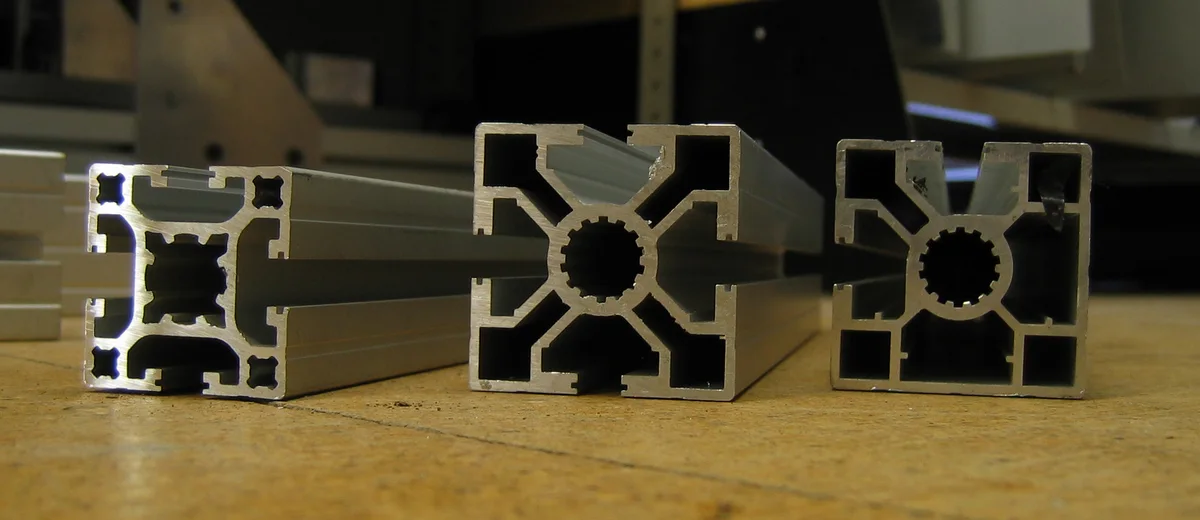
6106 is a 6xxx-series alloy designed for extrusion. Its magnesium and silicon form Mg2Si precipitates during ageing, which gives the strength, while a small manganese addition refines the grain structure and lifts strength above that of 6063 without destroying the alloy's flow through the die. The result is a material that can be pushed through porthole dies into multi-cavity hollows with walls around 1 – 2 mm, yet still meets structural property minimums.
In automotive work that combination is valuable. A single 6106 extrusion can integrate screw ports, clip channels, ribs and closed cells that would otherwise need several stamped steel parts and spot welds. Because the profile cross-section is fixed, part designers move complexity into the die and keep downstream operations to cutting, bending, machining and joining.
6106 is most common in Europe, where it is listed in EN 573-3 and EN 755-2 alongside 6060, 6063 and 6005A. It is less familiar in North America, where engineers usually reach for 6063 or 6061 instead; for export projects we can advise on the closest ASTM-registered substitute.
Limits are those registered for EN AW-6106 in EN 573-3. Compared with 6063, the manganese window (0.05 – 0.20 %) and the slightly wider copper allowance are the distinguishing features. Each lot certificate reports the actual cast analysis.
| Element | Minimum | Maximum | Role |
|---|---|---|---|
| Silicon (Si) | 0.30 | 0.60 | Forms Mg2Si with magnesium |
| Iron (Fe) | — | 0.35 | Impurity; kept low for surface quality and ductility |
| Copper (Cu) | — | 0.25 | Adds a little strength |
| Manganese (Mn) | 0.05 | 0.20 | Grain control and modest strengthening |
| Magnesium (Mg) | 0.40 | 0.80 | Main strengthening element with Si |
| Chromium (Cr) | — | 0.20 | Grain structure control |
| Zinc (Zn) | — | 0.10 | Impurity |
| Others, each / total | — | 0.05 / 0.10 | |
| Aluminium (Al) | Remainder |
EN 755-2 specifies 6106 in the T6 temper for profiles up to 10 mm wall. Values below are specified minimums unless marked typical; design to the minimums. T5 and T4 can be produced for parts that will be formed before final ageing, with properties agreed on the order.
| Temper / condition | Tensile strength Rm | Proof strength Rp0.2 | Elongation A / A50 | Hardness |
|---|---|---|---|---|
| T6, wall ≤ 10 mm (EN 755-2 minimum) | 250 MPa | 200 MPa | 8 % / 6 % | about 75 HB |
| T6, typical as delivered | 260 – 290 MPa | 220 – 250 MPa | 10 – 12 % | 80 – 85 HB |
| Heat-affected zone after MIG welding (indicative) | about 50 – 60 % of parent T6 | — | — | — |
Solution heat-treated (on the press by controlled quenching, or separately) and artificially aged. The standard delivery condition for structural members and housings.
Cooled from the press and artificially aged. Suits thin sections where press quenching achieves near-T6 properties at lower cost.
Naturally aged. Softer and more ductile for stretch-bending roof rails and window frames, then aged after forming, often in the paint-bake oven or a separate furnace.
Under-aged or enhanced tempers can be agreed where a design needs extra bendability or slightly higher strength; specify target values on the drawing.
Every custom profile needs a die. Send the cross-section drawing with critical dimensions and we will review extrudability before quoting.
| Standard shape | Typical size range | Typical wall range |
|---|---|---|
| Round tube | 25 – 250 mm OD | 1.5 – 19 mm |
| Square tube | 25 – 200 mm | 1.5 – 12 mm |
| Rectangular tube | 25 × 50 – 200 × 300 mm | 1.5 – 12 mm |
| Angle | 25 × 25 – 200 × 200 mm | 2 – 12 mm |
| T and U (channel) | 25 – 150 mm legs | 2 – 12 mm |
Automotive profiles are almost always made to a part drawing, and the drawing tolerances override the general tables. Where the drawing is silent, the general tolerance standard of the order applies. Critical dimensions, such as mating faces, screw bosses and crash-relevant wall thicknesses, should be marked so they can be measured on every lot.
6106 behaves much like 6063 in the workshop. MIG and TIG welding work well with ER4043 (lower crack sensitivity) or ER5356 (higher fillet strength); expect the heat-affected zone to lose a large part of its T6 strength, so place welds in low-stress areas or allow for the reduction in design. Self-piercing rivets, flow-drill screws, adhesive bonding and friction stir welding are all used in mixed-material bodies.
For bending, T4 material or local heating gives tighter radii than T6; stretch-bending is common for roof rails and window frames. Machining is straightforward in T6, producing short chips with sharp carbide tools.
Supplied as extruded and aged, for parts that are welded, bonded or painted later in the body shop or e-coat line.
Clear or coloured anodic films for trim, roof rails and visible parts. Film class is specified in micrometres, for example AA15 or AA20 for exterior exposure.
Thin, uniform paint that penetrates hollow sections; often used after anodising for a smooth, durable finish on trim.
Thicker polyester or epoxy layers for chassis brackets, racks and accessories that see stone chipping.
Chromium-free titanium or zirconium pre-treatment before adhesive bonding or painting, improving bond durability.
Cut-to-length, CNC machining, punching, bending and drilling on request, so profiles arrive ready for assembly.
6106 is not a primary crash-management alloy. Bumper beams and crash boxes usually use higher-strength or specially processed 6xxx and 7xxx grades; 6106 is chosen where moderate strength and a complex section are the priorities.
| Property (T6, EN 755-2 minimum, thin wall) | 6063 | 6106 | 6005A | 6082 |
|---|---|---|---|---|
| Tensile strength Rm | 215 MPa | 250 MPa | 270 MPa | 290 MPa |
| Proof strength Rp0.2 | 170 MPa | 200 MPa | 225 MPa | 250 MPa |
| Extrudability (thin, complex hollows) | Excellent | Very good | Good | Fair |
| Anodised appearance | Excellent | Very good | Good | Fair |
| Typical automotive use | Trim, frames | Frames, rails, housings | Structural members | Highly loaded members |
Choose 6106 when 6063 is not quite strong enough but a 6005A or 6082 die would be hard to fill or would leave poor surfaces. Minimum values change with wall thickness band; the certificate shows the band that applies to your section.
6106 adds 0.05 – 0.20 % manganese and allows a little more copper, which raises the T6 minimums from about 215 / 170 MPa (6063) to 250 / 200 MPa while keeping similar extrudability and finish quality.
6106 is registered with the Aluminum Association, but it is rarely called up in ASTM-based North American drawings. 6063 or 6061 are the usual substitutes there, depending on whether finish or strength matters more.
Yes. Arc weldability is very good with ER4043 or ER5356 filler. The heat-affected zone loses a significant part of its T6 strength, so welded parts are designed to reduced allowable stresses or re-aged.
Yes. Its low iron and moderate alloy content give a clean, even anodised film, close to 6063. For mirror-bright trim, a bright-trim alloy such as 6463 is better.
Small multi-cavity hollows can be extruded with walls of around 1 – 1.5 mm, depending on section size and shape. We review every drawing for extrudability before quoting.
Yes. Metline supplies 6106 profiles worldwide from Mumbai with EN 10204 3.1 certificates, export packing and EXW, FOB, CIF or DAP terms.
Send the section drawing, temper, finish and volume. Our team will reply with feasibility, certification and delivered pricing.





