


6A01 T5 / T6 Automotive Aluminium Extrusions
6A01 is a GB/T 3190 extrusion alloy of the Al-Mg-Si type, closely matching the Japanese 6N01 and broadly comparable with European 6005A. It was developed for large, wide, thin-walled hollow profiles that weld well, which is why it is used for rail car bodies, bus and coach frames, truck bodies and vehicle structures. Metline supplies 6A01-T5 and T6 profiles to drawing for vehicle builders worldwide.
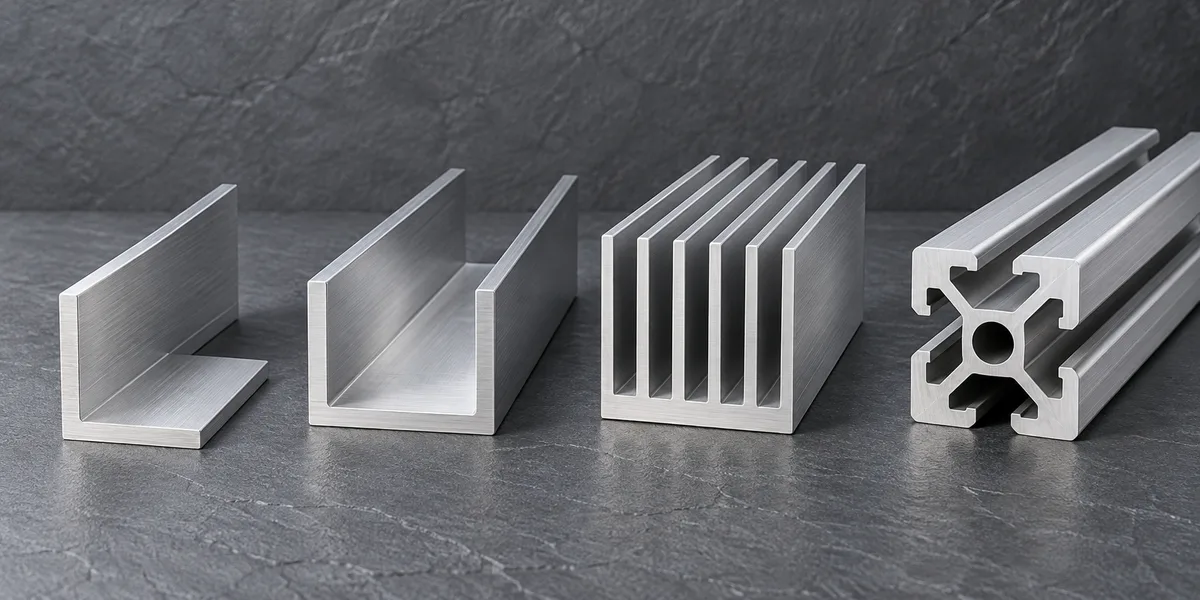
- Alloy
- 6A01 (GB/T 3190), 6N01-type
- Tempers
- T5, T6
- Min. strength (T6, thin wall)
- about Rm 265 / Rp0.2 235 MPa
- Standards
- GB/T 6892 · GB/T 33910 · JIS H4100
What is 6A01 aluminium?
6A01 belongs to the 6xxx family. Silicon and magnesium give age-hardening strength, and controlled manganese and chromium additions (together no more than 0.50 %) refine the grain. The alloy is formulated to be press-quenched: wide hollow profiles leave the die hot enough that air or water-mist cooling at the press achieves useful T5 properties without a separate solution heat treatment, which is essential for sections too large to quench in a furnace.
That property made 6A01 and its Japanese counterpart 6N01 the standard material for welded aluminium rail car bodies, built from long double-skin floor, side-wall and roof extrusions. The same logic applies to buses, coaches, truck bodies, trailers and electric-vehicle battery frames, where long, wide profiles are friction-stir or MIG welded into a light structure.
Strength sits between 6063 and 6082: higher than 6063 for structural members, with better extrudability and weld behaviour in large thin sections than 6082.
6A01 chemical composition (wt %)
Limits below follow the 6N01-type registration that GB/T 3190 uses for 6A01. Some catalogues print a 6063-like analysis for 6A01; that is not correct, as 6A01 permits more silicon, copper, manganese and chromium. Confirm against the edition of GB/T 3190 named on your drawing.
| Element | Minimum | Maximum |
|---|---|---|
| Silicon (Si) | 0.40 | 0.90 |
| Iron (Fe) | — | 0.35 |
| Copper (Cu) | — | 0.35 |
| Manganese (Mn) | — | 0.50 |
| Magnesium (Mg) | 0.40 | 0.80 |
| Chromium (Cr) | — | 0.30 |
| Mn + Cr | — | 0.50 |
| Zinc (Zn) | — | 0.25 |
| Titanium (Ti) | — | 0.10 |
| Others, each / total | — | 0.05 / 0.10 |
| Aluminium (Al) | Remainder |
6A01 mechanical properties
Minimum values for thin-walled profiles (up to about 6 mm), as given in JIS H4100 for 6N01 and used in GB profile standards; thicker walls have slightly lower minimums. Typical production values are usually 10 – 15 % above the minimums.
| Temper | Tensile strength Rm (min.) | Proof strength Rp0.2 (min.) | Elongation (min.) |
|---|---|---|---|
| T5 | 245 MPa | 205 MPa | 8 % |
| T6 | 265 MPa | 235 MPa | 8 % |
Physical properties (typical)
- Density
- 2.70 g/cm³
- Modulus of elasticity
- about 69 GPa
- Thermal conductivity
- about 180 – 190 W/m·K
- Coefficient of thermal expansion
- about 23.5 µm/m·°C
Welding reduces strength in the heat-affected zone; friction stir welding loses less strength than MIG. Design allowables for welded joints should come from the applicable code (for example EN 1999 or the vehicle builder's rules).
6A01 profile range
Typical supply range
- Shapes
- Custom open and hollow sections, double-skin panels, round, square and rectangular tubes, angle, U, T, Z and H sections
- Round sections
- About 10 – 250 mm diameter
- Wall thickness
- From about 1.5 mm in small hollows; double-skin panels typically 2 – 4 mm skins
- Width
- Wide flat and double-skin profiles up to the limit of the available press, often 500 mm and above
- Length
- Mill lengths up to the full vehicle length on request, or cut to drawing
- Finish
- Mill, anodised, e-coated, powder coated or sand-blasted
Tolerances and inspection
Automotive profiles are almost always made to a part drawing, and the drawing tolerances override the general tables. Where the drawing is silent, the general tolerance standard of the order applies. Critical dimensions, such as mating faces, screw bosses and crash-relevant wall thicknesses, should be marked so they can be measured on every lot.
Tolerance and inspection framework
- General dimensional tolerances
- EN 755-9 for EN orders; ASTM B221 with ANSI H35.2 tables for ASTM orders; GB/T 14846 where a GB drawing applies
- Straightness and twist
- Per the same standards, or tighter values agreed for long members and parts that go straight into robotic welding
- Wall thickness
- Measured at drawing-defined points; closed hollow sections are checked for eccentricity and die-line quality
- Mechanical testing
- Tensile test per lot to EN ISO 6892-1 or ASTM B557, with hardness (Webster or Brinell) for in-process checks
- Microstructure
- Grain size and recrystallised surface layer checked on request, which matters for crash and bending performance
- Documentation
- EN 10204 3.1 certificate; PPAP-style first-article dimensional report on request for series parts
Where 6A01 is used
- Bus and coach bodies: roof and side-wall frames, floor sections
- Truck and trailer bodies: side rails, floor profiles and upper frames
- Electric vehicles: battery tray frames and side members
- Rail vehicles: double-skin floor, wall and roof extrusions
- Vehicle accessories: ladders, racks and loading equipment
6A01 compared with similar alloys
| Alloy | System | Relationship to 6A01 |
|---|---|---|
| 6N01 | JIS H4100 | Same composition concept; the usual reference for 6A01 properties |
| 6005A | EN 573-3 / EN 755-2 | Close European equivalent with similar Mn + Cr window and T6 minimums of about 270 / 225 MPa in thin walls |
| 6063 | Global | Lower strength, better finish; not a substitute for structural members |
| 6082 | EN | Higher strength, harder to extrude in large thin sections |
How to order 6A01 profiles
- SpecifyAlloy and temper (6A01-T5 or T6), section drawing, lengths, finish and annual volume; state if 6N01 or 6005A is an accepted alternative.
- Confirm the standardGB/T 6892 or GB/T 33910 for GB orders; JIS H4100 for 6N01; EN 755 for 6005A alternatives.
- QuoteWe confirm availability, tolerances, certification and delivery terms (EXW, FOB, CIF or DAP) for your plant or port.
- Process and inspectProfiles are cut, finished, inspected to drawing and packed with spacers to protect long thin walls.
- Document and shipEach lot ships with an EN 10204 3.1 mill test certificate, lot traceability and a packing list, in seaworthy export packing. Third-party inspection can be arranged on request.
References and standards
- GB/T 3190 – Wrought aluminium and aluminium alloys: chemical composition
- GB/T 33910 – Aluminium and aluminium alloy extruded profiles for automobiles
- JIS H4100 – Aluminium and aluminium alloy extruded shapes
- EN 755-2 – Extruded rod/bar, tube and profiles: mechanical properties
- EN 1999-1-1 (Eurocode 9) – Design of aluminium structures
6A01 automotive aluminium (aluminum) extrusions: frequently asked questions
Is 6A01 the same as 6N01?
6A01 in GB/T 3190 follows the 6N01 composition concept closely, and profile properties are usually referenced to the JIS 6N01 values. Confirm acceptance on your drawing if you want to substitute one for the other.
What is the European equivalent of 6A01?
6005A is the closest EN alloy, with a similar Mn + Cr control and comparable T6 strength.
Why is 6A01 used for large welded vehicle bodies?
It extrudes into wide thin hollows, reaches good properties by press quenching and welds well by MIG or friction stir welding.
What is the strength of 6A01-T6?
For thin-walled profiles, minimum tensile strength is about 265 MPa and minimum proof strength about 235 MPa, with 8 % elongation.
Do you export 6A01 profiles?
Yes. Metline supplies 6A01 profiles worldwide with mill certificates and export packing.
Need 6A01 profiles for a vehicle body?
Send the section drawing, temper and lengths. We will reply with feasibility, certification and delivered pricing.





