T4
Solution treated and naturally aged. Softest heat-treated temper, chosen when the profile will be stretch-bent or roll-formed, then optionally aged to T6.



6060 is a lean Al-Mg-Si extrusion alloy that flows through complex, thin-walled dies at high speed and anodises to a very even finish. In vehicles it is used for trim, roof rails, window and sunroof frames, interior structures and cooling profiles, where appearance, tight tolerances and moderate strength matter more than crash performance. Metline supplies 6060 profiles to drawing in T4, T5, T6, T64 and T66 tempers, cut, machined and finished as required, to customers worldwide.
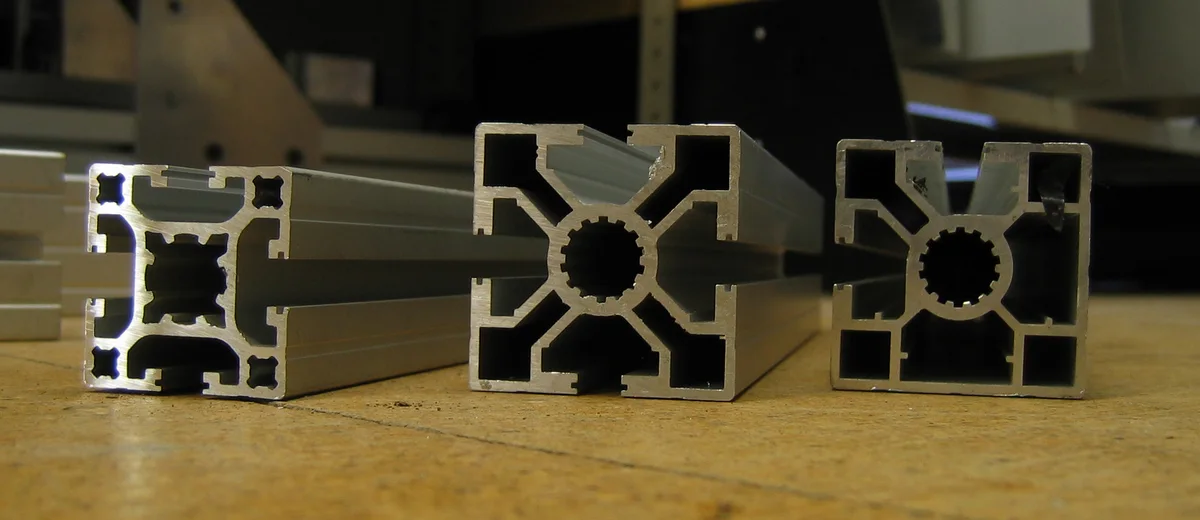
6060 is the leanest of the common 6xxx extrusion alloys. With only about 0.35 – 0.6 % each of magnesium and silicon, it extrudes faster and through more intricate dies than 6063, 6061 or 6082, and it can be press-quenched with air in thin sections. The trade-off is strength: 6060-T6 reaches roughly two thirds of the strength of 6082-T6.
That balance makes 6060 a natural choice for vehicle parts that are seen or touched, or that need complex hollow shapes, but do not absorb crash energy. Bright-anodised roof rails, window surrounds, door sill trims and interior decorative strips are typical. 6060 is also popular for thin-walled cooling and heat-sink profiles in electric vehicles because of its high thermal conductivity.
In Europe 6060 and 6063 are close relatives and often interchangeable on drawings; 6063 has a slightly higher magnesium ceiling and gives a little more strength. Both are covered by the precision-profile tolerance standard EN 12020, which is useful for trim parts that must fit tightly against glass, seals and painted panels.
| Element | Minimum | Maximum | Role |
|---|---|---|---|
| Silicon (Si) | 0.30 | 0.6 | Forms Mg2Si with magnesium |
| Iron (Fe) | 0.10 | 0.30 | Controlled for surface quality and anodising |
| Copper (Cu) | — | 0.10 | Kept low for corrosion resistance |
| Manganese (Mn) | — | 0.10 | |
| Magnesium (Mg) | 0.35 | 0.6 | Main strengthening element with silicon |
| Chromium (Cr) | — | 0.05 | |
| Zinc (Zn) | — | 0.15 | |
| Titanium (Ti) | — | 0.10 | Grain refiner |
| Others, each / total | — | 0.05 / 0.15 | |
| Aluminium (Al) | Remainder |
Limits per EN 573-3 (EN AW-6060) and the Aluminum Association registration. Some older tables show a copper limit of 0.18 %; the registered maximum is 0.10 %.
Values below are the specified minimums for extruded profiles in EN 755-2. They fall slightly in thicker walls because thick sections cool more slowly during quenching. A is elongation on a proportional gauge; A50 is on 50 mm.
| Temper | Wall thickness (mm) | Rm min (MPa) | Rp0.2 min (MPa) | A / A50 min (%) | Typical hardness (HBW) |
|---|---|---|---|---|---|
| T4 | ≤ 25 | 120 | 60 | 16 / 14 | 50 |
| T5 | ≤ 5 | 160 | 120 | 8 / 6 | 60 |
| T5 | > 5 – 25 | 140 | 100 | 8 / 6 | 60 |
| T6 | ≤ 3 | 190 | 150 | 8 / 6 | 70 |
| T6 | > 3 – 25 | 170 | 140 | 8 / 6 | 70 |
| T64 | ≤ 15 | 180 | 120 | 12 / 10 | 60 |
| T66 | ≤ 3 | 215 | 160 | 8 / 6 | 75 |
| T66 | > 3 – 25 | 195 | 150 | 8 / 6 | 75 |
Solution treated and naturally aged. Softest heat-treated temper, chosen when the profile will be stretch-bent or roll-formed, then optionally aged to T6.
Press-quenched and artificially aged. The economical everyday temper for trim and frames with walls up to a few millimetres.
Fully solution treated and aged for higher strength. Used for interior structures and rails that carry light loads.
Under-aged for better bendability while keeping more strength than T4. Useful for curved roof rails and window frames.
A T6 with tightly controlled chemistry and process to reach higher minimums. Chosen when 6060 must carry a little more load without changing alloy.
Profiles are stretched after quenching to straighten them and reduce residual stress; a T5 or T6 profile is normally stretch-straightened as standard.
Feasibility of a new section depends on wall ratio, tongue ratio and cavity design; send the drawing for a die review.
| Requirement | Standard | Notes |
|---|---|---|
| Mechanical properties | EN 755-2 | Minimums by temper and wall thickness, as tabulated above |
| Dimensional tolerances, general profiles | EN 755-9 | Default when the drawing does not specify |
| Precision profiles in 6060 / 6063 | EN 12020-2 | Tighter tolerances for trim, frames and parts mating with seals |
| Anodising quality | EN ISO 7599 / Qualanod | Film thickness class and sealing quality agreed per part |
| Quality management | IATF 16949 / ISO 9001 | Automotive parts usually need PPAP documentation from the part maker |
For visible trim, agree the decorative surface (the side that will be seen), acceptable die-line depth and anodising colour range before production. Supply limit samples to both the extruder and the anodiser; this avoids most appearance disputes.
| Part | Typical temper | Why 6060 |
|---|---|---|
| Roof rails and roof bars | T5, T64, T6 | Bright anodised finish; T64 for stretch-bent curves |
| Window surrounds, belt-line and sunroof frames | T5, T6 | Precision tolerances against glass and seals |
| Door sill and interior decorative trims | T5 | Fine surface, brushing and anodising |
| Seat and console frames (lightly loaded) | T6, T66 | Complex hollows at low weight |
| EV cooling profiles and electronics housings | T5, T6 | High thermal conductivity, thin fins |
| Bus, coach and caravan body frames | T6, T66 | Light frames, easy joining and finishing |
6060 is not suitable for bumper beams, crash boxes or suspension parts. Those need the higher strength and controlled crush behaviour of 6082, 6005A or 7xxx alloys.
| Property | 6060-T6 | 6063-T6 | 6005A-T6 | 6082-T6 |
|---|---|---|---|---|
| Rp0.2 min, thin wall | 150 MPa | 170 MPa | 225 MPa | 250 MPa |
| Extrudability | Excellent | Excellent | Good | Fair |
| Anodised appearance | Excellent | Excellent | Good | Fair |
| Thermal conductivity | Highest | High | Medium | Lower |
| Typical use | Trim, cooling, light frames | Trim, frames, rails | Structural profiles, battery trays | Crash and chassis parts |
If a 6060 design needs about 15 % more strength, try 6060-T66 or 6063-T6 before changing to a structural alloy. When strength or crash performance drives the design, 6005A and 6082 are the logical steps up.
For lightly loaded frames, trim and cooling parts, yes. 6060-T6 has a minimum yield of 140 – 150 MPa, which is too low for crash rails, bumper beams or suspension parts; those use 6082, 6005A or 7xxx alloys.
Both are solution treated and artificially aged. T66 uses controlled chemistry and processing to reach higher guaranteed values, for example 215 MPa tensile and 160 MPa yield in walls up to 3 mm instead of 190 and 150 MPa for T6.
They are close but not identical. 6063 allows more magnesium and silicon, so it reaches slightly higher strength; 6060 extrudes a little faster. Both anodise well and share the EN 12020 precision tolerance standard.
T4 or T64 is normally used for bending, because both retain more elongation. The bent part can then be artificially aged to reach T6-level strength.
Yes. 6060 is one of the best alloys for even clear, black and coloured anodising, which is why it is widely used for visible trim.
Yes. Metline supplies 6060 extrusions worldwide with mill certificates, protective packing and EXW, FOB, CIF or DAP terms.
Send the drawing, temper, finish and annual volume. Our team will review feasibility and reply with tolerances and delivered pricing.





