7003-T5
Cooled at the press and artificially aged. The usual automotive temper: good strength, low distortion and a cost advantage because no separate solution treatment is needed.



7003 is a weldable aluminium-zinc-magnesium extrusion alloy that reaches yield strengths around 300 MPa in the T5 temper while still extruding into thin, multi-cell hollow sections. That combination makes it a standard choice for bumper beams, side-impact door beams and other crash-relevant profiles. Metline supplies 7003 profiles in T5 and T6 to drawing, with certification, to vehicle and component makers worldwide.
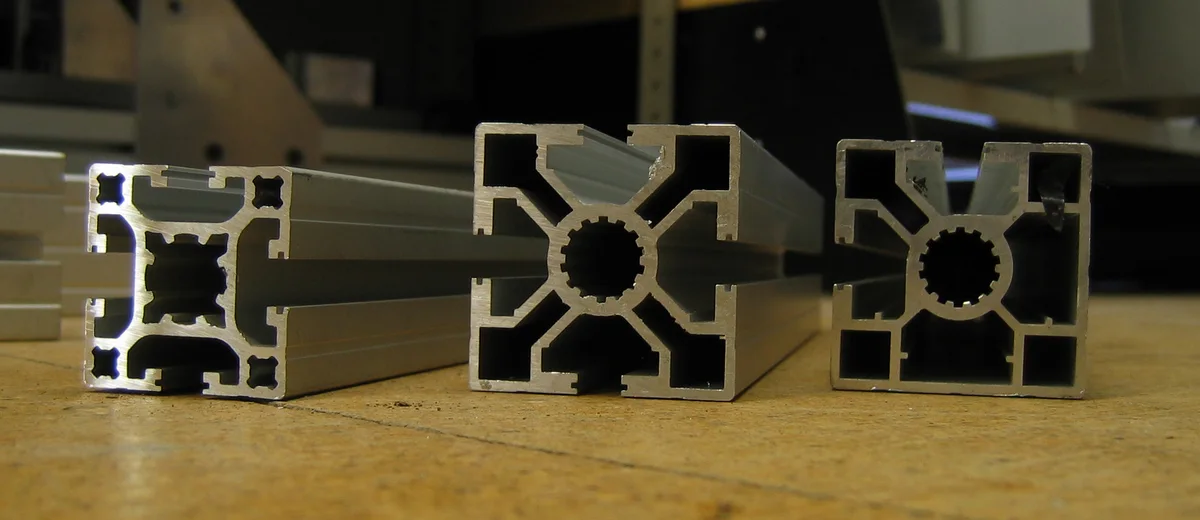
7003 belongs to the medium-strength, weldable branch of the 7xxx family: alloys that rely on zinc and magnesium for strength but carry little or no copper. Compared with aerospace 7075, they are far easier to extrude and weld; compared with 6082, they offer roughly 15 – 30 % more yield strength in the same section.
The alloy keeps magnesium deliberately low (0.5 – 1.0 %). That choice is what lets 7003 flow through complex hollow dies at reasonable speeds, a weakness of richer 7xxx grades. Zirconium (0.05 – 0.25 %) is added to hold an unrecrystallised, fibrous grain structure after extrusion, which improves toughness and resistance to stress corrosion.
Al-Zn-Mg alloys of this type are also relatively quench-insensitive. A 7003 profile can often be cooled with air or water mist at the press exit and then artificially aged, giving the T5 temper without a separate solution heat treatment. For the buyer, this means good strength with fewer process steps and less distortion than a fully water-quenched part.
Limits follow the registered Aluminum Association values, which EN 573-3 (EN AW-7003 / AlZn6Mg0.8Zr) also uses. Each lot is certified with its actual analysis.
| Element | Minimum | Maximum | Role |
|---|---|---|---|
| Zinc (Zn) | 5.0 | 6.5 | Main strengthening element with Mg (forms MgZn2 precipitates) |
| Magnesium (Mg) | 0.50 | 1.0 | Strength; kept low for extrudability |
| Zirconium (Zr) | 0.05 | 0.25 | Keeps a fibrous grain structure; improves SCC resistance |
| Copper (Cu) | — | 0.20 | Kept low to preserve weldability and corrosion resistance |
| Manganese (Mn) | — | 0.30 | |
| Chromium (Cr) | — | 0.20 | |
| Silicon (Si) | — | 0.30 | Impurity |
| Iron (Fe) | — | 0.35 | Impurity |
| Titanium (Ti) | — | 0.20 | Grain refiner |
| Others, each / total | — | 0.05 / 0.15 | |
| Aluminium (Al) | Remainder |
Specified minimums are what EN 755-2 guarantees for extruded 7003; typical values show what well-processed material normally reaches. Design to the minimums and confirm them on the certificate.
| Temper / basis | Tensile strength | Yield strength (0.2 %) | Elongation |
|---|---|---|---|
| T5, specified minimum (EN 755-2) | 310 MPa | 260 MPa | 10 % |
| T5, typical | about 350 MPa | about 300 MPa | about 11 % |
| T6, typical | about 370 – 390 MPa | about 310 MPa | about 10 % |
Cooled at the press and artificially aged. The usual automotive temper: good strength, low distortion and a cost advantage because no separate solution treatment is needed.
Separately solution heat-treated, quenched and aged. Slightly higher strength and more uniform properties through thick walls, at the cost of more distortion risk in long thin profiles.
Profiles that must be stretch-bent into a curved bumper beam are often formed shortly after quenching, then aged. Agree the forming window with your supplier, because Al-Zn-Mg alloys harden steadily at room temperature.
Over-ageing practices (two-step ageing) are sometimes specified to trade a little strength for better SCC resistance and crash ductility. If your OEM specification calls for one, state it on the order.
| System | Designation | Typical product standard |
|---|---|---|
| Aluminum Association / UNS | 7003 / A97003 | ASTM B221 (where agreed) |
| European (EN) | EN AW-7003 / AlZn6Mg0.8Zr | EN 755-2, EN 573-3 |
| Japan (JIS) | A7003 | JIS H4100 (extruded shapes) |
| China (GB) | 7003 | GB/T 3190, GB/T 33910 |
Extrusion dies are made to your drawing. Send the section with critical dimensions and tolerances.
MIG and TIG weld well with 5xxx fillers such as ER5356, ER5183 or ER5556; 4xxx fillers give brittle welds on Al-Zn-Mg and should be avoided. The heat-affected zone softens during welding but regains a large share of its strength by natural ageing over several weeks at room temperature.
Like all Al-Zn-Mg alloys, 7003 can crack under sustained tensile stress in damp or salty service if the temper, residual stress and grain structure are wrong. Specify a controlled ageing practice, avoid cold forming after ageing, keep assembly stresses low, and ask for SCC test data (for example ASTM G47 alternate immersion) on critical parts.
Stretch bending and rotary-draw bending are best done in the freshly quenched (W) or T4 condition, then aged to T5 or T6. Bending in the fully aged condition needs generous radii and raises residual stress.
Machines more cleanly than 6xxx alloys in the aged condition, with short chips and a good finish using sharp carbide tools and flood coolant.
Accepts anodising, e-coating and powder coating. Zinc-rich alloys anodise with a slight yellow-grey tint, so check colour needs for visible parts. Coatings also add a barrier against galvanic and stress corrosion.
Isolate 7003 from steel, carbon fibre and copper with sealants, coatings or insulating washers, and use coated fasteners, to avoid galvanic corrosion in wet road environments.
| Component | Why 7003 | Typical temper |
|---|---|---|
| Front and rear bumper beams | High yield strength in a multi-cell hollow; stays stable in crash bending | T5 / T6 |
| Side-impact door beams | Thin-wall closed section with good strength-to-weight | T5 |
| Seat rails and cross-members | Higher strength than 6xxx allows lighter sections | T5 / T6 |
| Motorcycle frames and swing arms | Weldable high-strength tube and profile | T5 / T6 |
| EV battery-protection beams | Side-impact members around the pack | T6 |
A typical bumper system pairs a 7003 or 7xxx beam with 6xxx crash boxes. The beam carries bending loads across the vehicle front; the crash boxes fold progressively to absorb energy in low-speed impacts. See our EV battery tray guide for related structural uses.
| Property | 7003-T5 | 6082-T6 | 7005-T6 | 7021-T6 |
|---|---|---|---|---|
| Typical yield strength | about 300 MPa | about 260 – 310 MPa | about 290 MPa | about 390 MPa |
| Extrudability (hollows) | Good | Very good | Good | Fair |
| Weldability | Good | Good | Good | Fair |
| SCC sensitivity | Moderate | Very low | Moderate | Higher |
| Typical use | Bumper and door beams | General structures | Frames, tubes | High-strength beams |
Choose 6082 when corrosion and cost dominate and strength is adequate; choose 7021 when the beam must be as light as possible and the supplier can control SCC risk.
The profile is cooled directly after extrusion (by air or water mist) and then artificially aged, without a separate solution heat treatment. Al-Zn-Mg alloys respond well to this route, so 7003-T5 reaches a guaranteed minimum yield of 260 MPa under EN 755-2.
Yes. It is one of the weldable 7xxx alloys. Use 5xxx filler wire (ER5356, ER5183 or ER5556). The heat-affected zone softens but recovers much of its strength through natural ageing over several weeks.
Its higher yield strength allows thinner walls for the same bending resistance, which saves weight across the vehicle front, while it still extrudes into multi-cell hollows.
Like all Al-Zn-Mg alloys it can be, if the temper, residual stress or grain structure is wrong. Zirconium, controlled ageing, low assembly stress and protective coatings keep the risk low. Critical parts are SCC-tested.
JIS A7003 under JIS H4100. The European designation is EN AW-7003 (AlZn6Mg0.8Zr).
Yes. Profiles can be cut, bent, punched and machined to drawing on request and shipped worldwide with mill certificates.
Send your section drawing, temper and volumes. We will reply with feasibility, certification and a delivered price.





