7010-T7451 (AMS 4205)
Solution treated, stretched and over-aged for high stress-corrosion resistance. The default for thick machined parts loaded in the short-transverse direction.



7010 is a zirconium-bearing Al-Zn-Mg-Cu plate alloy that keeps high strength, toughness and stress-corrosion resistance through thick sections. It competes directly with 7050 and is used for machined wing ribs, spars, frames and bulkheads, especially on European programmes. Metline supplies 7010 plate in T7451, T7651 and T7351 to AMS 4205, AMS 4204, AMS 4203 and EN 485, certified and shipped worldwide.
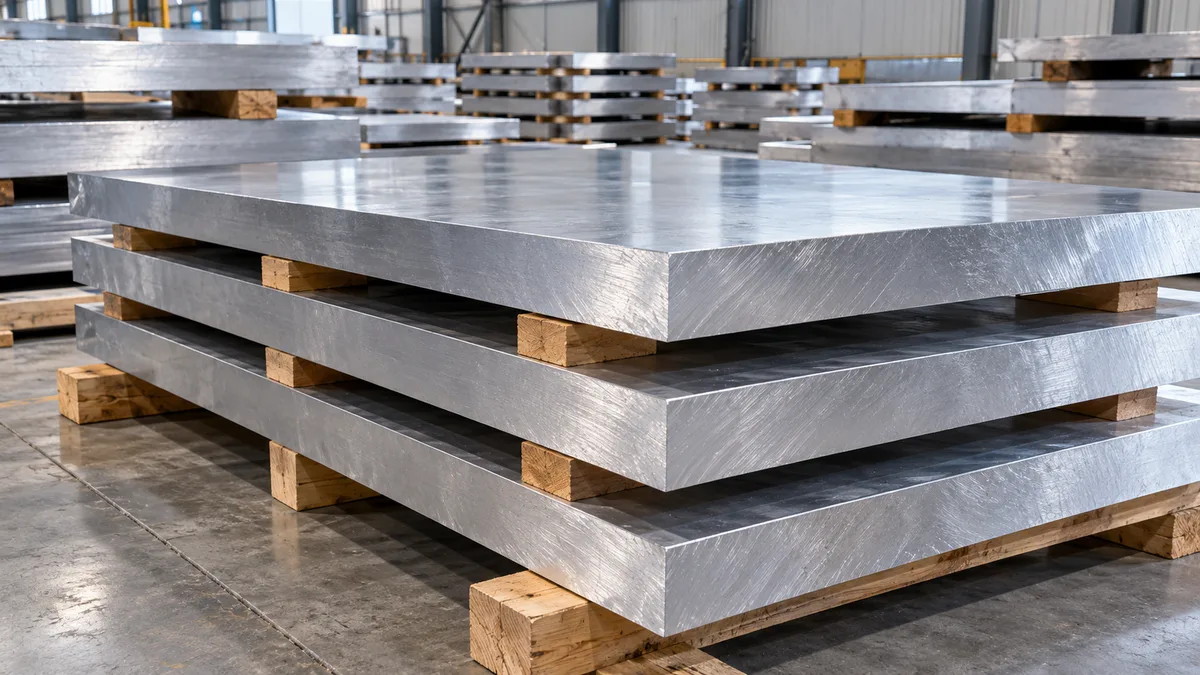
7010 was developed in the UK as a thick-plate aerospace alloy. Like 7050, it uses zirconium rather than chromium to control grain structure. Zirconium makes the alloy far less sensitive to quench rate than 7075, so the centre of a thick plate keeps most of the strength and toughness of the surface.
The alloy is supplied in over-aged T7-type tempers that trade a small amount of peak strength for much better resistance to stress-corrosion cracking and exfoliation. T7451 offers the best stress-corrosion resistance in thick sections, T7651 gives higher strength with good exfoliation resistance, and T7351 is the most over-aged and corrosion-resistant condition.
Because the plates are stretched after quenching (the "51" in each temper), residual stresses are low and parts machined from them distort very little. That makes 7010 a natural choice for monolithic machined parts: wing ribs, spar sections, fuselage frames, bulkheads and landing-gear support structure cut from plates 50–150 mm thick.
Registered limits for 7010 / EN AW-7010. The nominal composition named in AMS 4204 is 6.2 Zn – 1.8 Cu – 2.4 Mg – 0.13 Zr.
| Element | Minimum | Maximum | Role |
|---|---|---|---|
| Zinc (Zn) | 5.7 | 6.7 | Main strengthening element (with Mg) |
| Magnesium (Mg) | 2.1 | 2.6 | Forms MgZn2 precipitates |
| Copper (Cu) | 1.5 | 2.0 | Strength and stress-corrosion resistance |
| Zirconium (Zr) | 0.10 | 0.16 | Grain control, low quench sensitivity |
| Silicon (Si) | — | 0.12 | Kept low for toughness |
| Iron (Fe) | — | 0.15 | Kept low for toughness |
| Manganese (Mn) | — | 0.10 | |
| Chromium (Cr) | — | 0.05 | Deliberately low |
| Nickel (Ni) | — | 0.05 | |
| Titanium (Ti) | — | 0.06 | Grain refiner |
| Others, each / total | — | 0.05 / 0.15 | |
| Aluminium (Al) | Remainder |
An earlier version of this page gave copper as 0.1 % maximum and zinc as 5.2–6.2 %, with vanadium. Those figures do not describe 7010; the table above shows the registered limits.
Values below are approximate typical figures for plate around 50–100 mm thick, given to compare tempers. Specified minimums in AMS 4203/4204/4205 and EN 485-2 vary with thickness and test direction (L, LT, ST) and fall as plate gets thicker. Design to the specification minimums shown on the certificate.
| Temper | Tensile strength (L) | Yield strength (L) | Elongation | Main benefit |
|---|---|---|---|---|
| T7651 | ≈ 520 – 540 MPa | ≈ 460 – 480 MPa | ≈ 8 % | Highest strength, good exfoliation resistance |
| T7451 | ≈ 500 – 520 MPa | ≈ 430 – 450 MPa | ≈ 8 – 9 % | Best balance of strength, toughness and SCC resistance |
| T7351 | ≈ 470 – 490 MPa | ≈ 390 – 410 MPa | ≈ 9 % | Maximum stress-corrosion resistance |
Solution treated, stretched and over-aged for high stress-corrosion resistance. The default for thick machined parts loaded in the short-transverse direction.
Less over-aged than T7451 for higher strength, with good exfoliation resistance. Used for wing skins and parts where strength governs. AMS 4204 covers 6.35–139.7 mm.
The most over-aged temper, with the highest stress-corrosion resistance and lower strength. Used where SCC risk is the deciding factor.
Electrical conductivity testing is a fast way to confirm the degree of over-ageing. Each temper has a conductivity window in the specification, and it is checked on every plate.
| System | Designation / specification |
|---|---|
| SAE AMS | AMS 4203 (T7351), AMS 4204 (T7651), AMS 4205 (T7451) |
| European (EN) | EN AW-7010 [AlZn6MgCu]; plate to EN 485-1/-2/-4; aerospace EN 2xxx/4xxx series where called up |
| UNS | A97010 |
| Airframe OEM specifications | Many OEMs issue their own 7010 plate specifications; tell us the document and revision |
| Inspection | Ultrasonic testing to AMS-STD-2154 or ASTM B594, typically class A or AA for thick plate |
7010 weighs 2.82 kg per square metre for each millimetre of thickness.
| Thickness (mm) | kg per m² | 1,250 × 2,500 mm plate (kg) |
|---|---|---|
| 10 | 28.2 | 88 |
| 20 | 56.4 | 176 |
| 25 | 70.5 | 220 |
| 40 | 112.8 | 352 |
| 50 | 141.0 | 441 |
| 75 | 211.5 | 661 |
| 100 | 282.0 | 881 |
| 125 | 352.5 | 1102 |
| 150 | 423.0 | 1322 |
Excellent. High-speed milling with carbide tools gives fast metal removal; stretched tempers keep thin-walled parts flat.
Not fusion-welded in aerospace structures because of hot cracking and strength loss. Friction stir welding is possible but must be qualified.
Anodise (sulphuric or boric-sulphuric) and prime. The alloy is not clad, so finished parts always need a protective system.
Limited at room temperature in T7 tempers. Creep or age forming is used for contoured skins.
| Property | 7010-T7451 | 7050-T7451 | 7075-T7351 | 7475-T7351 |
|---|---|---|---|---|
| Quench sensitivity | Low | Low | High | Medium |
| Strength in thick plate | High | High | Medium | Medium |
| Fracture toughness | High | High | Medium | Very high |
| Stress-corrosion resistance | High | High | Very high | Very high |
| Main user base | Europe | Global | Global | Damage-tolerant parts |
7010 and 7050 are close substitutes, and the choice is often set by the airframe programme. 7075-T7351 loses more strength in thick sections, while 7475 is chosen for damage-tolerant skins rather than thick machined parts.
Both are zirconium-bearing Al-Zn-Mg-Cu thick-plate alloys with similar strength, toughness and stress-corrosion resistance. 7050 has more copper (2.0–2.6 %) and slightly less magnesium; 7010 is more common on European programmes. They are not interchangeable without design approval.
T7451 for thick machined parts that see short-transverse loads, T7651 where higher strength and exfoliation resistance are the priority, and T7351 where stress-corrosion resistance must be maximised.
Typically from about 6 mm up to around 200 mm. AMS 4204 (T7651) covers 6.35–139.7 mm; other specifications cover thicker plate.
It is not fusion-welded in aircraft structure. Parts are machined from solid and joined with fasteners.
Chemistry, tensile tests, electrical conductivity and ultrasonic inspection, reported on an EN 10204 3.1 certificate.
Send the temper, specification, thickness and quantity. We will reply with availability, certification and a delivered price.





