T77
A three-step ageing treatment: a conventional low-temperature age, a short high-temperature "retrogression" step, then re-ageing. It combines near-peak strength with corrosion resistance close to overaged tempers.



7055 is one of the strongest commercial aluminium plate alloys, developed for compression-dominated upper wing skins and stringers on large aircraft. In the T7751 temper it gives yield strength above 600 MPa together with useful exfoliation and stress-corrosion resistance. Metline supplies 7055-T7751 plate to AMS 4206 and matching T77511 extrusions to AMS 4337, with full certification, to aerospace buyers worldwide.
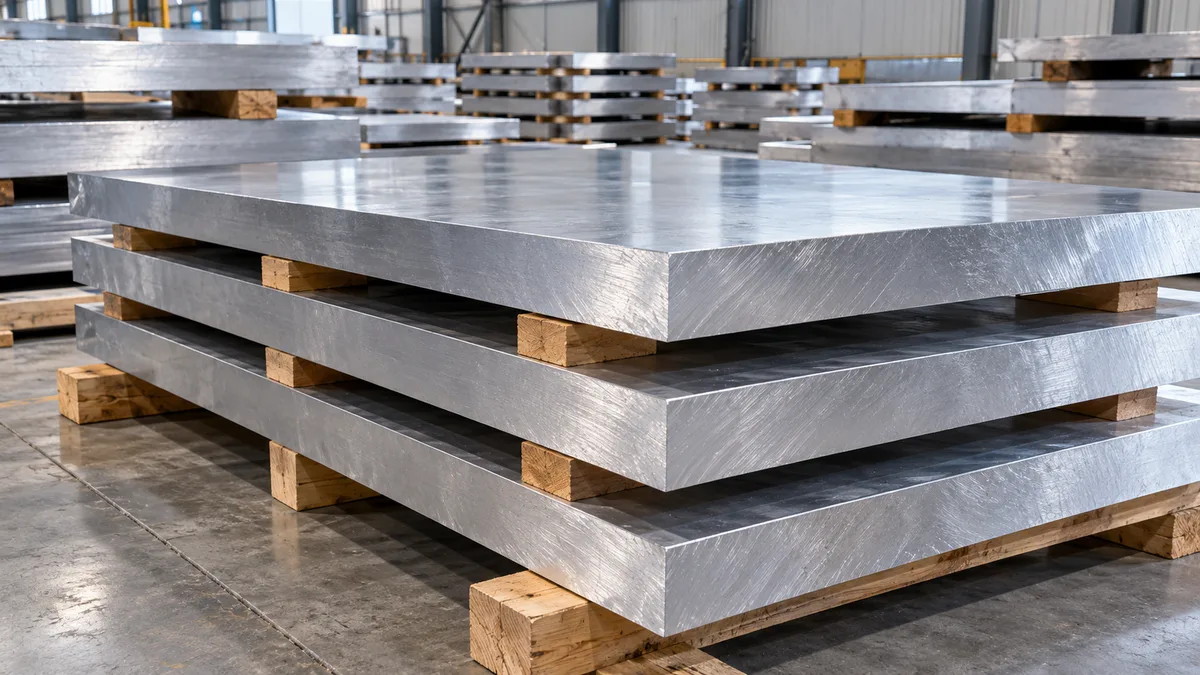
An aircraft wing bends upward in flight, so the upper skin and its stringers are loaded mainly in compression while the lower skin is in tension. Upper-wing structure is therefore sized by compressive yield strength and stability, and every gain in strength lets the designer use a thinner, lighter skin. 7055 was developed specifically for this job.
The alloy raises zinc to about 8 % with roughly 2.3 % copper and 2 % magnesium, and uses zirconium for grain control. The high solute content gives very high strength, and the T77 temper, a multi-step retrogression-and-re-ageing treatment, recovers much of the corrosion resistance that peak-aged high-zinc alloys normally lack. The result is strength above 7150-T651 with exfoliation resistance comparable to overaged tempers.
7055-T7751 plate and T77511 extrusions entered service on the Boeing 777 upper wing skins and stringers and have since been used on other large commercial aircraft. They are specialised products: buyers usually order them against a specific aircraft-manufacturer specification and part programme.
Registered Aluminum Association limits, used by AMS 4206 and AMS 4337. Manganese is limited to 0.05 % maximum; some published tables wrongly show 0.50 %.
| Element | Minimum | Maximum | Role in the alloy |
|---|---|---|---|
| Silicon (Si) | — | 0.10 | Held very low for toughness |
| Iron (Fe) | — | 0.15 | Held very low |
| Copper (Cu) | 2.0 | 2.6 | Strength and stress-corrosion resistance |
| Manganese (Mn) | — | 0.05 | Residual |
| Magnesium (Mg) | 1.8 | 2.3 | Forms MgZn2 with zinc |
| Chromium (Cr) | — | 0.04 | Kept low; zirconium controls grain structure |
| Zinc (Zn) | 7.6 | 8.4 | Main strengthening element; the highest of the common 7xxx plate alloys |
| Titanium (Ti) | — | 0.06 | Grain refiner |
| Zirconium (Zr) | 0.08 | 0.25 | Grain control and low quench sensitivity |
| Others, each / total | — | 0.05 / 0.15 | |
| Aluminium (Al) | Remainder | About 86.1 – 88.5 % |
Values are approximate typical figures for plate within the AMS 4206 thickness range, in the longitudinal direction. Specification minimums are lower and are set by thickness and test direction; compressive yield strength, which drives upper-wing design, is also reported in aircraft-manufacturer specifications.
| Product | Tensile strength (typical) | Yield strength (typical) | Elongation (typical) |
|---|---|---|---|
| 7055-T7751 plate (AMS 4206) | About 640 MPa / 93 ksi | About 610 MPa / 89 ksi | About 10 % |
| 7055-T77511 extrusions (AMS 4337) | About 650 MPa | About 620 MPa | About 10 % |
| For comparison: 7075-T651 plate | 570 MPa | 505 MPa | 11 % |
Some sources quote 7055 yield strength as 480 – 510 MPa. That is well below typical values for the T7751 temper and should not be used.
A three-step ageing treatment: a conventional low-temperature age, a short high-temperature "retrogression" step, then re-ageing. It combines near-peak strength with corrosion resistance close to overaged tempers.
The plate is stretched about 1.5 – 3 % after quenching to relieve residual stress, so it stays flat during machining of integrally stiffened panels.
Peak-aged high-zinc alloys have poor exfoliation and stress-corrosion resistance. For a wing skin that sees moisture and fuel for decades, the T77 temper is essential.
7055 is produced on a limited basis by specialised aerospace rolling mills, so availability and timing should be confirmed for each enquiry.
Machines like other high-strength 7xxx alloys: sharp carbide, high speed, flood coolant. Balance material removal between faces to control distortion on thin-skinned panels.
Wing-skin contours are produced by age forming or shot-peen forming under qualified processes; cold bending capacity is limited.
Not weldable by arc processes. Panels are fastened and sealed into the wing box.
Anodise or conversion coat and prime; fastener holes are typically sealed and many are cold expanded for fatigue life.
7055 is not a general engineering alloy. It is not used for engine hot-section parts or turbine components, and claims of good weldability or "several times" the corrosion resistance of ordinary alloys are not supported.
| Property | 7055-T7751 | 7150-T7751 | 7075-T651 | 7050-T7451 |
|---|---|---|---|---|
| Typical yield strength | About 610 MPa | About 570 MPa | 505 MPa | 469 MPa |
| Exfoliation resistance | Good | Good | Poor | Good |
| Fracture toughness | Moderate | Moderate–good | Moderate | Good |
| Typical role | Upper wing skin and stringers | Upper wing structure | General high-strength parts | Thick machined structure |
7055 is the right choice only where compressive strength drives the design. For thick machined parts, 7050-T7451 is tougher and more widely available; for general high-strength parts, 7075 remains cheaper.
Typical tensile strength is about 640 MPa and yield about 610 MPa in the longitudinal direction, making it one of the strongest aluminium plate products in commercial use.
Mainly upper wing skins and stringers, where compressive strength sets the thickness. It also appears in horizontal stabilisers and other compression-critical structure.
AMS 4206 covers 7055-T7751 plate from 0.500 to 1.500 in thick. AMS 4337 covers T77511 extruded profiles.
No, not by conventional arc welding. Like other high-zinc 7xxx alloys it is joined mechanically.
It is much stronger and has better exfoliation resistance in T7751, but it is more expensive, less tough and less available. It is chosen only where its strength is needed.
Send thickness, size, specification and quantity. Our team will confirm availability, certification and a delivered price.





