7150-T7751
Solution heat-treated, stretched 1.5 – 3 % and aged by the three-step T77 process. AMS 4252 covers plate 0.250 – 3.000 in (6.35 – 76.2 mm). Choose it for new designs and for parts exposed to moisture.



7150 is a high-strength, high-purity Al-Zn-Mg-Cu-Zr plate alloy developed from 7050 for compression-loaded aircraft structure such as upper wing skins and spar caps. Metline supplies 7150 plate in the T7751 and T6151 tempers to SAE AMS 4252 and AMS 4306, with full mill certification, to aerospace manufacturers and MRO shops worldwide.
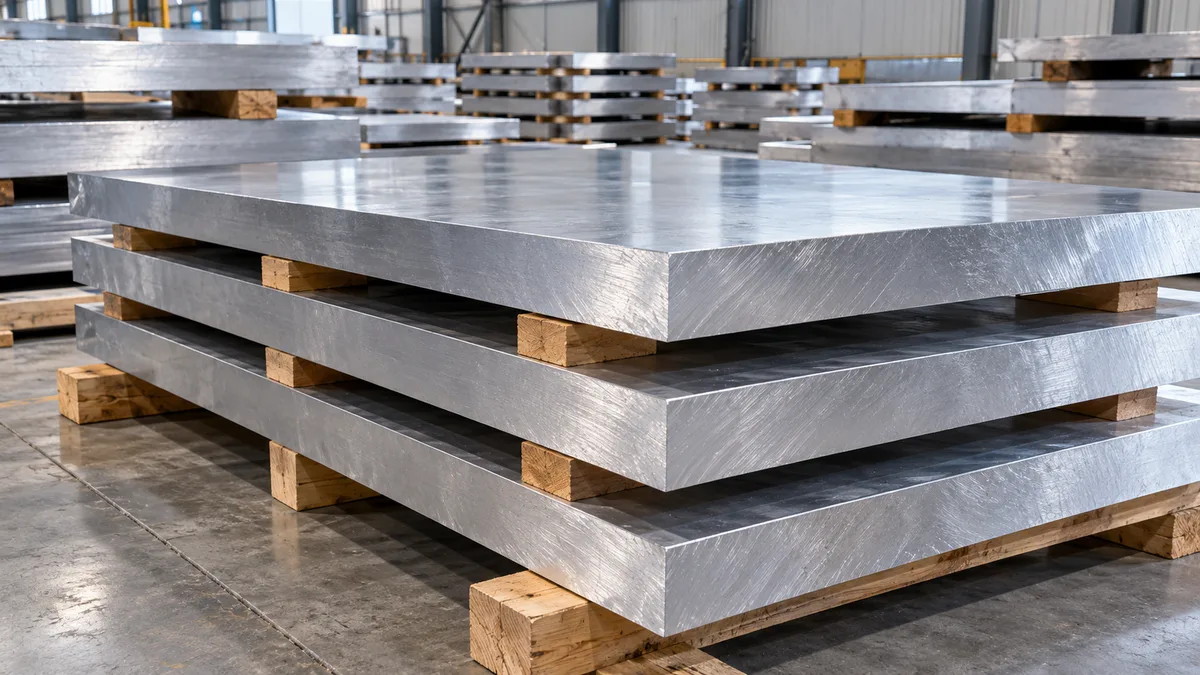
Upper wing skins and stringers are loaded mainly in compression as the wing bends upward in flight. For those parts compressive yield strength matters more than damage tolerance, so the industry developed 7150: 7050 chemistry with slightly more zinc and magnesium and tighter iron and silicon limits, giving more strength without losing toughness.
7150 uses zirconium rather than chromium for grain control, like 7050. Zirconium keeps the plate unrecrystallised and makes it less sensitive to quench rate, so plate several centimetres thick still reaches high strength in the centre. Low iron and silicon reduce the coarse particles that start fatigue cracks and lower toughness.
Two tempers matter. T6151 is the peak-aged, stretched condition introduced first and used on upper-wing structure of jet airliners. T7751 came later: a three-step ageing treatment that keeps strength close to T6151 while raising exfoliation and stress-corrosion resistance. Most current designs and many replacement parts use T7751.
Limits are the registered Aluminum Association values for 7150 (UNS A97150), as used in AMS 4252. The AMS title gives the nominal chemistry, 6.4 Zn - 2.4 Mg - 2.2 Cu - 0.12 Zr.
| Element | Minimum | Maximum | Role in the alloy |
|---|---|---|---|
| Silicon (Si) | — | 0.12 | Kept very low for toughness |
| Iron (Fe) | — | 0.15 | Kept very low; fewer coarse particles |
| Copper (Cu) | 1.9 | 2.5 | Strength and SCC resistance |
| Manganese (Mn) | — | 0.10 | Minor |
| Magnesium (Mg) | 2.0 | 2.7 | Forms MgZn2 precipitates |
| Chromium (Cr) | — | 0.04 | Kept low; zirconium does grain control |
| Zinc (Zn) | 5.9 | 6.9 | Main strengthening element |
| Titanium (Ti) | — | 0.06 | Grain refiner |
| Zirconium (Zr) | 0.08 | 0.15 | Prevents recrystallisation; lowers quench sensitivity |
| Others, each / total | — | 0.05 / 0.15 | |
| Aluminium (Al) | Remainder |
Some sales sheets list a 7150 chemistry with chromium at 0.18 – 0.28 % and no zirconium. That describes a 7075-type alloy, not 7150; check the certificate shows Zr and a chromium maximum of 0.04 %.
Minimum properties in AMS 4252 and AMS 4306 are set by thickness band and test direction, and design allowables are published in MMPDS. The comparison below shows approximate typical values for plate around 25 mm thick so the alloys can be ranked; it is not design data.
| Property (approx. typical) | 7150-T7751 | 7150-T6151 | 7050-T7451 | 7075-T651 |
|---|---|---|---|---|
| Tensile strength | About 600 MPa | About 600 MPa | About 525 MPa | About 570 MPa |
| Yield strength (0.2 %) | About 560 MPa | About 560 MPa | About 470 MPa | About 505 MPa |
| Elongation | About 10 % | About 10 % | About 11 % | About 11 % |
| Exfoliation resistance | Good (EB) | Moderate | Very good | Poor |
| SCC resistance, ST | Good | Moderate | Very good | Low |
| Fracture toughness | Good | Good | Very good | Moderate |
Solution heat-treated, stretched 1.5 – 3 % and aged by the three-step T77 process. AMS 4252 covers plate 0.250 – 3.000 in (6.35 – 76.2 mm). Choose it for new designs and for parts exposed to moisture.
Solution heat-treated, stretched and artificially aged to near-peak strength. Covered by AMS 4306. Used where the drawing calls for it; exfoliation resistance is lower than T7751.
T77 tempers use a three-step ageing cycle (age, brief high-temperature retrogression, re-age). The result keeps strength close to peak-aged T6 while giving exfoliation and stress-corrosion resistance close to the over-aged T76 condition.
Old data sheets mention 7150 in O or T651 for general engineering. These are not aerospace plate tempers; for general machining plate see our 7075 or 7050 plate pages instead.
| Specification / system | Covers |
|---|---|
| SAE AMS 4252 | 7150-T7751 plate, 0.250 – 3.000 in thick |
| SAE AMS 4306 | 7150-T6151 plate |
| SAE AMS 4345 | 7150-T77511 extrusions (for stringers to match plate skins) |
| Aluminum Association / UNS | 7150 / A97150 |
| EN designation | EN AW-7150 (AlZn6CuMgZr), used in aerospace EN specifications |
Where an OEM material specification is listed on the drawing, it controls. Send it with the enquiry so we can confirm the supplier holds the required approval.
Plate weight is 2.82 kg per m² for every millimetre of thickness:
| Thickness (mm) | kg per m² | 1000 × 2000 mm piece (kg) | 1250 × 2500 mm piece (kg) |
|---|---|---|---|
| 6.35 | 17.9 | 35.8 | 56.0 |
| 10 | 28.2 | 56.4 | 88.1 |
| 12.7 | 35.8 | 71.6 | 111.9 |
| 16 | 45.1 | 90.2 | 141.0 |
| 20 | 56.4 | 112.8 | 176.2 |
| 25.4 | 71.6 | 143.3 | 223.8 |
| 30 | 84.6 | 169.2 | 264.4 |
| 38.1 | 107.4 | 214.9 | 335.8 |
| 50.8 | 143.3 | 286.5 | 447.7 |
| 63.5 | 179.1 | 358.1 | 559.6 |
| 76.2 | 214.9 | 429.8 | 671.5 |
Machines like 7050 and 7075 plate. Stretched tempers stay flat when skins and spar caps are pocketed from thick plate.
Wing skins are often shot-peen formed or age-formed to contour. Bend radii must be generous because elongation is about 10 %.
Not fusion-welded. Riveted or bolted; friction stir welding is used only in qualified applications.
Anodise or conversion coat, prime and seal. Keep heat exposure below about 120 °C to avoid further ageing.
Mainly compression-critical aircraft structure: upper wing skins, upper spar caps and stringers, and some fuselage keel and floor beams.
Both are stretched and aged. T6151 is aged close to peak strength. T7751 uses a three-step ageing cycle that keeps similar strength but gives better exfoliation and stress-corrosion resistance, so it is preferred for new parts.
7150 has slightly higher zinc and magnesium and tighter iron and silicon limits. It is stronger, especially in compression, while 7050 offers higher toughness and SCC resistance and is used for lower wing and thick fittings.
SAE AMS 4252, for plate 0.250 to 3.000 in (6.35 to 76.2 mm) thick. Airframe makers often add their own material specification.
Not by arc welding. Parts are riveted or bolted.
Yes. We can supply saw-cut blanks with the original mill certificate, shipped worldwide from Mumbai.
Send the temper, thickness, sizes and specification. We will confirm availability, testing and a delivered price.





