O / H111
Annealed for deep forming, spinning and dished tank heads. H111 carries a small amount of strain from levelling.



5454 is the aluminium-magnesium alloy engineers choose when a welded, corrosion-resistant structure will run warm. With magnesium held below 3 %, it can work continuously above 65 °C, where 5083 and 5086 risk sensitisation. Metline supplies 5454 sheet and plate in O, H111, H112, H22/H32 and H24/H34 tempers to ASTM B209 and legacy QQ-A-250/10, to customers worldwide.
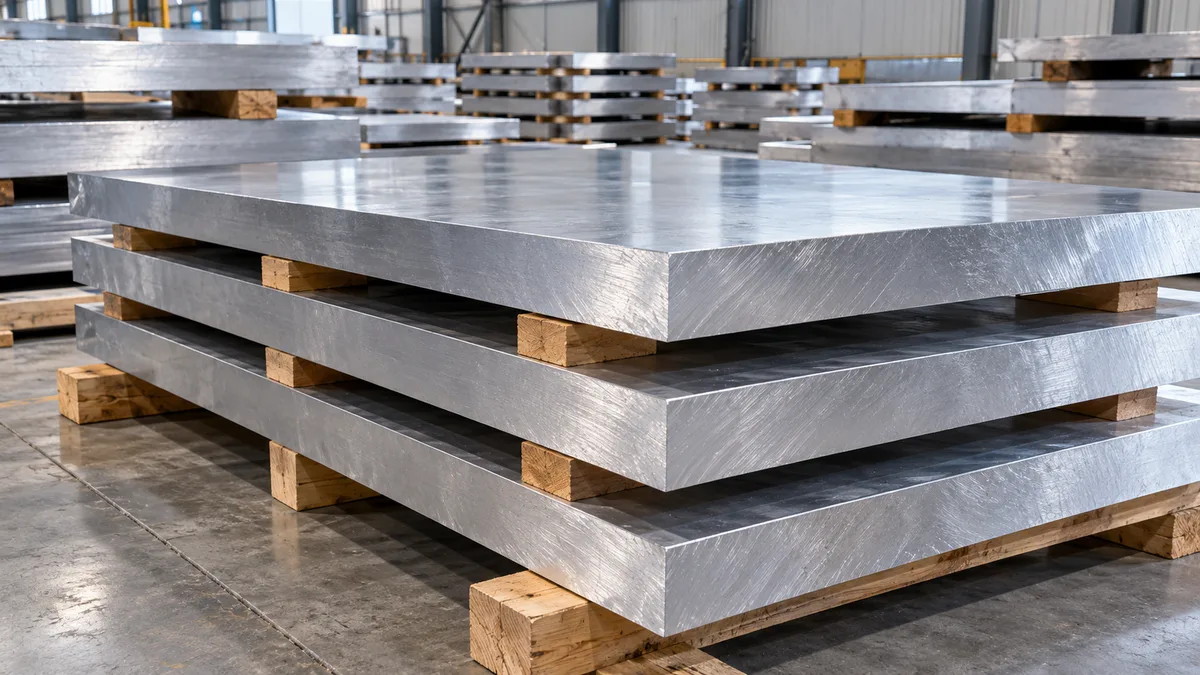
The strongest 5xxx alloys contain 4 – 5 % magnesium. That magnesium gives strength, but if the metal sits at moderately raised temperatures for long periods it can precipitate along grain boundaries and make the alloy vulnerable to intergranular and stress corrosion. 5454 was developed to avoid that: about 2.7 % magnesium with 0.5 – 1.0 % manganese gives the best strength available in an Al-Mg alloy that is safe for sustained warm service.
In aerospace, 5454 is a support-and-ground material rather than an airframe alloy. It is used for welded tanks and vessels that hold heated fluids, such as de-icing fluid heaters, hot-water and fuel-conditioning tanks; for ducting and enclosures near engines or exhausts on ground power units and test cells; for heat-exchanger shells; and for wheels, chassis members and bodies on airport vehicles and ground support equipment.
Its weldability is excellent, its strength is about 20 % higher than 5052, and it keeps good toughness. Where the structure always runs cool, 5083 or 5086 gives more strength; where it runs warm, 5454 is the safer specification.
| Element | Minimum | Maximum | Role in the alloy |
|---|---|---|---|
| Silicon (Si) | — | 0.25 | Impurity |
| Iron (Fe) | — | 0.40 | Impurity |
| Copper (Cu) | — | 0.10 | Kept low for corrosion resistance |
| Manganese (Mn) | 0.50 | 1.0 | Adds strength without raising sensitisation risk |
| Magnesium (Mg) | 2.4 | 3.0 | Strengthening element, held below 3 % |
| Chromium (Cr) | 0.05 | 0.20 | Grain control, stress-corrosion resistance |
| Zinc (Zn) | — | 0.25 | Impurity |
| Titanium (Ti) | — | 0.20 | Grain refiner |
| Others, each / total | — | 0.05 / 0.15 | |
| Aluminium (Al) | Remainder | About 94.5 – 97.1 % |
Registered Aluminum Association limits, followed by ASTM B209 and EN 573-3 (EN AW-5454, AlMg3Mn).
Specified minimums from ASTM B209 are what you design to; the thickness band changes the elongation requirement more than the strength.
| Temper | Thickness (mm) | Tensile strength (MPa) | Yield strength (MPa, min) | Elongation (min, %) |
|---|---|---|---|---|
| O | 0.50 – 80 | 215 – 285 | 85 | 12 – 18 (rises with thickness) |
| H32 / H22 | 0.50 – 50 | 250 – 305 | 180 | 5 – 12 |
| H34 / H24 | 0.50 – 25 | 270 – 325 | 200 | 4 – 10 |
| H112 | 6.3 – 12.5 | 220 min | 125 | 8 |
| H112 | 12.5 – 80 | 215 min | 85 | — |
| Temper | Typical tensile | Typical yield | Typical elongation | Brinell hardness |
|---|---|---|---|---|
| O | 250 MPa / 36 ksi | 117 MPa / 17 ksi | 22 % | About 62 HB |
| H32 | 276 MPa / 40 ksi | 207 MPa / 30 ksi | 10 % | About 73 HB |
| H34 | 303 MPa / 44 ksi | 241 MPa / 35 ksi | 10 % | About 81 HB |
Annealed for deep forming, spinning and dished tank heads. H111 carries a small amount of strain from levelling.
As rolled with guaranteed minimums. The usual condition for thicker plate cut into flanges, bases and machined fittings.
Quarter-hard. The standard temper for welded tank shells, ducting and panels; H22 is partly annealed and slightly more ductile.
Half-hard. Higher strength for flat panels and bodies with gentle bends.
5454 cannot be solution treated and aged. Claims that it can be hardened by heat treatment are wrong; strength comes from cold work.
Marine-tested H116 and H321 tempers under ASTM B928 apply to 5083, 5086 and 5456, not 5454, which does not need sensitisation testing.
| System | Designation / standard | Notes |
|---|---|---|
| ASTM / ASME | ASTM B209 (ASME SB-209) | Sheet and plate |
| US Federal (legacy) | QQ-A-250/10 | 5454 sheet and plate; superseded by ASTM B209 |
| UNS | A95454 | — |
| European | EN AW-5454 (AlMg3Mn), EN 485 | Sheet, strip and plate |
| German Werkstoff | 3.3537 | — |
| Japan | A5454P | JIS H4000 |
| Extrusions | ASTM B221, EN 755 | For matching profiles and tube |
| Thickness (mm) | kg per m² | 1220 × 2440 mm (kg) | 1500 × 3000 mm (kg) |
|---|---|---|---|
| 1 | 2.69 | 8.0 | 12.1 |
| 1.5 | 4.04 | 12.0 | 18.2 |
| 2 | 5.38 | 16.0 | 24.2 |
| 3 | 8.07 | 24.0 | 36.3 |
| 4 | 10.76 | 32.0 | 48.4 |
| 5 | 13.45 | 40.0 | 60.5 |
| 6 | 16.14 | 48.0 | 72.6 |
| 8 | 21.52 | 64.1 | 96.8 |
| 10 | 26.90 | 80.1 | 121.0 |
| 12 | 32.28 | 96.1 | 145.3 |
| 16 | 43.04 | 128.1 | 193.7 |
| 20 | 53.80 | 160.2 | 242.1 |
| 25 | 67.25 | 200.2 | 302.6 |
| 30 | 80.70 | 240.2 | 363.1 |
| 40 | 107.60 | 320.3 | 484.2 |
| 50 | 134.50 | 400.4 | 605.2 |
Weld with ER5554, which has a matching magnesium level and is recommended for warm service. ER5356 is acceptable for parts that run cool, as its 5 % magnesium deposit can sensitise above 65 °C.
O temper forms like 5052. H32 bends to about 1 – 1.5 × thickness in thin sheet; allow more for H34 and for plate.
Suitable for continuous service up to roughly 150 °C, with strength falling gradually as temperature rises.
Fair; harder tempers machine more cleanly. Sharp, polished carbide tools and good coolant prevent built-up edge.
How 5454 compares with neighbouring Al-Mg grades:
| Property | 5052-H32 | 5454-H32 | 5086-H32 | 5083-H321 |
|---|---|---|---|---|
| Typical tensile strength | 228 MPa | 276 MPa | 290 MPa | 317 MPa |
| Typical yield strength | 193 MPa | 207 MPa | 207 MPa | 228 MPa |
| Continuous service above 65 °C | Yes | Yes | No | No |
| Recommended filler | ER5356 | ER5554 | ER5356 | ER5183 |
A typical example is a de-icing truck: the heated fluid tank is welded from 5454-H32 plate with ER5554 filler, because the fluid is held warm for long periods and a 5083 tank would risk sensitisation.
Because it can run warm. 5083 has about 4.5 % magnesium and can become susceptible to intergranular and stress corrosion after long exposure above 65 °C. 5454, with under 3 % magnesium, is suitable for sustained elevated-temperature service.
No. It is strengthened by cold work only. Heat can anneal it or stabilise it, not harden it.
ER5554 is recommended, especially for warm service. ER5356 can be used for parts that stay below 65 °C.
Not in primary airframe structure. It is used in heated tanks, ground equipment, enclosures and vehicles that support aircraft operations.
It is the legacy US federal specification for 5454 plate and sheet. It has been superseded by ASTM B209, but older drawings still reference it.
Send the temper, size, quantity, specification and destination. We will reply with availability, certification and a delivered price.





