5086-O / H111
Annealed. Lowest strength and best formability, used for deep-formed tank heads, spun parts and pieces that will be bent tightly. H111 has a small amount of strain from levelling.



5086 is a non-heat-treatable aluminium-magnesium alloy with about 4 % magnesium, valued for weldability, toughness at low temperature and resistance to salt-laden air. In aerospace it is used for welded tanks, ground support equipment, shelters and launch-site structures rather than flight-critical airframe parts. Metline supplies 5086 sheet and plate in O, H111, H112, H32, H34, H116 and H321 tempers, certified to ASTM B209, ASTM B928 or legacy QQ-A-250/7, to buyers worldwide.
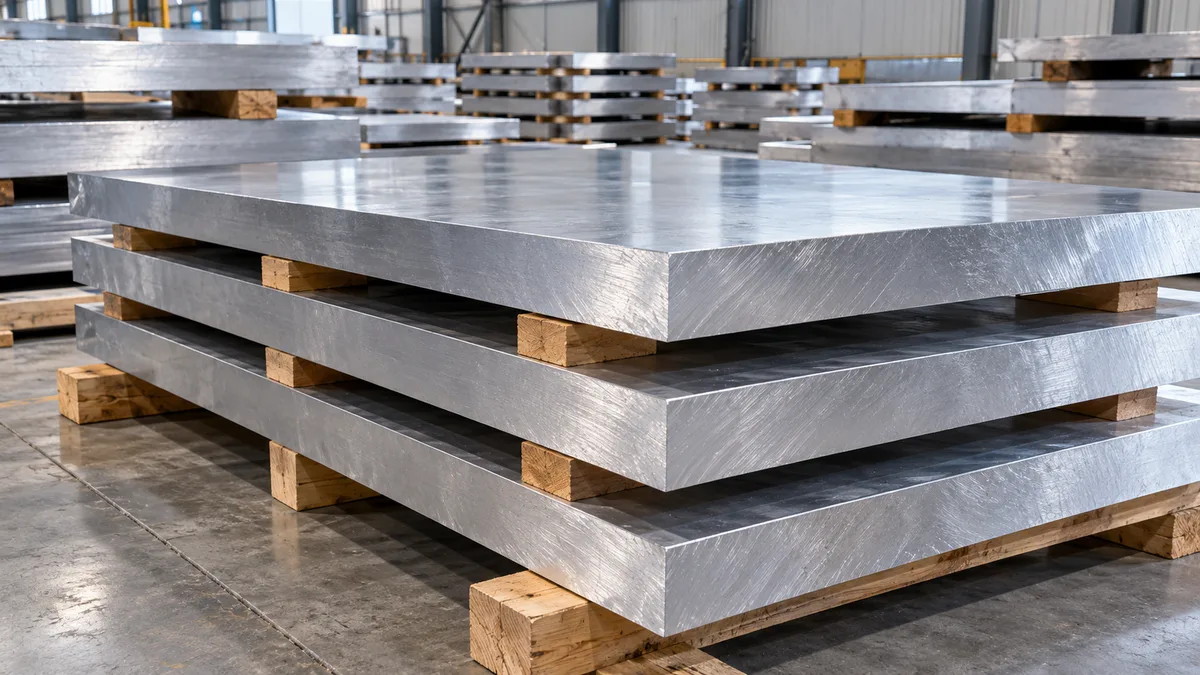
5086 sits between 5052 and 5083 in the 5xxx family. With 3.5 – 4.5 % magnesium it is noticeably stronger than 5052, yet a little more formable and slightly less prone to sensitisation than the higher-magnesium 5083 and 5456.
Airframe skins, spars and frames are made from heat-treatable 2xxx and 7xxx alloys, and 5086 is not a substitute for them. Its value is in structures that must be welded, that live outdoors or near the sea, or that must stay tough at cryogenic temperatures. Typical aerospace uses include welded tanks and pressure vessels on the ground, ground support equipment (GSE) such as stairs, platforms and towable carts, transportable shelters and equipment containers, radar and antenna enclosures, and structures at launch sites and naval air stations where salt spray is constant.
Because strength comes from cold work rather than precipitation hardening, 5086 keeps most of its strength through the heat of welding. A welded 5086-H32 assembly loses some of its strain-hardened strength in the heat-affected zone, but it does not fall to the very low values seen in welded 2024 or 7075. That property, together with good fatigue behaviour and no need for cladding, is the reason the alloy appears on so many support-equipment drawings.
Limits are the registered Aluminum Association values, followed by ASTM B209, ASTM B928 and EN 573-3 (EN AW-5086, AlMg4). The certificate supplied with each lot reports the actual analysis.
| Element | Minimum | Maximum | Role in the alloy |
|---|---|---|---|
| Silicon (Si) | — | 0.40 | Impurity |
| Iron (Fe) | — | 0.50 | Impurity; controlled for toughness |
| Copper (Cu) | — | 0.10 | Kept low to protect corrosion resistance |
| Manganese (Mn) | 0.20 | 0.7 | Adds strength and controls grain size |
| Magnesium (Mg) | 3.5 | 4.5 | Main strengthening element (solid solution) |
| Chromium (Cr) | 0.05 | 0.25 | Grain control; improves stress-corrosion resistance |
| Zinc (Zn) | — | 0.25 | Impurity |
| Titanium (Ti) | — | 0.15 | Grain refiner in the cast ingot |
| Others, each / total | — | 0.05 / 0.15 | |
| Aluminium (Al) | Remainder | About 93.0 – 96.3 % |
The first table summarises specified minimums from ASTM B209 and ASTM B928 for mid-range thicknesses; these are the numbers to design to. The second gives typical values, which are useful when comparing tempers. Exact limits depend on the thickness band and are printed on the mill certificate.
| Temper | Tensile strength (min) | Yield strength 0.2 % (min) | Elongation (min, typical band) |
|---|---|---|---|
| O / H111 | 240 – 305 MPa (35 – 44 ksi) | 95 MPa (14 ksi) | 15 – 18 % |
| H112 (6.3 – 12.5 mm) | 250 MPa (36 ksi) | 125 MPa (18 ksi) | 8 % |
| H32 | 275 – 325 MPa (40 – 47 ksi) | 195 MPa (28 ksi) | 6 – 12 % |
| H34 | 300 – 345 MPa (44 – 50 ksi) | 235 MPa (34 ksi) | 4 – 10 % |
| H116 / H321 (ASTM B928) | 275 MPa (40 ksi) | 195 MPa (28 ksi) | 8 – 10 % |
| Temper | Typical tensile | Typical yield | Typical elongation | Brinell hardness |
|---|---|---|---|---|
| O | 262 MPa / 38 ksi | 117 MPa / 17 ksi | 22 % | About 65 HB |
| H112 | 270 MPa / 39 ksi | 130 MPa / 19 ksi | 14 % | About 65 HB |
| H32 / H116 | 290 MPa / 42 ksi | 207 MPa / 30 ksi | 12 % | About 78 HB |
| H34 | 324 MPa / 47 ksi | 255 MPa / 37 ksi | 10 % | About 85 HB |
Harder tempers such as H36 and H38 exist in the standards but are rarely rolled as plate; they are mainly made as thin sheet and strip.
Annealed. Lowest strength and best formability, used for deep-formed tank heads, spun parts and pieces that will be bent tightly. H111 has a small amount of strain from levelling.
As hot rolled with guaranteed minimum properties. Common for thick plate that will be machined into flanges, bases and fittings.
Strain-hardened and stabilised to quarter-hard. The general-purpose temper for welded structures, panels and GSE frames.
Half-hard and stabilised. Higher strength for panels and covers that are not formed severely; allow larger bend radii than H32.
Special marine temper tested to ASTM G66 and G67 for resistance to exfoliation and intergranular attack. Specify it for equipment exposed to sea spray.
Stabilised temper with controlled cold work, also tested for corrosion resistance under ASTM B928. Often treated as interchangeable with H116 for plate.
Many aerospace drawings still call the US federal specification QQ-A-250/7, which was cancelled for new design and replaced by ASTM B209. Corrosion-tested H116 and H321 plate is ordered to ASTM B928. Tell us exactly which document and revision appears on your drawing, and we will supply and certify to it.
| System | Designation / standard | Notes |
|---|---|---|
| ASTM / ASME | ASTM B209 (ASME SB-209) | General sheet and plate |
| ASTM | ASTM B928 | High-magnesium sheet and plate for marine and similar service (H116, H321) |
| US Federal (legacy) | QQ-A-250/7 | 5086 sheet and plate; superseded by ASTM B209 |
| UNS | A95086 | — |
| European | EN AW-5086 (AlMg4), EN 485 | Sheet, strip and plate |
| German Werkstoff | 3.3545 | — |
| ISO | AlMg4 | ISO 6361 |
| Japan | A5086P | JIS H4000 |
| China | 5086 | GB/T 3880 |
Ask for H116 or H321 by name if the part is exposed to sea spray. An H32 certificate does not include the ASTM G66/G67 corrosion tests.
5086 weighs 2.66 kg per square metre for every millimetre of thickness. Use the table for quick estimates or the plate weight calculator for any size.
| Thickness (mm) | kg per m² | 1220 × 2440 mm (kg) | 1500 × 3000 mm (kg) |
|---|---|---|---|
| 1 | 2.66 | 7.9 | 12.0 |
| 1.5 | 3.99 | 11.9 | 18.0 |
| 2 | 5.32 | 15.8 | 23.9 |
| 3 | 7.98 | 23.8 | 35.9 |
| 4 | 10.64 | 31.7 | 47.9 |
| 5 | 13.30 | 39.6 | 59.9 |
| 6 | 15.96 | 47.5 | 71.8 |
| 8 | 21.28 | 63.3 | 95.8 |
| 10 | 26.60 | 79.2 | 119.7 |
| 12 | 31.92 | 95.0 | 143.6 |
| 16 | 42.56 | 126.7 | 191.5 |
| 20 | 53.20 | 158.4 | 239.4 |
| 25 | 66.50 | 198.0 | 299.2 |
| 30 | 79.80 | 237.5 | 359.1 |
| 40 | 106.40 | 316.7 | 478.8 |
| 50 | 133.00 | 395.9 | 598.5 |
| 60 | 159.60 | 475.1 | 718.2 |
| 80 | 212.80 | 633.5 | 957.6 |
| 100 | 266.00 | 791.8 | 1197.0 |
For aerospace customers who need source inspection, we can arrange independent witness testing before shipment, provided this is stated at the enquiry stage.
Excellent by MIG and TIG. ER5356 is the usual filler; ER5183 gives slightly higher weld strength in thick sections. Do not use ER4043, which gives brittle, low-ductility welds on high-magnesium alloys.
O and H111 bend tightly. H32 accepts inside radii of roughly 1 – 2 × thickness in thin sheet; H34 needs more. Bend across the rolling direction where you can.
Fair. Soft tempers tend to be gummy; H32, H34 and H112 machine more cleanly. Use sharp, polished carbide tools with high positive rake and plenty of coolant.
Avoid long service above about 65 °C. Prolonged heat can precipitate a magnesium-rich phase along grain boundaries (sensitisation) and make the alloy prone to intergranular and stress corrosion. For warm parts choose 5454.
Strength and toughness rise as temperature falls, so 5086 is a good choice for welded tanks and lines handling cryogenic liquids on the ground.
Can be anodised, though the film looks slightly greyer than on 6xxx alloys. Painted systems need a suitable pretreatment and primer.
A typical example is a towable aircraft maintenance platform: the deck is 5086-H32 tread plate, the welded side frames are 5086-H112 plate and extrusions, and all joints are welded with ER5356. The whole unit can stand outdoors on a coastal flight line for years without paint.
| Property | 5052-H32 | 5086-H32 | 5083-H116 | 5456-H116 | 6061-T6 |
|---|---|---|---|---|---|
| Typical tensile strength | 228 MPa | 290 MPa | 317 MPa | 351 MPa | 310 MPa |
| Typical yield strength | 193 MPa | 207 MPa | 228 MPa | 255 MPa | 276 MPa |
| Heat treatable | No | No | No | No | Yes |
| As-welded strength retention | Very good | Very good | Very good | Very good | Fair (HAZ softening) |
| Seawater resistance | Very good | Excellent | Excellent | Excellent | Good |
| Service above 65 °C | Acceptable | Avoid | Avoid | Avoid | Acceptable |
| Formability | Very good | Good | Fair | Fair | Fair in T6 |
Choose 5052 for thin, heavily formed sheet; 5086 when you need more strength with good formability; 5083 or 5456 when welded strength is the priority; and 6061 when the part will be machined heavily or must run warm. See the general 5086 sheet and plate page for industrial grades.
No. Primary airframe structure uses heat-treatable 2xxx and 7xxx alloys. 5086 is chosen for welded tanks, ground support equipment, shelters, containers and outdoor structures where corrosion resistance and weldability matter more than peak strength.
Both have similar strength. H116 is a special temper that must pass ASTM G66 exfoliation and G67 intergranular corrosion tests under ASTM B928, so it is the right choice for equipment exposed to seawater or sea spray. H32 has no corrosion test requirement.
No. It is strengthened only by cold work. Heat can anneal it to the O temper or stabilise a strain-hardened temper, but it cannot be solution treated and aged like 6061.
ER5356 is standard and ER5183 is used where higher weld strength is needed in thick plate. Avoid ER4043 on 5086.
It was cancelled for new design and replaced by ASTM B209, but many existing drawings still cite it. We can supply material that meets the requirements on your drawing and certify it accordingly.
With about 4 % magnesium, long exposure to moderate heat can form a continuous magnesium-rich phase on grain boundaries, which makes the alloy susceptible to intergranular and stress corrosion. 5454 is the usual alternative for warm service.
Send the temper, size, quantity, specification and destination. We will reply with availability, certification and a delivered price.





