O / H111
Annealed. Best for tank heads, spun and pressed parts and tight bends. H111 has a small amount of strain hardening from flattening.



5454 is the aluminium-magnesium plate to choose when a marine structure or tank runs warm. With magnesium held below 3 %, it keeps its resistance to intergranular corrosion above 65 °C, where 5083 and 5456 can become sensitised, while still welding well and resisting seawater. Metline supplies 5454 sheet and plate in O, H111, H32, H34 and H112, cut to size and certified, worldwide.
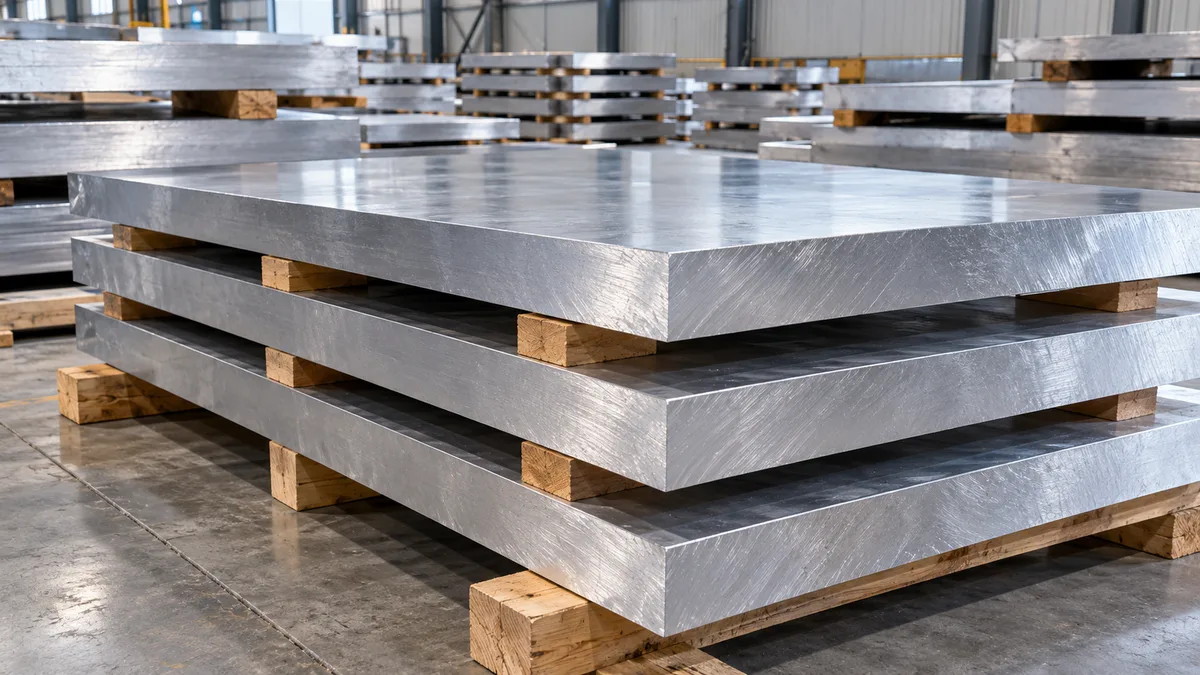
5454 contains 2.4 – 3.0 % magnesium and 0.5 – 1.0 % manganese. That chemistry was set deliberately: enough magnesium and manganese for useful strength, but not so much magnesium that the alloy forms continuous grain-boundary films of β-phase (Al3Mg2) during long exposure to heat.
This matters on ships because many structures run warm. Fuel tanks next to engines, engine-room casings, exhaust trunk surrounds, heated cargo and asphalt tanks, and hot-water and process tanks on offshore and fishing vessels can sit above 65 °C for years. Alloys with more than about 3 % magnesium, including 5083 and 5456, can become sensitised in those conditions and then suffer intergranular or stress-corrosion cracking in seawater. 5454 is the standard answer.
The price of that heat tolerance is lower strength: 5454-O has a minimum tensile strength of 215 MPa against 275 MPa for 5083-O. For cool hull plating, 5083 or 5383 remains the normal choice, and 5454 is not listed for rolled hull plate in IACS UR W25. Designers therefore use 5454 selectively, for the warm parts of a vessel and for tanks, rather than for the whole hull.
| Element | Minimum | Maximum | Role |
|---|---|---|---|
| Silicon (Si) | — | 0.25 | Impurity |
| Iron (Fe) | — | 0.40 | Impurity |
| Copper (Cu) | — | 0.10 | Held low for corrosion resistance |
| Manganese (Mn) | 0.50 | 1.0 | Adds strength without heat sensitivity |
| Magnesium (Mg) | 2.4 | 3.0 | Strength; kept below 3 % to avoid sensitisation |
| Chromium (Cr) | 0.05 | 0.20 | Grain control, stress-corrosion resistance |
| Zinc (Zn) | — | 0.25 | Impurity |
| Titanium (Ti) | — | 0.20 | Grain refiner |
| Others, each / total | — | 0.05 / 0.15 | |
| Aluminium (Al) | Remainder | About 94.5 – 96.9 % |
Registered Aluminum Association limits, used in ASTM B209 and EN 573-3 (EN AW-5454, AlMg3Mn).
Specified values from ASTM B209 for the thickness bands most used in marine work; EN 485-2 values are very close. Elongation minimums depend on thickness and are shown on the mill certificate.
| Temper | Thickness | Tensile strength Rm | Proof Rp0.2 (min) | Elongation (min) |
|---|---|---|---|---|
| O / H111 | up to 80 mm | 215 – 285 MPa | 85 MPa | 12 – 18 % |
| H32 / H22 | up to about 50 mm | 250 – 305 MPa | 180 MPa | 5 – 12 % |
| H34 / H24 | up to about 25 mm | 270 – 325 MPa | 200 MPa | 4 – 10 % |
| H112 | 6.3 – 12.5 mm | ≥ 220 MPa | 125 MPa | 8 % |
| H112 | 12.5 – 75 mm | ≥ 215 MPa | 85 MPa | 12 % |
| Temper | Typical tensile | Typical proof | Typical elongation | Brinell |
|---|---|---|---|---|
| O | 250 MPa | 115 MPa | 22 % | 62 HB |
| H32 | 275 MPa | 205 MPa | 10 % | 73 HB |
| H34 | 305 MPa | 240 MPa | 10 % | 81 HB |
Annealed. Best for tank heads, spun and pressed parts and tight bends. H111 has a small amount of strain hardening from flattening.
Quarter-hard and stabilised. The most common temper for welded tanks and panels: stronger than O but still bends readily.
Half-hard and stabilised for stiffer panels that see little forming.
Strain-hardened then partially annealed. Similar strength to H32/H34 with slightly better formability.
As rolled, for thicker plate (above about 6 mm) used for machined flanges and heavy doublers.
The weld zone returns to roughly O-temper strength, so design welded joints to O-temper allowables whatever temper is purchased.
5454 sheet and plate is normally ordered to ASTM B209 or EN 485 (with EN 573-3 composition). It is not covered by ASTM B928, the US specification for corrosion-tested marine plate, which applies only to higher-magnesium grades such as 5083, 5086, 5383, 5456 and 5059 in H116 and H321. Nor is it among the rolled grades listed in IACS UR W25. On classed ships, 5454 used outside the scope of those rules needs the society's agreement; for small craft built to ISO 12215-5 scantlings, the designer uses the alloy's welded properties in the calculation.
| System | Designation | Plate standard |
|---|---|---|
| Aluminum Association / ASTM | 5454 | ASTM B209 (ASME SB-209) |
| UNS | A95454 | — |
| European | EN AW-5454 / AlMg3Mn | EN 485-1/-2/-4, EN 573-3 |
| German Werkstoff | 3.3537 | — |
| ISO | AlMg3Mn | ISO 6361 |
| Japan (JIS) | A5454P | JIS H4000 |
| China (GB) | 5454 | GB/T 3880 |
5454 plate weighs 2.69 kg per m² for each millimetre of thickness. Use the plate weight calculator for other sizes.
| Thickness (mm) | kg per m² | 1250 × 2500 (kg) | 1500 × 3000 (kg) | 2000 × 6000 (kg) |
|---|---|---|---|---|
| 2 | 5.38 | 16.8 | 24.2 | 64.6 |
| 3 | 8.07 | 25.2 | 36.3 | 96.8 |
| 4 | 10.76 | 33.6 | 48.4 | 129.1 |
| 5 | 13.45 | 42.0 | 60.5 | 161.4 |
| 6 | 16.14 | 50.4 | 72.6 | 193.7 |
| 8 | 21.52 | 67.2 | 96.8 | 258.2 |
| 10 | 26.90 | 84.1 | 121.0 | 322.8 |
| 12 | 32.28 | 100.9 | 145.3 | 387.4 |
| 15 | 40.35 | 126.1 | 181.6 | 484.2 |
| 20 | 53.80 | 168.1 | 242.1 | 645.6 |
| 25 | 67.25 | 210.2 | 302.6 | 807.0 |
| 30 | 80.70 | 252.2 | 363.1 | 968.4 |
| 40 | 107.60 | 336.2 | 484.2 | 1291.2 |
| 50 | 134.50 | 420.3 | 605.2 | 1614.0 |
Typical thickness tolerances for hot-rolled 5454 plate, consistent with EN 485-3 and the equivalent Chinese tables. ASTM B209 orders use the ANSI H35.2 tables, which are similar.
| Thickness (mm) | Width ≤ 1500 mm | Width 1500 – 2000 mm | Width over 2000 mm |
|---|---|---|---|
| 3 – 4 | ±0.10 | +0.17 / −0.15 | +0.23 / −0.15 |
| over 4 – 8 | ±0.20 | +0.23 / −0.20 | +0.28 / −0.25 |
| over 8 – 12 | +0.38 / −0.25 | +0.51 / −0.25 | +0.58 / −0.25 |
| over 12 – 20 | +0.50 / −0.35 | +0.60 / −0.40 | +0.65 / −0.50 |
| over 20 – 50 | +0.65 / −0.45 | +0.75 / −0.50 | +0.90 / −0.65 |
Use ER5554 filler for structures that run above 65 °C, since it has matching low magnesium; ER5356 gives higher strength for cool joints. Avoid ER5183 and ER5556 on warm-service welds.
O and H32 bend easily; allow inside radii of about 0 – 1 × t in O and 1 – 2 × t in H32 for thin sheet, more for thick plate.
Plasma, waterjet and sawing all work; remove any heat-affected edge before welding critical joints.
Very good in seawater and marine air. Isolate from copper alloys and steel, and keep bilges dry where 5454 meets wet insulation.
Paints well after chromate-free conversion coating or etch primer; anodises to a uniform finish.
Suitable for long-term service up to about 150 °C in tanks and casings, which is its main advantage.
In a typical aluminium fast ferry, the hull and decks are 5083-H116 or 5383, while the day tanks and the plating around the engine exhaust trunks are 5454-H32, welded with ER5554 so that the warm structure keeps its corrosion resistance.
| Property | 5454-H32 | 5083-H116 | 5754-H32 | 5052-H32 |
|---|---|---|---|---|
| Min tensile | 250 MPa | 305 MPa | 220 MPa | 215 MPa |
| Min proof | 180 MPa | 215 MPa | 130 MPa | 160 MPa |
| Magnesium | 2.4 – 3.0 % | 4.0 – 4.9 % | 2.6 – 3.6 % | 2.2 – 2.8 % |
| Service above 65 °C | Yes | No | Limited | Yes |
| Rolled grade in UR W25 | No | Yes | Yes | No |
| Main marine use | Warm tanks and casings | Hull and deck plating | Superstructure, interiors | Small craft, tanks |
Pick 5083 or 5383 for cool, primary hull plating; 5454 for structures that run warm; 5754 for lighter-duty plating and superstructure panels; and 5052 for small craft and sheet-metal work.
For structures that run above about 65 °C, such as tanks and casings near engines. 5083 can become sensitised there; 5454, with less than 3 % magnesium, does not. For cool hull plating, 5083 is stronger and is the usual choice.
No. ASTM B928 covers corrosion-tested high-magnesium marine plate (5083, 5086, 5383, 5456, 5059) in H116 and H321. 5454 is ordered to ASTM B209 or EN 485.
ER5554 for welds that will run warm, because its magnesium is also below 3 %. ER5356 can be used for cool joints when higher weld strength is wanted.
ASTM B209 specifies 250 – 305 MPa tensile strength and at least 180 MPa proof strength. Typical values are about 275 MPa and 205 MPa.
2.69 kg per m² per millimetre. A 1500 × 3000 × 6 mm plate weighs about 72.6 kg.
Yes. Metline supplies 5454 sheet and plate cut to size with an EN 10204 3.1 certificate and export packing, to shipyards and fabricators worldwide.
Send temper, thickness, sizes, quantity and destination. We will reply with availability, certification and a delivered price.





