Welding
Use ER5556 or ER5183 filler to reach the required as-welded strength; ER5356 gives lower joint strength. Avoid 4xxx fillers.



5456 is the strongest of the commonly used non-heat-treatable aluminium alloys: about 5 % magnesium gives welded strength above 5083 while keeping excellent seawater resistance. It is used for welded tanks, armoured and protective structures and heavy ground equipment rather than airframes. Metline supplies 5456 sheet and plate in O, H111, H112, H116 and H321 to ASTM B209, ASTM B928 and legacy QQ-A-250/9, worldwide.
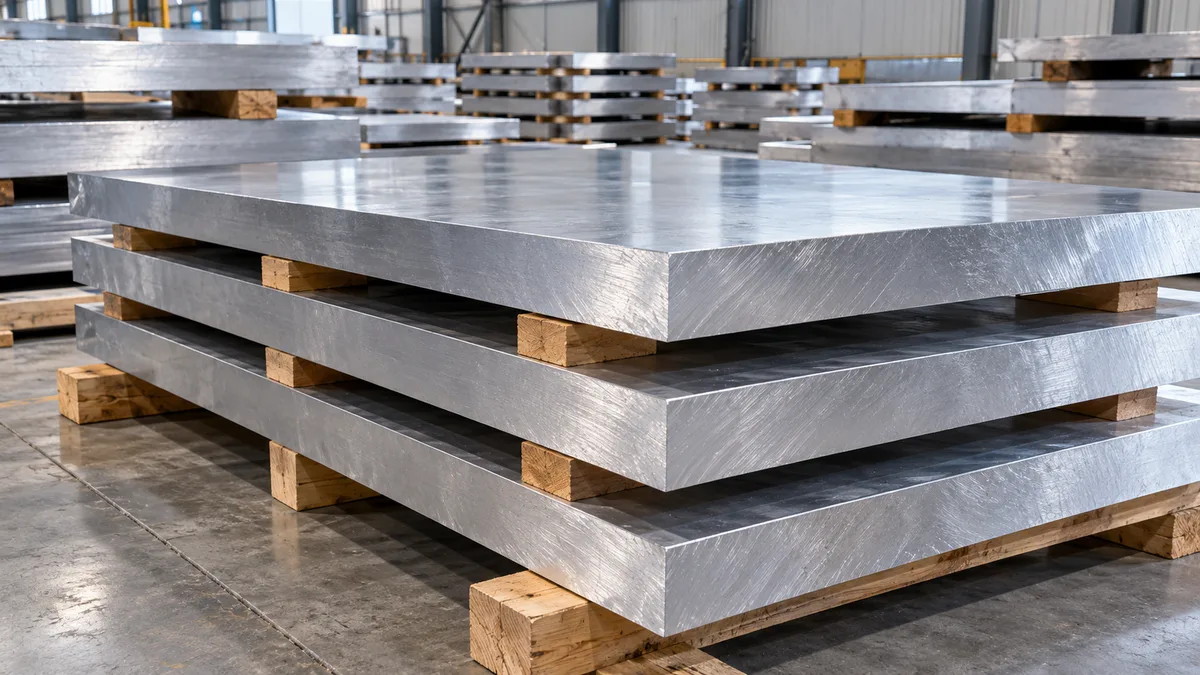
5456 is close to 5083 in composition but carries a little more magnesium and manganese. The result is roughly 10 % higher strength in both parent metal and welds, which is why designers move to 5456 when a welded 5083 structure is too heavy.
In aerospace and defence, 5456 is used for welded fuel and liquid-propellant storage tanks on the ground, rugged transport containers and shelters, armour and blast-protective panels on vehicles and equipment (where it appears alongside 5083 in MIL-DTL-46027), heavy GSE and naval aviation deck equipment. It is not used for flight structures, where heat-treatable 2xxx and 7xxx alloys give far more strength per kilogram.
Like 5083 and 5086, 5456 must not be used for long periods above about 65 °C, because its high magnesium content can sensitise. For warm service choose 5454.
| Element | Minimum | Maximum | Role in the alloy |
|---|---|---|---|
| Silicon (Si) | — | 0.25 | Impurity |
| Iron (Fe) | — | 0.40 | Impurity |
| Copper (Cu) | — | 0.10 | Kept low for seawater resistance |
| Manganese (Mn) | 0.50 | 1.0 | Adds strength, refines grain |
| Magnesium (Mg) | 4.7 | 5.5 | Main strengthening element |
| Chromium (Cr) | 0.05 | 0.20 | Grain control, stress-corrosion resistance |
| Zinc (Zn) | — | 0.25 | Impurity |
| Titanium (Ti) | — | 0.20 | Grain refiner |
| Others, each / total | — | 0.05 / 0.15 | |
| Aluminium (Al) | Remainder | About 92.2 – 94.8 % |
5456 has no registered zirconium or tin addition. Its standard designation is unrelated to 7050, and AMS 4341 and AMS 4344 are 7050 specifications, not 5456 documents.
| Temper | Typical tensile | Typical yield | Typical elongation | Design note |
|---|---|---|---|---|
| O | 310 MPa / 45 ksi | 159 MPa / 23 ksi | 24 % | Standard minimum yield about 130 MPa |
| H116 / H321 | 351 MPa / 51 ksi | 255 MPa / 37 ksi | 16 % | ASTM B928 minimum about 315 MPa tensile and 230 MPa yield in thinner plate |
| H112 | About 310 MPa | About 160 MPa | About 14 % | As rolled; guaranteed minimums lower in thick plate |
Minimum values fall as plate thickness rises; confirm the limits for your thickness band in ASTM B209 or B928 and on the mill certificate.
| System | Designation / standard | Notes |
|---|---|---|
| ASTM / ASME | ASTM B209 (ASME SB-209) | General sheet and plate |
| ASTM | ASTM B928 | H116 and H321 with exfoliation and intergranular corrosion tests |
| US Federal (legacy) | QQ-A-250/9 | 5456 sheet and plate; superseded by ASTM B209 |
| US Military | MIL-DTL-46027 | Weldable aluminium armour plate (5083 and 5456) |
| UNS | A95456 | — |
Plate weight is 2.66 kg per m² per millimetre: a 1500 × 3000 × 10 mm plate weighs about 120 kg.
Use ER5556 or ER5183 filler to reach the required as-welded strength; ER5356 gives lower joint strength. Avoid 4xxx fillers.
Moderate. Use generous bend radii in H116 and H321 and form across the rolling direction; O temper for severe forming.
Keep below about 65 °C in continuous service to avoid sensitisation; never use for hot tanks or engine-area parts.
Fair; tends to be gummy. Sharp carbide tools with high rake and flood coolant give the best finish.
| Property | 5086-H116 | 5083-H116 | 5456-H116 |
|---|---|---|---|
| Magnesium | 3.5 – 4.5 % | 4.0 – 4.9 % | 4.7 – 5.5 % |
| Typical tensile strength | 290 MPa | 317 MPa | 351 MPa |
| Typical yield strength | 207 MPa | 228 MPa | 255 MPa |
| Recommended filler | ER5356 | ER5183 | ER5556 |
| Formability | Good | Fair | Fair |
Yes. With more magnesium and manganese, 5456 is roughly 10 % stronger than 5083 in comparable tempers, both as plate and after welding.
No. It is strengthened by cold work only. H116 and H321 are strain-hardened tempers with controlled processing, not heat-treated conditions.
ER5556 matches the parent strength best; ER5183 is also widely used. ER5356 gives a weaker joint.
Integral aircraft fuel tanks are part of the 2xxx and 7xxx wing structure. 5456 is used for welded ground storage and transport tanks.
It requires H116 and H321 plate to pass exfoliation and intergranular corrosion tests, giving assurance for seawater and salt-spray service.
Send the temper, size, quantity, specification and destination. We will reply with availability, certification and a delivered price.





