Filler choice
ER5356 is widely used for general tank seams; ER5183 gives higher as-welded strength and is preferred for the most highly stressed joints or harsher service.



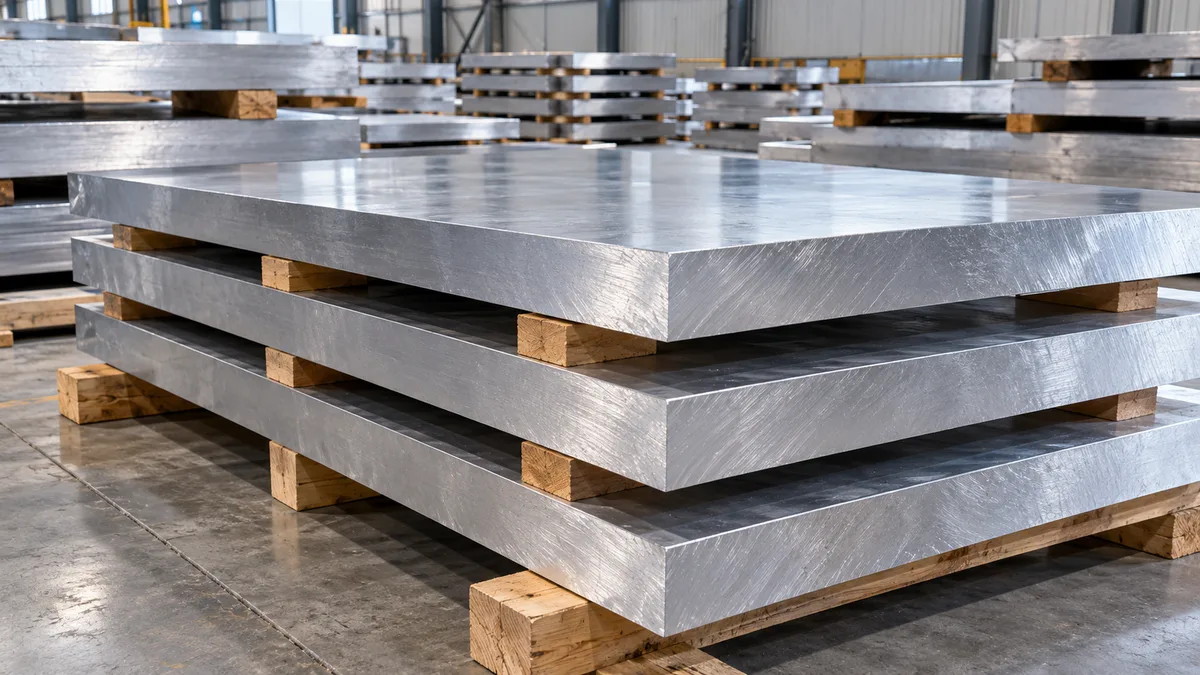
5182 is a 4.5 % magnesium aluminium alloy whose high elongation and steady weldability make it a favoured shell material for ADR road tankers carrying petrol, diesel and other dangerous goods at ambient temperature. H111 is used for rolled shells and O for spun heads and pressed baffles. Metline supplies 5182 tanker sheet 3 – 12 mm thick and up to about 2600 mm wide, to EN 14286 and ASTM B209, as flat plate or cut kits, worldwide.
ADR, the European agreement on carrying dangerous goods by road, sets tank wall thickness and impact protection on the basis of a reference steel shell. Aluminium tanks may be thinner than an equivalent mild-steel shell in proportion to the material's strength and elongation, so an alloy that combines good strength with very high elongation lets the designer reach a light, compliant shell.
5182 was developed for formed automotive inner panels and beverage can ends, applications that demand strength and extreme formability. The same balance suits tank construction: 5182-O and H111 sheet stretch uniformly during rolling, spinning and pressing, and weld consistently along very long seams. Its manganese level (0.20 – 0.50 %) is lower than in 5083, which gives a slightly softer, more ductile sheet at a similar magnesium content.
In practice, 5182 sits between 5083 and 5754 in a tanker builder's choice: lighter-gauge capable like 5083, more forgiving to form, and well proven for ambient-temperature petroleum service across Europe, the Middle East and Asia.
| Element | Limit (%) | Role |
|---|---|---|
| Magnesium (Mg) | 4.0 – 5.0 | Main strengthening element |
| Manganese (Mn) | 0.20 – 0.50 | Strength and grain control |
| Silicon (Si) | 0.20 max | Impurity; kept low for formability |
| Iron (Fe) | 0.35 max | Impurity |
| Copper (Cu) | 0.15 max | Kept low for corrosion resistance |
| Chromium (Cr) | 0.10 max | Impurity in this alloy |
| Zinc (Zn) | 0.25 max | Impurity |
| Titanium (Ti) | 0.10 max | Grain refiner |
| Others, each / total | 0.05 / 0.15 | |
| Aluminium (Al) | Remainder |
Registered limits for 5182 / EN AW-5182 (AlMg4.5Mn0.4). Some older data sheets list copper up to 0.50 %, which is incorrect; 0.15 % is the maximum.
Standard limits for O and H111 sheet are shown with typical values. For tank work, mills often guarantee elongation above the general standard minimum; agree the required value at order stage and check it on the certificate.
| Temper / basis | Tensile strength | Yield strength (0.2 %) | Elongation |
|---|---|---|---|
| O / H111, EN 485-2 limits | 255 – 315 MPa | ≥ 110 MPa | per thickness band |
| O, typical | about 275 MPa | about 130 MPa | about 21 – 25 % |
| H111, typical | about 280 MPa | about 135 MPa | about 20 – 24 % |
| Part | Temper | Why |
|---|---|---|
| Shell / barrel | 5182-H111 | Slight strain hardening improves flatness and handling; rolls to shape and welds uniformly |
| Heads / end caps | 5182-O | Maximum formability for spinning or pressing dished heads |
| Baffles and surge plates | 5182-O | Pressed, punched and flanged without cracking |
| Compartment bulkheads | 5182-O | Dished and welded into the shell |
| Reinforcing rings, brackets | 5182-H111 / O | Cut and bent to drawing |
Builders frequently buy shells, heads and baffles as a kit: shell plates cut to developed length with bevels and openings marked, heads spun with weld-ready edges, and baffles cut, punched and flanged. Kitting reduces nesting time, scrap and handling damage in the tank shop.
All 5xxx alloys with more than about 3 % magnesium can become sensitised if they spend long periods between roughly 65 °C and 200 °C: magnesium-rich β phase forms along grain boundaries and the metal becomes prone to intergranular and stress-corrosion cracking. Ambient-temperature fuel tankers rarely approach this range, but tanks parked in desert sun, or carrying warm product, need attention.
| NAMLT mass loss (ASTM G67) | Interpretation |
|---|---|
| ≤ 15 mg/cm² | Resistant to intergranular corrosion |
| 15 – 25 mg/cm² | Intermediate; investigate further |
| > 25 mg/cm² | Susceptible; not acceptable for exposed service |
A NAMLT report can be supplied with the mill certificate on request. For cargo kept above about 65 °C, such as bitumen or heated chemicals, choose 5454 rather than 5182. A bright or highly reflective exterior finish lowers the skin temperature of tanks in hot climates and is often specified in the Gulf region.
ER5356 is widely used for general tank seams; ER5183 gives higher as-welded strength and is preferred for the most highly stressed joints or harsher service.
Degrease with solvent, then remove oxide with a stainless wire brush immediately before welding. Most porosity comes from moisture, oil or old oxide.
Keep heat input and interpass temperature moderate to limit the softened zone and distortion on long seams.
Penetrant, radiographic or ultrasonic testing of critical seams as required by the tank code; smooth weld toes improve fatigue life.
O temper spins into heads readily. Avoid slow warm forming that could sensitise the alloy.
PE film protects bright or mirror sheet during fabrication; remove it before welding near the seam.
5182 weighs about 2.65 kg per m² per millimetre of thickness.
| Thickness (mm) | kg per m² | 1600 × 6000 mm sheet (kg) | 2500 × 8000 mm sheet (kg) |
|---|---|---|---|
| 3 | 7.9 | 76 | 159 |
| 4 | 10.6 | 102 | 212 |
| 5 | 13.2 | 127 | 265 |
| 5.5 | 14.6 | 140 | 292 |
| 6 | 15.9 | 153 | 318 |
| 8 | 21.2 | 204 | 424 |
| 10 | 26.5 | 254 | 530 |
| 12 | 31.8 | 305 | 636 |
| Factor | 5182 | 5083 | 5454 | 5754 |
|---|---|---|---|---|
| Main use in tankers | ADR fuel tankers, ambient cargo | Coastal routes, cryogenic tanks | Hot cargo (bitumen) | Food, water, general |
| O-temper tensile (approx.) | 255 – 315 MPa | 275 – 350 MPa | 215 – 285 MPa | 190 – 240 MPa |
| Formability | Very good | Good | Good | Very good |
| Long service above 65 °C | Not advised | Not advised | Suitable | Generally acceptable |
| Typical shell temper | H111 | H111 / O | H111 / H32 | H111 / O |
Choose 5182 when formability and elongation lead the design; 5083 when you need the last bit of strength or cryogenic service; 5454 for heated cargo; 5754 for general-purpose tanks.
Use H111 for the rolled shell, where flatness and stable welding matter, and O for spun heads, pressed baffles and bulkheads, where maximum formability is needed.
ADR does not list approved alloys; it sets design rules. 5182 supplied to EN 14286 is widely used for ADR tank shells, with wall thickness calculated by the tank designer under EN 13094 or the applicable standard.
It is advisable where tanks may run warm or the specification calls for it. ASTM G67 mass loss of 15 mg/cm² or less indicates resistance to intergranular corrosion.
ER5356 for most seams and ER5183 where higher as-welded strength or harsher service applies. Do not use 4xxx silicon fillers on high-magnesium alloys.
A highly reflective surface absorbs less solar heat, keeping cargo and shell cooler and limiting vapour loss, and it keeps a uniform appearance. Mill finish is fine for painted tanks.
Yes. Shell plates cut and bevelled, heads and baffles to drawing, and kits packed by compartment can be arranged along with the mill certificates.
Send the sizes, tempers and quantities, or your shell, head and baffle drawings. We will reply with availability, certification and a delivered price.





