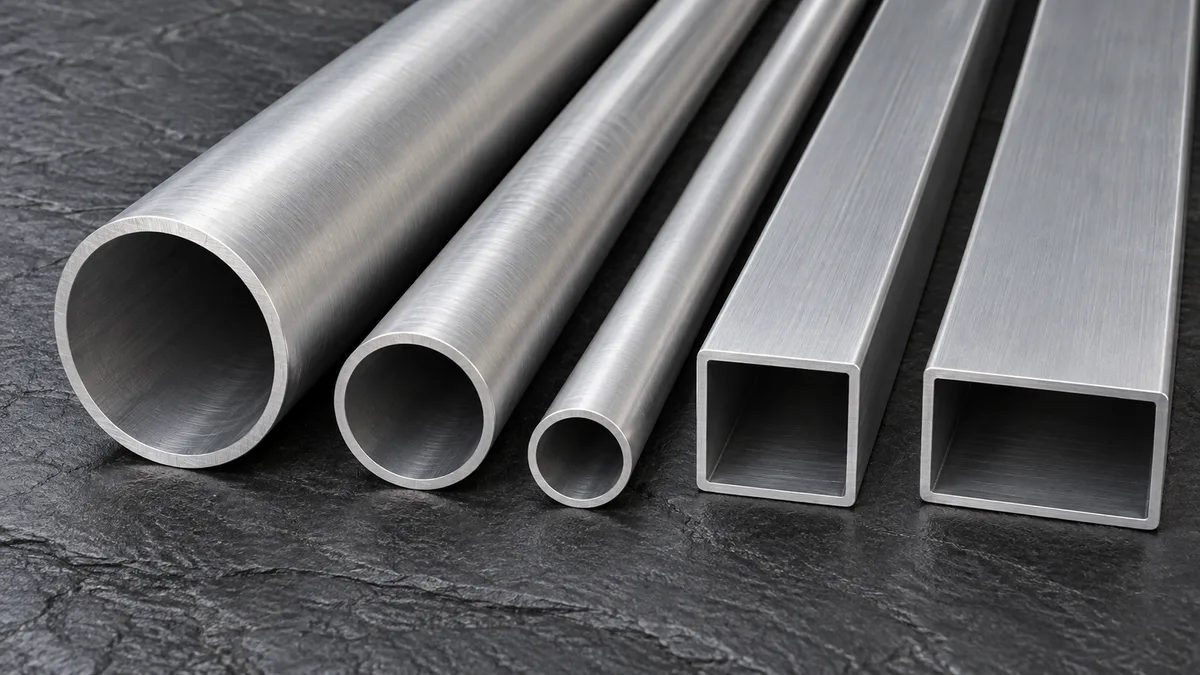
Thin-Wall Aluminium Pipe & Tube: A Complete Buying Guide
A thin-wall aluminium pipe or tube is one whose wall is small compared with its diameter, usually a wall-to-diameter ratio below about 0.05 (D/t above 20). It gives the most stiffness and strength per kilogram of any aluminium section, but it is also the easiest to dent, ovalise or buckle, so the alloy, temper, production route and tolerances have to be chosen with care. This guide explains how to specify thin-wall aluminium tube correctly, with property data, size and weight tables, design checks and the mistakes buyers most often make.
There is no single legal definition of "thin wall". Engineers use the ratio of outside diameter to wall thickness (D/t). When D/t is greater than about 20, that is, when the wall is less than 5 % of the diameter, the stress through the wall can be treated as uniform and thin-wall formulas such as Barlow's equation apply. Commercially, the term is also used loosely for any small-diameter tube with a wall of 0.5 – 2 mm, even when D/t is below 20.
The distinction matters because thin and thick tubes fail in different ways. A thick-wall tube under load usually yields; a thin-wall tube is more likely to buckle locally, kink when bent, or go oval when clamped. Buyers who specify a thinner wall to save weight must therefore also specify the right temper, roundness and straightness, and allow for how the tube will be handled and joined.
In aluminium, "tube" and "pipe" are also used differently. Tube is ordered by actual outside diameter and wall thickness (for example 25 × 1.0 mm), and is usually drawn or precision extruded. Pipe is ordered by nominal pipe size (NPS) and schedule, follows the dimensional tables used for steel pipe, and is normally extruded to ASTM B241 or ASTM B429. Thin-wall pipe means the light schedules, Schedule 5 and Schedule 10.
Example size
OD (mm)
Wall (mm)
D/t ratio
Classed as
Instrument tube
6.0
0.5
12
Thin by trade use, not by D/t
Bicycle or frame tube
25.4
1.0
25
Thin-wall
Tent or antenna pole
16.0
0.8
20
Thin-wall (borderline)
NPS 2 Schedule 10 pipe
60.3
2.77
22
Thin-wall
NPS 6 Schedule 5 pipe
168.3
2.77
61
Very thin-wall
Hydraulic cylinder tube
50.0
5.0
10
Thick-wall
Alloy selection
Which aluminium alloy for thin-wall tube?
Almost every wrought alloy can be made into thin-wall tube, but six grades cover most orders. The choice is a trade-off between strength, formability, corrosion resistance and price. Values below are typical properties published by the Aluminum Association and ASM for the stated temper; the guaranteed minimums in ASTM B210, B241 and EN 754-2 are lower and depend on wall thickness, so design to the standard and check the mill certificate.
Alloy & temper
Type
Tensile strength (typical)
Yield strength (typical)
Elongation
Best known for
3003-O
Al-Mn, non-heat-treatable
110 MPa
40 MPa
30 – 40 %
Brazed heat exchangers, deep forming
3003-H14
Al-Mn, strain-hardened
150 MPa
145 MPa
8 – 16 %
Refrigeration lines, condensers, general tubing
5052-O
Al-Mg, non-heat-treatable
195 MPa
90 MPa
25 – 30 %
Fuel and oil lines, marine tubing, easy bending
5083-O
Al-Mg-Mn
290 MPa
145 MPa
20 – 22 %
Marine and cryogenic pipe, welded structures
6061-T6
Al-Mg-Si, heat-treatable
310 MPa
276 MPa
10 – 12 %
Structural and frame tube, general engineering
6063-T6
Al-Mg-Si, heat-treatable
241 MPa
214 MPa
12 %
Architectural tube, anodised parts, bus tube
2024-T3
Al-Cu-Mg
483 MPa
345 MPa
18 %
Aircraft fluid lines and structural tube
7075-T6
Al-Zn-Mg-Cu
572 MPa
503 MPa
11 %
Tent and trekking poles, arrow shafts, high-stress tube
Typical values are for guidance only. Minimum guaranteed values for drawn tube (ASTM B210 / EN 754-2) and extruded tube or pipe (ASTM B241, B221 / EN 755-2) vary with temper and wall thickness and are reported on the EN 10204 3.1 certificate.
3003: the forming grade
Manganese gives slightly more strength than pure aluminium while keeping excellent ductility and brazeability. 3003 thin-wall tube is the standard for air-conditioning and refrigeration lines, radiator and condenser tubes and anywhere the tube must be expanded, flared or brazed.
5052 and 5083: the corrosion grades
Magnesium alloys keep their strength without heat treatment and resist seawater well. 5052-O bends tightly and is common for fuel, oil and instrument lines; 5083 is chosen for marine pipe and cryogenic service because it stays tough at low temperature and welds without large strength loss.
6061: the structural default
Heat-treatable, weldable, machinable and widely available. 6061-T6 thin-wall tube is the general choice for frames, booms, rollers, furniture and vehicle parts. For tight bends, order T4 or O and age after forming.
6063: the finishing grade
Lower strength than 6061 but a finer, smoother surface and the best anodising response. Used for architectural tube, handrails, display systems and electrical bus tube where appearance or conductivity matters more than strength.
2024: the aircraft grade
High strength and good fatigue resistance. Drawn 2024-T3 tube is used for aircraft hydraulic and structural tube to AMS specifications. It has lower corrosion resistance and is not usually welded.
7075: the strength grade
The strongest common tube alloy, with strength above many mild steels. Thin 7075-T6 drawn tube makes very light poles and shafts; the T73 temper trades some strength for much better resistance to stress-corrosion cracking.
Standards
Standards that cover thin-wall aluminium tube and pipe
Quote the governing standard on every enquiry. It decides the property minimums, the dimensional tolerances and the test frequency, and two tubes with the same size and alloy can differ significantly if they are made to different standards.
Standard
Covers
Typical use
ASTM B210 / B210M
Drawn seamless tube, straight lengths and coils
Precision thin-wall tube for general and pressure use
ASTM B483 / B483M
Drawn tube for general purpose applications
Commercial drawn tube where B210 tolerances are not needed
ASTM B241 / B241M
Seamless pipe and seamless extruded tube
Thin-wall pipe in NPS sizes, Schedule 5 and 10
ASTM B429 / B429M
Extruded structural pipe and tube
Structural pipe, may be seam-welded (porthole die)
ASTM B221
Extruded bars, rods, wire, profiles and tubes
Extruded round, square and rectangular tube
ASTM B234
Drawn seamless tube for condensers and heat exchangers
3003 and similar heat-exchanger tube
EN 754-1/-2/-7/-8
Cold-drawn rod, bar and tube: delivery, properties, tolerances
European drawn tube
EN 755-1/-2/-7/-8
Extruded rod, bar, tube and profiles
European extruded tube
SAE AMS / WW-T-700
Aerospace and US federal tube specifications
2024, 5052, 6061 and 3003 aircraft tube
JIS H4080
Aluminium and alloy extruded and drawn tubes
Japanese projects
Tempers you will meet on thin-wall tube:
O: fully annealed, softest condition, for tight bends, flaring and expansion
H112, H14, H18: as-fabricated or strain-hardened tempers for 1xxx, 3xxx and 5xxx tube
T4: solution treated and naturally aged; formable heat-treatable condition that can be aged later
T6: solution treated and artificially aged; full strength for 6061, 6063 and 7075
T3: solution treated, cold worked and naturally aged; the usual temper for 2024 drawn tube
T73: over-aged 7075 for stress-corrosion resistance
T6511 / T3511: stretched and straightened extruded tempers, used for extruded tube rather than drawn tube
Production
How thin-wall aluminium tube is produced
The production route has more influence on a thin-wall tube than on almost any other aluminium product. It controls the minimum wall you can buy, how concentric the bore is, whether there are weld seams and what the surface looks like.
Billet casting and homogenisingDirect-chill cast billet is homogenised so that alloying elements are evenly distributed, which gives consistent extrusion and drawing behaviour.
Hot extrusion of the tube shellThe heated billet is pushed through a die. A mandrel (piercing) press makes seamless tube; a porthole or bridge die splits the metal and welds it together again round a fixed mandrel, producing "structural" tube with longitudinal seams. Extrusion alone can reach walls of about 1 mm in smaller sizes.
Cold drawingFor thinner walls and tighter tolerances the extruded shell is drawn through a die over a plug or mandrel, often in several passes. Each pass reduces wall and diameter, work-hardens the metal and improves surface finish and concentricity. Drawing is how walls of 0.3 – 0.5 mm are reached.
Intermediate annealingBetween heavy draws the tube is annealed to restore ductility so that it can be drawn again without cracking.
Heat treatmentHeat-treatable alloys are solution treated, quenched and aged to the final temper (T4, T6, T73). Non-heat-treatable alloys get their final temper from the last draw or a final anneal.
Straightening and cuttingRoller or stretch straightening brings the tube within straightness tolerance; ends are cropped and lengths cut.
Inspection and packingDimensions, surface, and mechanical properties are checked per lot; eddy-current testing is added where leak-tightness matters. Tubes are packed to prevent denting.
Route
Wall range
Seams
Tolerance and finish
When to choose it
Porthole-die extrusion
About 1 mm upwards
Yes (die-weld seams)
Commercial
Structural and architectural tube, non-round shapes, lowest cost
Seamless extrusion
About 1.5 mm upwards
No
Commercial
Pressure pipe, gas lines, where seams are not allowed
Cold-drawn seamless
About 0.3 mm upwards
No
Precision, bright surface
Thin precision tube, aerospace, instruments, poles
Welded from strip (HF or laser)
About 0.2 mm upwards
One weld line
Good on OD, depends on bead treatment
High-volume heat-exchanger and furniture tube
Impact extrusion
Very thin, closed one end
No
Good
Cans, aerosol and battery housings
A common question is whether porthole-die tube is "seamed". It is: the die-weld seams are solid-state bonds that are normally as strong as the parent metal in a static test, and the tube is perfectly suitable for frames, railings and furniture. For pressure, gas or hydraulic service, and for any tube that will be flared, expanded or heavily bent, specify seamless tube to ASTM B210 or B241 instead.
Supply range
Thin-wall tube sizes and weights
Typical supply range
Round tube
OD 5 – 220 mm; wall 0.5 – 10 mm (thinner drawn walls in small diameters by enquiry)
Square tube
Side 10 – 120 mm; wall 1 – 7 mm
Rectangular tube
14 × 10 mm up to 120 × 100 mm; wall 1 – 7 mm
Oval / flat-oval tube
About 27 × 11.5 mm up to 115 × 49 mm; wall 1 – 2.5 mm
Other shapes
Tapered, telescopic, hexagonal, streamline and multi-port microchannel tube
Length
Random 1 – 6 m, fixed lengths, cut-to-length parts, or coils for small soft tube
Imperial sizes
Fractional-inch OD with wall in inches or gauge, for example 1.000 × 0.035 in
Not every wall is possible on every diameter. Very thin walls are limited to small diameters, and large diameters need heavier walls to stay round in handling. Send the size and we confirm the route.
Weight per metre of a round tube is π × (OD − wall) × wall × 2.70 / 1000 kg, with OD and wall in millimetres. The table uses this formula and a density of 2.70 g/cm³; 7075 (2.81 g/cm³) and 2024 (2.78 g/cm³) are about 3 – 4 % heavier. For other sizes use the tube weight calculator.
OD (mm)
Wall (mm)
D/t
kg per metre
Metres per 100 kg
6
0.5
12
0.023
4287
8
0.75
11
0.046
2168
10
1
10
0.076
1310
12
1
12
0.093
1072
16
1
16
0.127
786
20
1
20
0.161
620
20
1.5
13
0.235
425
25
1
25
0.204
491
25
1.5
17
0.299
334
30
1.5
20
0.363
276
32
2
16
0.509
196
40
1.5
27
0.490
204
40
2
20
0.645
155
50
2
25
0.814
123
60
2
30
0.984
102
63.5
1.65
38
0.866
116
76.2
2
38
1.259
79
80
2.5
32
1.643
61
100
3
33
2.468
41
120
3
40
2.977
34
150
4
38
4.954
20
200
5
40
8.270
12
Thin-wall pipe is sold by NPS and schedule. The outside diameter for each NPS is fixed and the schedule sets the wall. Schedule 5 and Schedule 10 are the light walls; the dimensions follow the ANSI H35.2 tables referenced by ASTM B241, which match the stainless pipe sizes of ASME B36.19.
NPS
OD (mm)
Sch 5 wall (mm)
Sch 5 kg/m
Sch 10 wall (mm)
Sch 10 kg/m
1/2
21.3
1.65
0.28
2.11
0.34
1
33.4
1.65
0.44
2.77
0.72
1-1/2
48.3
1.65
0.65
2.77
1.07
2
60.3
1.65
0.82
2.77
1.35
3
88.9
2.11
1.55
3.05
2.22
4
114.3
2.11
2.01
3.05
2.88
6
168.3
2.77
3.89
3.40
4.76
8
219.1
2.77
5.08
3.76
6.87
Quality
Tolerances, roundness and surface quality
With a 1 mm wall, a wall tolerance of ±0.1 mm is already ±10 % of the section, so the tolerance class matters far more than on heavy tube. Standard tolerances come from the order specification (ASTM B210 and ANSI H35.2 for drawn tube, EN 754-7 for European drawn seamless tube, EN 755-7 or 755-8 for extruded tube). Tighter values can be agreed on drawn tube.
Characteristic
What it means
What to specify
Mean OD
Average of two diameters at right angles
Standard class, or a tighter value for press fits and telescoping
OD at any point (ovality)
Difference between largest and smallest diameter
Important for thin tube; it is often greater than the mean tolerance, especially in soft tempers
Wall thickness
Mean and point-to-point variation
Mean wall for weight; minimum wall for pressure calculations
Eccentricity
Offset between bore and OD
Critical for rotating shafts, rollers and telescopic tubes
Straightness
Bow over a given length, e.g. mm per metre
Needed for poles, shafts and visible parts
Length and squareness of cut
Cut length tolerance and burr
For cut-to-length components
Precision cold-drawn tube in small sizes can be held to around ±0.05 mm on OD when the drawing calls for it, and to straightness of a few tenths of a millimetre per metre after precision straightening. These are agreed values, not defaults, so state them on the enquiry.
Surface quality is equally important. Inside and outside surfaces of drawn tube should be clean and smooth. Light marks, spots and shallow scratches are normally accepted if they are shallower than the permitted minus tolerance on wall; cracks, laps, blisters, folds, inclusions and corrosion are rejected. For anodised or polished parts, say so at the enquiry so the tube can be selected for appearance and protected accordingly.
Engineering
Designing with thin-wall tube: pressure, buckling and bending
Thin walls save weight but introduce failure modes that a quick strength check will miss. These are the four checks to run before fixing a wall thickness.
Internal pressure
For thin walls, hoop stress is σ = P × D / (2 × t). Rearranged as Barlow's formula, P = 2 × S × t / D. As an illustration only, a 25 × 1.0 mm 6061-T6 tube with a typical tensile strength of 310 MPa has a theoretical burst pressure of about 24.8 MPa. Working pressure must use the specified minimum strength, the minimum wall and the safety factor of your design code, and welded or seamed tube may need a joint factor.
Local buckling
Under compression or bending, a thin wall can wrinkle before the section yields. The higher the D/t, the lower the stress at which this happens. Aluminium design codes such as the Aluminum Association design manual and EN 1999-1-1 classify round tubes by slenderness and reduce the allowable stress for slender walls.
Column buckling
Long struts fail by overall buckling, governed by the modulus (about 69 GPa for aluminium, a third of steel) and the radius of gyration. Increasing diameter while keeping wall thin raises buckling load efficiently, until local buckling takes over.
Bending and ovalisation
When a thin tube is bent round a radius, the cross-section flattens and the inside wall can wrinkle. Rotary-draw bending with a mandrel and wiper die is needed for small radii. As a rough guide, soft tempers can be bent to a centreline radius of about 1.5 – 2 × OD with mandrel support; T6 tempers need larger radii.
Denting and handling
Very thin tubes dent from point loads such as clamps and set screws. Use split collars, inserts or swaged ends at fixing points, and avoid single-point clamping on walls below about 1 mm.
Galvanic contact
Thin walls have little material to lose. Isolate aluminium tube from copper, brass and carbon steel fittings in wet service with insulating washers or sleeves, or use aluminium fittings.
Stiffness scales with the second moment of area, I = π (D4 − d4) / 64. Doubling the outside diameter of a tube while keeping the same weight per metre increases its bending stiffness roughly four times. That is why aluminium bicycle frames, tent poles and booms use large, thin tubes rather than small, thick ones, and why the limit is set by local buckling and denting rather than by the strength of the metal.
Working with thin tube
Cutting, joining, forming and finishing thin-wall tube
Cutting
Use fine-tooth carbide saws or orbital tube cutters; support the tube near the cut to stop chatter and distortion. Deburr inside and out, especially on fluid lines where burrs can detach.
Welding
TIG is preferred for walls below about 2 mm because it gives better heat control than MIG. Use ER4043 or ER5356 filler depending on alloy. Expect heat-treatable alloys to lose strength in the heat-affected zone. Distortion and burn-through are the main risks on very thin walls.
Brazing
3003 and 1xxx tube braze well with Al-Si fillers; this is the standard joining method in heat exchangers. Many high-strength alloys (2024, 7075) are not brazeable.
Mechanical joining
Swaging, crimping, flaring, rolled grooves, compression fittings, blind rivets and adhesive bonding all suit thin tube. Inserted plugs or sleeves spread fixing loads.
Bending and end forming
Order O or T4 temper for tight bends, flares, beads and expansions, then age to T6 if needed. Lubricate dies and use mandrels to prevent wrinkling.
Machining
Light cuts and sharp tools; hold the tube on expanding mandrels or in collets rather than three-jaw chucks, which crush thin walls. Grooves and cross-holes reduce effective wall, so check the remaining section.
Anodising
Clear, colour and hard anodising are all possible. 6063 and 6061 give the most even appearance; hard anodising adds thickness, so allow for it on tight fits.
Painting and powder coating
Pre-treat with a chrome-free conversion coating before powder coating. Large thin tubes can sag at curing temperature if poorly supported.
Polishing and brushing
Mechanical polishing removes metal; on walls under 1 mm, agree the finish and stock removal in advance.
Applications
Where thin-wall aluminium tube is used
Application
Typical alloy and temper
Why thin-wall aluminium
Air-conditioning and refrigeration lines
3003-O, 1100-O
Corrosion resistance, brazeable, bends on site
Radiator, condenser and heat-exchanger tubes
3003, clad brazing alloys
Thermal conductivity and light weight
Aircraft hydraulic, fuel and structural tube
2024-T3, 5052-O, 6061-T6
Strength-to-weight ratio and AMS-qualified material
Tent, trekking and ski poles, arrow shafts
7075-T6, 6061-T6
Highest strength in the lightest tube
Bicycle frames, wheelchairs and mobility aids
6061-T6, 7005
Stiffness, weldability and fatigue performance
Furniture, display and shop-fitting systems
6063-T5/T6
Smooth anodised finish and easy fabrication
Telescopic masts, antenna and camera poles
6061-T6, 6063-T6
Close OD/ID tolerances let tubes nest
Marine rails, fuel and oil lines
5052-O, 5083
Seawater resistance
Rollers, idlers and printing equipment
6061-T6 drawn
Low inertia, concentricity
Electrical bus tube and conductors
6063-T6, 6101-T6
Conductivity, low weight, large surface area for cooling
A typical example shows how the choice is made. A camping-pole designer needs a 10 mm tube that will flex without permanent set. 6061-T6 with a 0.8 mm wall works but bends permanently in a gust; 7075-T6 at the same size has roughly 80 % more yield strength, so it springs back. The extra cost of 7075 is small compared with the improvement in field performance, so the designer specifies drawn 7075-T6 to tight straightness.
Comparison
Thin-wall versus thick-wall aluminium tube
Factor
Thin-wall tube
Thick-wall tube
Wall / OD ratio
Below about 0.05 (D/t above 20)
Above about 0.05
Typical wall
0.3 – 6 mm
5 mm to 50 mm and more
Main production route
Cold drawing, precision extrusion, welding from strip
Hot extrusion, sometimes boring or forging
Weight efficiency
Highest stiffness and strength per kg
Lower
Typical failure mode
Local buckling, denting, ovalisation
Yielding or fracture
Pressure capacity
Low to moderate
High (hydraulic cylinders, high-pressure lines)
Tolerance sensitivity
High; small deviations are a large share of wall
Lower
Cost per kg
Higher: more passes, more handling, tighter inspection
Lower per kg
Cost per metre
Often lower, because there is less metal
Higher
The cost comparison catches many buyers out. Thin-wall drawn tube costs more per kilogram than heavy extruded tube because of the extra drawing passes, anneals and inspection, but much less metal is needed, so the cost per metre and the cost per part are usually lower.
Related pages
Related tube products and guides
For high-strength aerospace thin-wall tube, see our eight thin-wall tube specifications explained, which focuses on aerospace grades. These pages cover individual alloys and production routes:
How to order thin-wall aluminium tube from Metline
Define the tubeAlloy and temper, shape, OD (or NPS and schedule), wall, length, quantity, and the standard (ASTM B210, B241, B483, EN 754 or EN 755). Say whether seamless tube is required.
Add critical tolerancesOvality, straightness, eccentricity or surface requirements that matter for your part, plus any testing such as eddy current or pressure tests.
ProcessingCut-to-length, end finishing, bending, CNC machining or surface treatment can be arranged on request.
QuotationWe confirm the production route, tolerance class, certification and delivery terms (EXW, FOB, CIF or DAP).
Documentation and packingEach shipment carries an EN 10204 3.1 mill certificate. Thin tube is film-wrapped or sleeved, separated to prevent rubbing, and packed in seaworthy wooden cases for worldwide delivery.
What is the thinnest wall available on aluminium tube?
Cold-drawn seamless tube can reach walls of around 0.3 – 0.5 mm in small diameters, and welded tube from strip can be thinner still. Our normal thin-wall range starts at 0.5 mm. The larger the diameter, the heavier the minimum practical wall, because big thin tubes cannot stay round in handling.
How do I know if my tube is thin-wall?
Divide the outside diameter by the wall thickness. If the result is more than about 20, thin-wall formulas apply and buckling, denting and ovality need attention. A 50 × 2 mm tube (D/t 25) is thin-wall; a 50 × 5 mm tube (D/t 10) is thick-wall.
Is seamless tube necessary for thin-wall aluminium?
Not always. Porthole-die extruded tube with die-weld seams is fine for frames, rails, furniture and most structures. Choose seamless drawn or extruded tube for pressure, gas, hydraulic and fuel lines, and for parts that will be flared, expanded or bent tightly.
What is the best alloy for strong, light thin-wall tube?
7075-T6 gives the highest strength and is used for poles and shafts; 2024-T3 is the classic aircraft tube; 6061-T6 is the best general compromise between strength, weldability and cost. For bending and brazing, choose 3003 or 5052 in the O temper.
How much does thin-wall aluminium tube weigh?
Weight per metre is π × (OD − wall) × wall × 2.70 / 1000 kg in millimetres. A 25 × 1.0 mm tube weighs about 0.204 kg/m and a 50 × 2.0 mm tube about 0.814 kg/m.
Can thin-wall aluminum tube be welded?
Yes, but TIG with careful heat control is preferred for walls under about 2 mm. Use fixtures and heat sinks to limit distortion, and remember that heat-treatable alloys lose strength near the weld. For very thin walls, brazing, swaging or adhesive bonding may be better.
Do you export thin-wall tube?
Yes. Metline supplies thin-wall aluminium tube and pipe worldwide from Mumbai, cut to length if required, with EN 10204 3.1 certificates and export packing designed to prevent denting.
Need thin-wall aluminium tube or pipe?
Send the alloy, temper, size, tolerances and destination. We will confirm the right production route and reply with certification and a delivered price.