CTP grade
No pressure scratches, chatter marks or roll prints visible to the eye; no dendritic patterns, roll-grain imprints or aluminium pick-up; no bright bands or colour variation; no deep dark streaks after electrolytic graining.



PS plate base is high-purity aluminium strip, usually 1050, 1052, 1060 or 1070 in H16 or H18 temper, delivered in coil to plate coating lines. Plate makers grade it into conventional, colour and CTP categories, and each tighter grade asks for closer thickness tolerance, better flatness and a cleaner surface. This guide sets out those requirements and how to specify them; Metline supplies plate base strip worldwide.
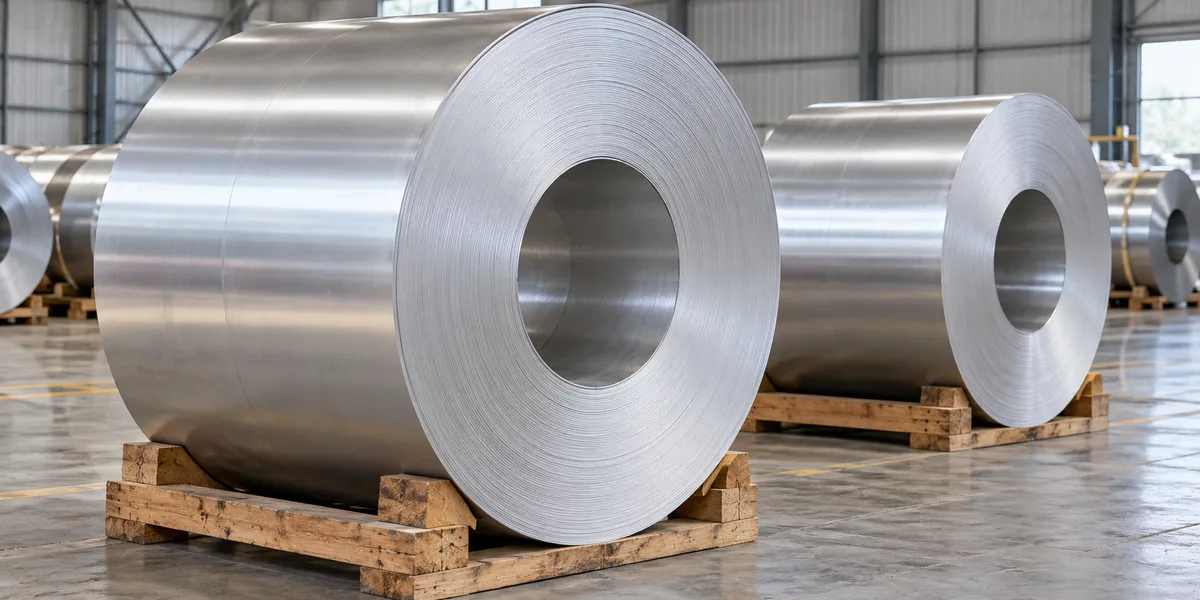
A pre-sensitised plate is an aluminium sheet that arrives at the printer already coated with a light-sensitive layer. The plate maker buys aluminium strip in coil, then grains, anodises, coats, dries and cuts it. The quality of that incoming strip sets the ceiling for everything downstream.
The term "PS plate" originally meant conventional plates exposed through film, but the same base strip family now supplies CTP plates too. What changes between categories is not the alloy but how tightly the strip is controlled: gauge, flatness, surface and the strength it keeps after the plate is baked.
| Category | Typical use | Relative demands |
|---|---|---|
| Conventional printing plate base | Newspapers, books and other text on ordinary paper | Basic: widest tolerances and surface allowances |
| Colour printing plate base | Illustrations, colour work, coated and speciality papers | Tighter gauge and flatness; fewer surface marks allowed |
| CTP plate base | Thermal, violet and UV computer-to-plate plates | Tightest gauge, flattest strip and near defect-free surface |
Order the category your plate line actually needs. CTP-grade strip costs more to produce because more of the coil is rejected during inspection, so specifying CTP quality for conventional plates adds cost without benefit.
| Element | 1050 | 1060 | 1070 |
|---|---|---|---|
| Silicon (Si) | 0.25 | 0.25 | 0.20 |
| Iron (Fe) | 0.40 | 0.35 | 0.25 |
| Copper (Cu) | 0.05 | 0.05 | 0.04 |
| Manganese (Mn) | 0.05 | 0.03 | 0.03 |
| Magnesium (Mg) | 0.05 | 0.03 | 0.03 |
| Zinc (Zn) | 0.05 | 0.05 | 0.04 |
| Titanium (Ti) | 0.03 | 0.03 | 0.03 |
| Vanadium (V) | 0.05 | 0.05 | 0.05 |
| Others, each | 0.03 | 0.03 | 0.03 |
| Aluminium (Al), min. | 99.50 | 99.60 | 99.70 |
1052 is used by some plate makers as a litho variant of 1050 with a small, controlled magnesium content, which adds strength and resistance to softening during baking. Because it is not a universally registered composition, the agreed chemistry is written into the purchase specification and confirmed on each mill certificate.
| Temper | Tensile strength | Elongation (A50) |
|---|---|---|
| H18 | ≥ 150 MPa (representative minimum) | ≥ 1 % |
| H16 | 130 – 170 MPa | ≥ 2 % |
Many plates are baked after imaging to harden the coating and multiply run length. Baking softens fully hard 1xxx strip, and a plate that loses too much strength can stretch or tear on the plate cylinder. Plate makers therefore run a simulated baking test on incoming strip: a sample is held at a set temperature and its tensile strength and flatness are measured afterwards.
| Bake temperature | Holding time | Representative strength after baking | Appearance requirement |
|---|---|---|---|
| 260 ± 2 °C | 5 min | ≥ 115 MPa | No visible warping or distortion |
| 280 ± 2 °C | 5 min | ≥ 100 MPa | No visible warping or distortion |
Representative values used in industry specifications for lithographic strip; the values that apply to your order are fixed in the purchase specification.
| Thickness | Category | Thickness tolerance |
|---|---|---|
| ≤ 0.20 mm | All categories | ±0.005 mm |
| > 0.20 – 0.30 mm | Conventional | ±0.010 mm |
| > 0.20 – 0.30 mm | Colour | ±0.008 mm |
| > 0.20 – 0.30 mm | CTP | ±0.005 mm |
| > 0.30 – 0.50 mm | All categories | ±0.015 mm |
| Category | Flatness (per metre of length) |
|---|---|
| Conventional | Wave height ≤ 3 mm, no more than 3 waves |
| Colour | Wave height ≤ 2 mm, no more than 3 waves |
| CTP | Tighter than colour grade, agreed with the plate maker |
Gauge consistency matters because coating weight is applied by volume: a thicker or thinner patch of strip changes coating thickness and therefore exposure response. Flatness matters because waves and edge buckle cause uneven coating and can crease the strip on the coating line.
No pressure scratches, chatter marks or roll prints visible to the eye; no dendritic patterns, roll-grain imprints or aluminium pick-up; no bright bands or colour variation; no deep dark streaks after electrolytic graining.
No roll marks, embossing, bright bands or colour variation; after anodising, no visible dark streaks deeper than the surface, with only short isolated streaks tolerated per square metre.
Limited isolated dark streaks and small pressure scratches per square metre allowed; no loose dendritic patterns, roll-grain imprints or aluminium pick-up.
These criteria are judged after graining or anodising as well as on the bare strip, because many substrate faults only become visible once the surface has been etched. Agree how samples are taken and which side is the working side before the first delivery.
It is the high-purity aluminium strip, usually 1050 to 1070 in H16 or H18, that plate makers grain, anodise and coat to make pre-sensitised and CTP printing plates.
Typically ±0.005 mm up to 0.30 mm thick, tighter than conventional plate base, which may allow ±0.010 mm between 0.20 and 0.30 mm.
Baking hardens the plate coating but softens the aluminium. The test confirms the strip keeps enough strength and stays flat, for example at least about 115 MPa after 5 minutes at 260 °C.
H18 is standard for thin plate base because of its higher strength. H16 offers slightly more elongation and is used where the plate is bent tightly or the gauge is heavier.
Yes. Strip can be supplied in coil with 150 – 510 mm ID or cut to lengths between 500 and 2,000 mm, interleaved and packed flat.
Tell us the alloy, temper, plate category, gauge and width. We reply with specification, certification and a delivered price.





