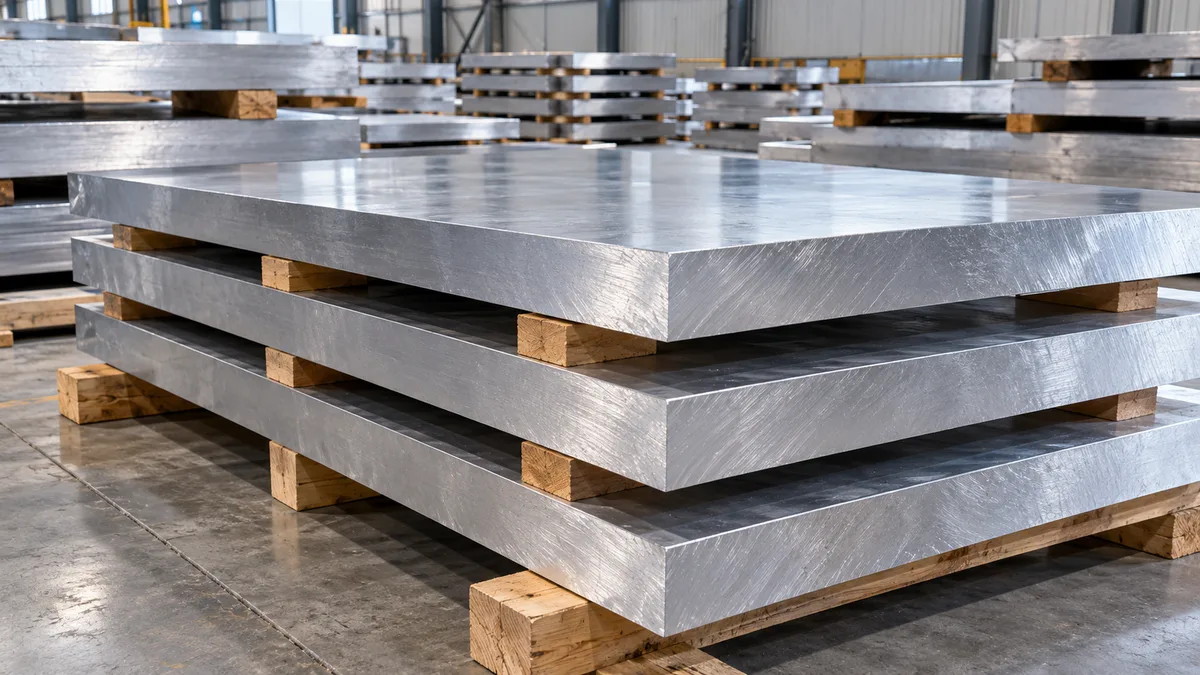
Rolled thick plate
Best through-thickness uniformity for the thicknesses that mills can roll; stretched tempers keep machining distortion low.



Aluminium sheet and plate is sold in standard metric thicknesses (2, 3, 5, 6, 8, 10, 12, 16, 20, 25 mm and up) and in fractional inches (1/8, 1/4, 1/2, 1 in), while thin sheet in North America is often ordered by gauge. This chart lists the common thicknesses in each system, converts aluminium gauge to millimetres and inches, gives weights per square metre, and shows which alloys and tempers are normal in each thickness band.
The boundary between aluminium sheet and plate is set by the standards. Under the Aluminum Association and ASTM B209 definitions, sheet is 0.006 – 0.249 in (about 0.15 – 6.3 mm) thick and plate is 0.250 in (6.35 mm) and thicker; anything thinner than 0.006 in is foil. European terminology draws the line at 6 mm, so a 6 mm product is sheet and 8 mm is plate.
The distinction matters because sheet and plate are listed in different tables of the standards, with different tolerances, tempers and minimum properties. Thick plate in heat-treatable alloys is supplied in stress-relieved tempers such as T651 or T7451, while sheet is usually T6 or T4. In practice buyers often say "plate" for anything thicker than about 3 mm; when ordering, give the thickness and the standard so there is no ambiguity.
| Product | ASTM / Aluminum Association | EN terminology | How thickness is usually stated |
|---|---|---|---|
| Foil | Under 0.006 in (0.15 mm) | Up to 0.20 mm | Microns (µm) or mm |
| Sheet | 0.006 – 0.249 in | Over 0.20 mm up to 6 mm | mm, inch or gauge |
| Plate | 0.250 in and over | Over 6 mm | mm or inch, never gauge |
This is the busiest range of the market: 2, 3, 5 and 6 mm sheet are bought for cladding, signage, enclosures, vehicle panels, boat building and general fabrication. Typical alloys are 1050, 1100, 3003, 5052, 5754 and 6061, in tempers such as O, H14, H24, H32 and T6. The range is also where most processed sheet sits: chequer and tread plate, perforated sheet and anodised or colour-coated sheet.
| Thickness (mm) | Inch | kg/m² | Common sheet sizes (mm) |
|---|---|---|---|
| 2 | 0.079″ | 5.4 | 1250 × 2500 |
| 2.5 | 0.098″ | 6.8 | 1250 × 2500 |
| 3 | 0.118″ | 8.1 | 1250 × 2500 / 1500 × 3000 |
| 4 | 0.157″ | 10.8 | 1250 × 2500 / 1500 × 3000 |
| 5 | 0.197″ | 13.5 | 1500 × 3000 |
| 6 | 0.236″ | 16.2 | 1500 × 3000 |
Medium plate carries structural loads. Common thicknesses are 8, 10, 12, 16, 20 and 25 mm. The usual alloys are 6061 and 6082 in T6 or T651 for machined and structural parts, and 5083 or 5754 in H111, H116 or H321 for marine and pressure work, with 7075-T651 where high strength is needed.
| Thickness (mm) | Inch | kg/m² | Common sheet sizes (mm) |
|---|---|---|---|
| 8 | 0.315″ | 21.6 | 1500 × 3000 |
| 10 | 0.394″ | 27.0 | 1500 × 3000 / 2000 × 6000 |
| 12 | 0.472″ | 32.4 | 1500 × 3000 / 2000 × 4000 |
| 16 | 0.630″ | 43.2 | 1500 × 3000 / 2000 × 4000 |
| 20 | 0.787″ | 54.0 | 2000 × 4000 / 2000 × 6000 |
| 25 | 0.984″ | 67.5 | 2000 × 4000 |
Typical uses include building and bridge connection plates, platforms and walkways, truck and trailer chassis members, marine decks and bulkheads, machine base plates and brackets. Face milling, cut-to-size blanks and PVC film protection are common processing options at this thickness.
Thick plate is bought mainly for machining: mould bases, jigs and fixtures, machine frames, vacuum chambers and aerospace ground tooling. Popular thicknesses are 30, 40, 50, 60, 80, 100 and 150 mm. Alloys are 6061-T651, 6082-T651, 7075-T651, 2024-T351 and 7050-T7451, plus cast tooling plate for applications that need flatness more than strength.
| Thickness (mm) | Inch | kg/m² | Common sizes (mm) |
|---|---|---|---|
| 30 | 1.181″ | 81.0 | 1525 × 3660 / 2000 × 4000 |
| 40 | 1.575″ | 108.0 | 1525 × 3660 / 2000 × 4000 |
| 50 | 1.969″ | 135.0 | 2000 × 4000 |
| 60 | 2.362″ | 162.0 | 2000 × 3000 / 2000 × 4000 |
| 80 | 3.150″ | 216.0 | 2000 × 3000 |
| 100 | 3.937″ | 270.0 | 2000 × 3000 |
| 150 | 5.906″ | 405.0 | 2000 × 3000 |
| 200 | 7.874″ | 540.0 | Cut to project size |
Two things change as plate gets thicker. First, the guaranteed minimum strength of heat-treatable alloys falls slightly, because the centre of a thick plate cools more slowly during quenching; the standards list lower minimums for thicker bands. Second, residual stress becomes the main machining risk. Stretched tempers (T651, T7351, T7451) relieve most of it, so parts stay flat when large volumes of metal are removed. For aerospace and critical parts, specify ultrasonic inspection of thick plate.
Above about 200 mm, rolled plate becomes a specialist product and is normally made to order for a project. Depending on alloy and size, very thick sections may be supplied as rolled plate, as forged blocks or as cast and stress-relieved blocks. Typical alloys are 6061, 7075, 7050 and 2219. Ultrasonic inspection to a recognised class is normal, and properties are confirmed by testing the actual product.
Best through-thickness uniformity for the thicknesses that mills can roll; stretched tempers keep machining distortion low.
Used where thickness, size or grain-flow needs go beyond rolled plate, such as large aerospace and defence parts.
Low stress and very stable to machine; lower strength than wrought plate. Suits mould bases and fixtures.
Typical uses are aerospace spars and frames machined from solid, large press and machine bases, defence structures and parts for energy and process equipment. Because each of these is made to order, give the finished part envelope as well as the plate size, so the most efficient product form can be proposed. See our aluminium block range and forged plate for these products.
North American mills and stockists list plate in fractional inches. The table converts the common fractions and gives the weight per square foot and per square metre.
| Thickness (in) | Decimal (in) | mm | lb/ft² | kg/m² |
|---|---|---|---|---|
| 1/16 | 0.0625 | 1.59 | 0.88 | 4.3 |
| 1/8 | 0.1250 | 3.17 | 1.75 | 8.6 |
| 3/16 | 0.1875 | 4.76 | 2.63 | 12.9 |
| 1/4 | 0.2500 | 6.35 | 3.51 | 17.1 |
| 3/8 | 0.3750 | 9.52 | 5.26 | 25.7 |
| 1/2 | 0.5000 | 12.70 | 7.02 | 34.3 |
| 5/8 | 0.6250 | 15.88 | 8.77 | 42.9 |
| 3/4 | 0.7500 | 19.05 | 10.53 | 51.4 |
| 1 | 1.0000 | 25.40 | 14.04 | 68.6 |
| 1-1/2 | 1.5000 | 38.10 | 21.06 | 102.9 |
| 2 | 2.0000 | 50.80 | 28.08 | 137.2 |
| 3 | 3.0000 | 76.20 | 42.12 | 205.7 |
| 4 | 4.0000 | 101.60 | 56.16 | 274.3 |
| 6 | 6.0000 | 152.40 | 84.24 | 411.5 |
Weights use a density of 2.70 g/cm³ (0.0975 lb/in³), which suits 6061 and most 1xxx and 3xxx alloys. 5083 is about 1.5 % lighter, 7075 about 4 % heavier and 2024 about 3 % heavier.
Gauge numbers are still common for thin sheet in the United States. Aluminium uses the Brown & Sharpe system (also called American Wire Gauge), which is not the same as the Manufacturers' Standard Gauge used for steel. A 16 gauge aluminium sheet is about 1.29 mm, while 16 gauge steel is about 1.52 mm. Always confirm the decimal thickness when ordering by gauge.
| Gauge | Aluminium (in) | Aluminium (mm) | Aluminium kg/m² | Steel MSG (in), for comparison |
|---|---|---|---|---|
| 6 | 0.1620 | 4.115 | 11.11 | — |
| 8 | 0.1285 | 3.264 | 8.81 | — |
| 10 | 0.1019 | 2.588 | 6.99 | 0.1345 |
| 12 | 0.0808 | 2.053 | 5.54 | 0.1046 |
| 14 | 0.0641 | 1.628 | 4.39 | 0.0747 |
| 16 | 0.0508 | 1.291 | 3.49 | 0.0598 |
| 18 | 0.0403 | 1.024 | 2.76 | 0.0478 |
| 20 | 0.0320 | 0.812 | 2.19 | 0.0359 |
| 22 | 0.0253 | 0.644 | 1.74 | 0.0299 |
| 24 | 0.0201 | 0.511 | 1.38 | 0.0239 |
| 26 | 0.0159 | 0.405 | 1.09 | 0.0179 |
| 28 | 0.0126 | 0.321 | 0.87 | — |
| 30 | 0.0100 | 0.255 | 0.69 | — |
Gauge is rarely used above about 6 gauge (4.1 mm), and never for plate. Outside North America, sheet is normally specified in millimetres, so a metric order for "1.2 mm" is clearer than "18 gauge" (1.02 mm). For quoting, Metline accepts thickness in mm, inch or gauge and confirms the decimal value on the quotation.
| Alloy | Tempers | Typical thickness range | Main uses |
|---|---|---|---|
| 1050 / 1060 | O, H12, H14, H24 | Mostly sheet up to about 6 mm | Signs, reflectors, chemical and electrical uses |
| 3003 | O, H14, H24 | Mostly sheet up to about 6 mm | General fabrication, tanks, roofing |
| 5052 | O, H32, H34 | Sheet and light plate | Vehicle panels, marine fittings, enclosures |
| 5754 | O, H111, H22 | Sheet and plate | Vehicle bodies, tread plate, boats |
| 5083 | H111, H116, H321 | Sheet to thick plate | Ship hulls, pressure vessels, cryogenic tanks |
| 6061 | T6, T651 | Sheet to thick plate | Machined parts, structures, tooling |
| 6082 | T6, T651 | Sheet to thick plate | European structural and machined parts |
| 7075 | T6, T651, T7351 | Sheet to thick plate | High-strength parts, moulds, aerospace |
| 7050 | T7451 | Mainly thick plate | Aerospace frames and spars |
| 2024 | T3, T351 | Sheet and plate | Aerospace skins and fittings |
For handling, freight and quoting it helps to know the weight of a whole sheet. The figures below use 2.70 g/cm³; multiply by 0.985 for 5083 and by 1.04 for 7075.
| Thickness (mm) | 1220 × 2440 mm (kg) | 1250 × 2500 mm (kg) | 1500 × 3000 mm (kg) | 2000 × 4000 mm (kg) |
|---|---|---|---|---|
| 1 | 8.0 | 8.4 | 12.2 | 21.6 |
| 1.5 | 12.1 | 12.7 | 18.2 | 32.4 |
| 2 | 16.1 | 16.9 | 24.3 | 43.2 |
| 3 | 24.1 | 25.3 | 36.5 | 64.8 |
| 4 | 32.1 | 33.8 | 48.6 | 86.4 |
| 5 | 40.2 | 42.2 | 60.8 | 108.0 |
| 6 | 48.2 | 50.6 | 72.9 | 129.6 |
| 8 | 64.3 | 67.5 | 97.2 | 172.8 |
| 10 | 80.4 | 84.4 | 121.5 | 216.0 |
| 12 | 96.4 | 101.2 | 145.8 | 259.2 |
| 16 | 128.6 | 135.0 | 194.4 | 345.6 |
| 20 | 160.7 | 168.8 | 243.0 | 432.0 |
| 25 | 200.9 | 210.9 | 303.8 | 540.0 |
| 30 | 241.1 | 253.1 | 364.5 | 648.0 |
| 40 | 321.5 | 337.5 | 486.0 | 864.0 |
| 50 | 401.9 | 421.9 | 607.5 | 1080.0 |
A 2000 × 4000 × 50 mm plate weighs more than a tonne, so thick plate is usually cut to smaller blanks before shipping unless the full size is needed. For any other size, use the plate weight calculator.
Fast and economical for sheet up to about 6 mm. Leaves a slightly deformed edge that is acceptable for most fabrication.
The standard method for plate from about 6 mm upwards. Gives square edges and tight size tolerances on blanks.
Profiles and shapes to drawing. Laser suits thinner sheet; waterjet cuts thick plate without a heat-affected edge.
Both faces milled to tight thickness and flatness tolerances, ready for machining. Common for tooling and fixture plate.
PVC or PE film on one or both faces to prevent scratches during transport and fabrication; normal for visible sheet.
Chequer or tread patterns, perforation, anodising and colour coating are applied mainly in the 0.5 – 8 mm range.
Flatness is controlled by the standard tolerance tables for mill plate, but stretched T651-type tempers and precision-milled plate give much better results after machining. If flatness is critical, state the required value on the order rather than relying on the default tolerance.
Under ASTM B209, plate is 0.250 in (6.35 mm) and thicker; thinner material is sheet. European standards treat products over 6 mm as plate.
About 0.0508 in or 1.29 mm on the Brown & Sharpe gauge used for aluminium. That is thinner than 16 gauge steel, which is about 1.52 mm.
In metric: 2, 3, 4, 5, 6, 8, 10, 12, 16, 20 and 25 mm, then 30 – 150 mm for thick plate. In inches: 1/8, 3/16, 1/4, 3/8, 1/2, 3/4 and 1 in, then thicker in steps.
About 2.70 kg per m² for every millimetre of thickness. A 10 mm plate weighs about 27 kg/m², and a 25 mm plate about 67.5 kg/m².
Yes, but usually made to order as thick rolled plate, forged block or cast block, depending on alloy and size, with ultrasonic inspection.
Thick heat-treatable plate cools more slowly at its centre during quenching, so the standards give slightly lower minimum properties for thicker bands. Check the band on the certificate.
Send the alloy, temper, thickness, size and quantity in any unit. Our team will confirm availability, certification and a delivered price.





