Aerospace
Bulkhead and wing attachment fittings, engine mounts, landing-gear supports, machined from 7050, 7075 or 2014 forgings.



Aluminium forged plate is a flat, rectangular hand forging: a cast ingot worked between open dies until its grain structure is refined and its properties are more uniform than those of very thick rolled plate. Metline supplies forged plate and near-net blanks in 7075, 7050, 6061, 2014, 2024 and 5083 to ASTM B247 and AMS specifications, with ultrasonic inspection and mill certificates, to customers worldwide.
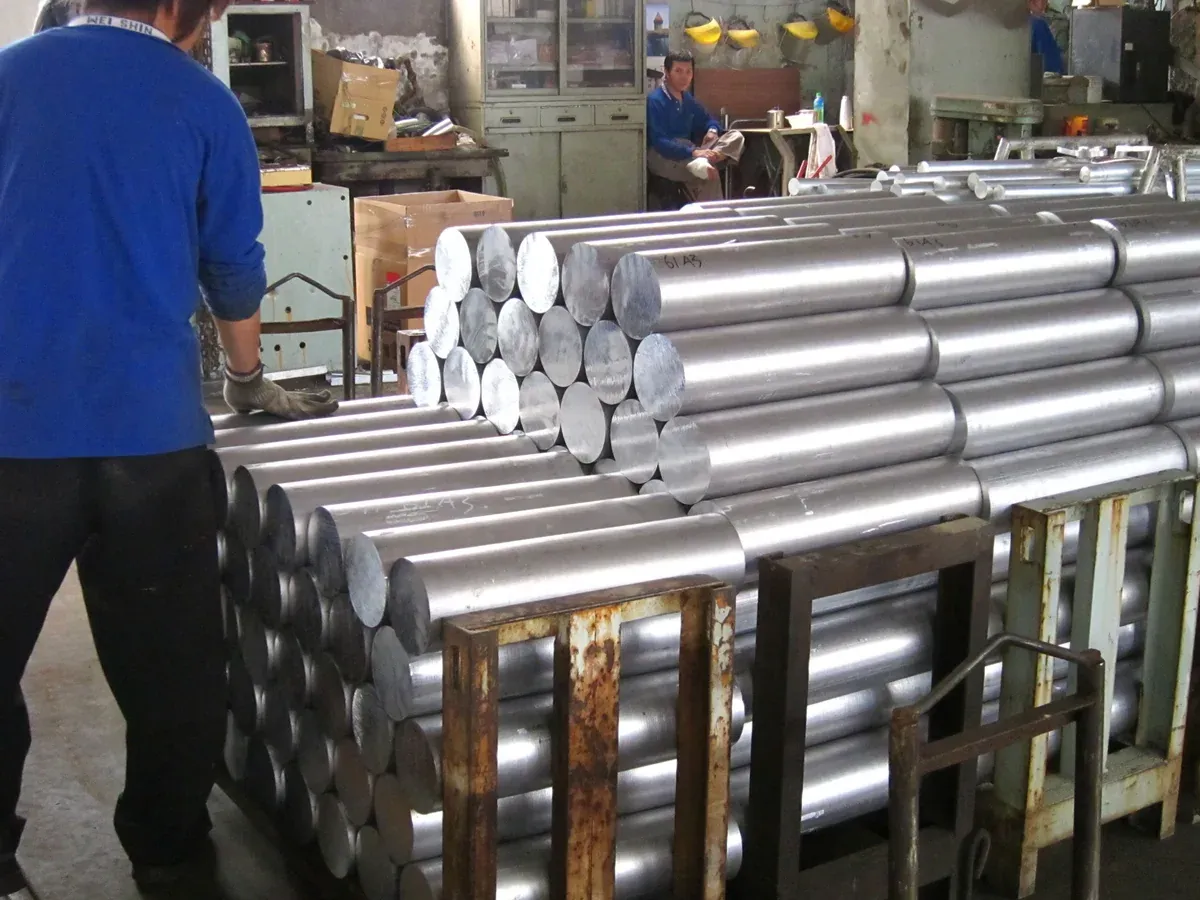
Forged plate is made by heating an aluminium ingot or billet and compressing it repeatedly between flat or simple dies on a hydraulic press, rotating and upsetting it so that the metal is worked in more than one direction. The result is a slab or block with closed internal porosity, a refined grain structure and properties that vary less between the length, width and thickness directions than in a comparable thick rolled plate.
Rolling works the metal mainly in one plane, so very thick rolled plate can show a marked difference between longitudinal and short-transverse properties, and the centre of the plate receives less deformation than the surface. Forging lets the producer control the reduction in each direction, which is why heavy, highly stressed parts such as aircraft bulkhead fittings, landing-gear supports, press platens, mould bases and pressure-vessel flanges are often machined from forged rather than rolled stock.
In standards terms, forged plate is a type of hand forging (open-die forging), covered in North America by ASTM B247 and by alloy-specific SAE AMS documents. It is different from "forged-look" or "tooling plate" products, which are rolled or cast and then machined. When a drawing simply says "forged plate", confirm whether the designer needs a true forging or just a thick, stress-relieved plate; the cost difference is significant.
| Aspect | Forged plate (hand forging) | Thick rolled plate |
|---|---|---|
| Deformation | Worked in several directions; reduction controlled by the forger | Worked mainly in the rolling plane |
| Short-transverse properties | Generally closer to longitudinal values | Lowest in the thickness direction, especially in thick plate |
| Internal soundness | Porosity closed by multi-directional working | Good, but centreline quality depends on total reduction |
| Thickness range | Very heavy sections and blocks possible | Limited by mill and quench capability |
| Shape | Rectangular, stepped or contoured near-net blanks | Flat rectangular plate only |
| Dimensional tolerance | Wider; machining allowance needed on all faces | Tighter; may be used with minimal machining |
| Cost | Higher per kg | Lower per kg |
The decision is rarely about tensile strength alone. For many parts below about 150 mm thick, stretched rolled plate such as 7075-T7351 or 7050-T7451 meets every requirement at lower cost. Forged plate earns its price when the part is very thick, needs guaranteed properties in all three directions, or has a stepped shape that would waste a large share of a rolled slab.
Forgings use their own temper designations. A "2" in the second digit after T (for example T652 or T7352) means the forging was compressed by about 1 – 5 % after quenching to relieve residual stress, the forging equivalent of the stretching that gives rolled plate its T651 temper. Order the forging temper, not the plate temper.
| Alloy | Common forging tempers | Character | Typical uses |
|---|---|---|---|
| 7075 | T6, T652, T73, T7352 | Very high strength; T73x for stress-corrosion resistance | Aircraft fittings, high-load machine parts, moulds |
| 7050 | T74, T7452 | High strength with low quench sensitivity and good SCC resistance in thick sections | Bulkheads, wing attachments, heavy structural fittings |
| 2014 | T6, T652 | High strength, good machinability, moderate corrosion resistance | Aircraft and truck structural forgings, heavy-duty parts |
| 2024 | T4, T351-type stress relieved | Good fatigue strength and toughness | Frames, connectors |
| 6061 | T6, T652 | Medium strength, weldable, corrosion resistant, excellent machinability | Flanges, mould bases, fixtures, vacuum and semiconductor parts |
| 5083 | O, H111, H112 | Non-heat-treatable; excellent seawater and cryogenic performance | Marine fittings, cryogenic flanges and tube sheets |
| 2618 / 2219 | T61, T6, T852 | Retain strength at elevated temperature | Compressor and engine parts, hot-service fittings |
Rolled-plate standards such as ASTM B209 or AMS 4045 (7075-T651 plate) do not cover forgings. For forged plate, the governing documents are ASTM B247 and the AMS specification for the alloy and forging type.
The figures below are typical longitudinal values for forgings of moderate section, rounded from published handbook data. Guaranteed minimums in ASTM B247 and AMS specifications fall as section thickness increases and are lower in the short-transverse direction, so design to the specification table for the actual thickness.
| Alloy and temper | Tensile strength | Yield strength (0.2 %) | Elongation |
|---|---|---|---|
| 7075-T6 / T652 | ≈ 570 MPa | ≈ 500 MPa | ≈ 10 % |
| 7075-T73 / T7352 | ≈ 500 MPa | ≈ 430 MPa | ≈ 12 % |
| 7050-T74 / T7452 | ≈ 510 MPa | ≈ 450 MPa | ≈ 11 % |
| 2014-T6 / T652 | ≈ 480 MPa | ≈ 415 MPa | ≈ 10 % |
| 6061-T6 / T652 | ≈ 310 MPa | ≈ 275 MPa | ≈ 12 % |
| 5083-H112 | ≈ 290 MPa | ≈ 150 MPa | ≈ 16 % |
A key point for buyers: the advantage of forged plate is uniformity and soundness, not a higher headline strength. A 7075 forging and a thin 7075-T651 plate have similar longitudinal strength. The difference appears in the centre of a 200 mm section and in the short-transverse direction, where the forging retains more of its properties.
Size limits depend on the alloy, the press used and the quench capability for heat-treatable grades. Send your finished-part envelope and we will propose a blank size.
Forged plate weighs the same per volume as any wrought plate of the same alloy: about 2.70 kg/dm³ for 6061 and 5083 (5083 is about 2.66), 2.81 for 7075 and 2.83 for 7050. A 1000 × 500 × 100 mm blank in 7075 therefore weighs about 140 kg before machining. Use the weight calculator for other sizes.
Bulkhead and wing attachment fittings, engine mounts, landing-gear supports, machined from 7050, 7075 or 2014 forgings.
Large mould bases and blow-mould blocks where through-thickness soundness prevents porosity showing on machined cavities.
Press platens, carrier plates, gear blanks and heavily loaded brackets.
Flanges, tube sheets and cryogenic fittings in 5083 and 6061.
5083 and 6061 fittings, shaft supports and heavy deck hardware.
6061 forged blanks for chamber bodies where porosity-free material helps vacuum integrity.
Not in the headline longitudinal strength. Its advantages are more uniform properties through the thickness, better short-transverse values and closed internal porosity, which matter most in very thick or fatigue-critical parts.
Solution heat-treated, stress-relieved by compressing the forging about 1 – 5 %, then artificially aged. It is the forging counterpart of the T651 temper used for stretched rolled plate.
ASTM B247 covers die forgings, hand forgings and rolled rings; aerospace orders usually add an alloy-specific AMS specification. Rolled-plate standards such as ASTM B209 do not apply.
Yes. Full-volume UT to ASTM B594 or AMS-STD-2154 is normal for aerospace and mould-making forgings. Specify the acceptance class on your purchase order.
When the section is within normal plate thickness and loads are mainly in the plane of the plate. Stretched 7075-T7351, 7050-T7451 or 6061-T651 plate is cheaper and has tighter dimensional tolerances.
Yes. Metline supplies forged plate worldwide with export packing, certificates and shipping by sea or air.
Send the drawing, alloy, temper and inspection class. We will propose the blank size and a delivered quotation.






