Round holes
The most versatile pattern; even flow and good strength retention. Standard for filtration, diffusers and acoustic use.



Perforated aluminium tube is round, square or shaped tube with a regular pattern of holes through the wall, used as filter cores, air and liquid diffusers, silencer liners, acoustic and architectural elements. It is made either by rolling and welding perforated sheet or by perforating finished seamless or extruded tube. This guide compares the two routes and explains how to choose alloy, wall thickness, hole pattern and open area.
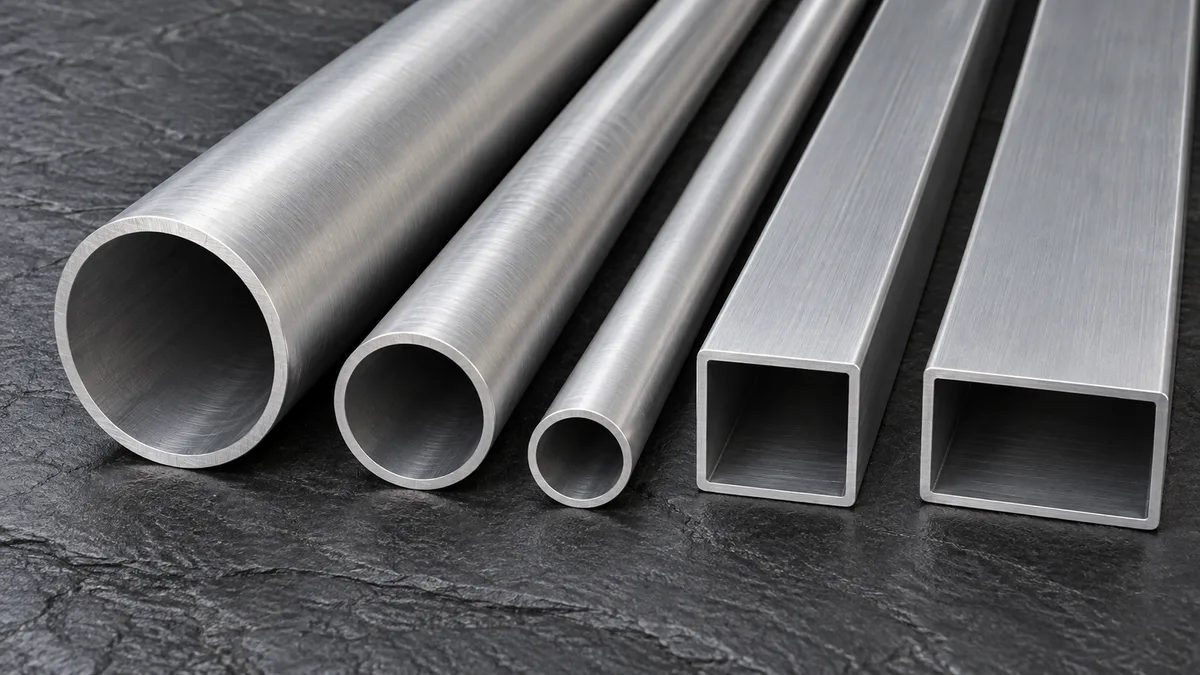
A perforated aluminium tube combines the structure of a tube with the permeability of perforated sheet. The holes let air, gas, liquid, light or sound pass through the wall in a controlled way, while the tubular shape gives stiffness, a defined flow path and simple end connections.
The product is common wherever a lightweight, corrosion-resistant permeable cylinder is needed: as the inner support core of cartridge filters, as a diffuser that spreads air or liquid evenly along a length, as the perforated liner in a silencer, or as a decorative column, light diffuser or furniture element. Aluminium is chosen over steel when weight, corrosion resistance without plating, thermal conductivity or appearance matter more than very high temperature or abrasion resistance.
Hole shapes include round, square, slotted, hexagonal, diamond and decorative patterns. Open area typically ranges from about 20 % to 65 %, and hole diameters from about 0.5 mm to 50 mm, depending on wall thickness and production route.
The right route depends mainly on size, wall thickness, quantity and whether the tube must be pressure-tight in unperforated zones.
| Aspect | Perforated sheet, rolled and welded | Seamless or extruded tube, then perforated |
|---|---|---|
| How it is made | Coil or sheet is perforated flat, then roll-formed and seam welded (straight or spiral seam) | Holes are punched, drilled or laser cut into finished tube |
| Typical size range | Medium to large diameters, thin to moderate walls | Small to medium diameters, moderate to thick walls |
| Hole options | Any sheet pattern, very high hole counts at low cost | Fewer holes, precise positions, local hole zones |
| Open area | Up to about 60 – 65 % | Usually lower, limited by machining time |
| Seam | Visible weld line; can be dressed or placed in a plain strip | No seam |
| Best for | Filter cores, diffusers, silencer liners, long lengths | Precision parts, structural tubes, sensors and manifolds |
Spiral-welded perforated tube is formed from a narrow strip wound at an angle, with the seam locked or welded. It allows large diameters and long lengths from relatively narrow coil and is common for filter cores. Straight-seam tube is made from a sheet the width of the circumference and is welded along its length by TIG, laser or high-frequency welding.
For square, rectangular and shaped tubes, a perforated extrusion or a formed and welded sheet profile can be used. Extruded 6063 or 6061 profiles are usually perforated after extrusion by punching or CNC machining.
Not every combination is possible: the hole must be no smaller than about the wall thickness, and very large diameters with thin walls need stiffening.
Hole edges are deburred inside and outside so that filter media and seals are not damaged, and so that flow is not disturbed. Tubes are inspected for diameter, straightness, roundness, hole size and position, and surface finish.
| Alloy | Typical temper | Why it is used | Typical perforated tube uses |
|---|---|---|---|
| 1060 / 1100 | O, H14 | Very ductile, easy to form and weld, highest conductivity | Light-duty diffusers, decorative tubes, heat-spreading liners |
| 3003 | H14, H24 | Stronger than pure aluminium, very good formability and weldability | Filter cores, HVAC diffusers, silencer liners |
| 5052 | H32, H34 | Higher strength and the best corrosion resistance of the common grades | Marine and outdoor equipment, water treatment, food processing |
| 6060 / 6063 | T5, T6 | Extrusion alloys with good surface and anodising response | Architectural tubes, furniture, lighting, perforated profiles |
| 6061 | T6 | Heat-treatable, strongest of the group, machines well | Structural perforated tubes, machine parts, precision perforated tubes |
Welded perforated tube is normally made from 3003 or 5052 sheet, because both form and weld easily. 6061-T6 tube loses strength near welds, so it is usually perforated after extrusion or drawing rather than formed from sheet. For anodised architectural tubes, 6063 gives the most even finish.
Mechanical properties of the parent material are reported on the mill test certificate. Perforating does not change the alloy, but it reduces the load-carrying cross-section of the tube.
The most versatile pattern; even flow and good strength retention. Standard for filtration, diffusers and acoustic use.
Higher open area for the same bar width and a clean, technical look for architectural tubes.
Directional flow and drainage; slots running along the tube axis keep more hoop strength than slots across it.
High open area with uniform bars; good for lightweight covers and guards.
Decorative patterns for lighting, ceilings and feature columns; louvred fish-scale holes also direct flow.
Holes only where needed, with plain bands at ends or joints for sealing, clamping or welding.
Open area is calculated exactly as for flat sheet: 90.69 × D² ÷ P² for round holes on a 60° stagger and 78.54 × D² ÷ P² for straight rows, where D is the hole diameter and P the pitch. For a welded tube made from perforated sheet, the figure refers to the perforated zone; plain bands and the weld strip reduce the average over the full length.
| Hole (mm) | Pitch (mm) | Open area, 60° stagger | Open area, straight |
|---|---|---|---|
| 1 | 2 | 22.7 % | 19.6 % |
| 2 | 3.5 | 29.6 % | 25.6 % |
| 3 | 5 | 32.6 % | 28.3 % |
| 5 | 8 | 35.4 % | 30.7 % |
| 8 | 12 | 40.3 % | 34.9 % |
| 10 | 15 | 40.3 % | 34.9 % |
In a filter core, the open area must be high enough that the core adds little pressure drop compared with the filter medium, but the bars must be wide enough to carry the collapse pressure. In a diffuser, the total hole area relative to the tube cross-section controls how evenly flow leaves along the length: too much hole area and most flow exits near the inlet.
The weight of a plain round aluminium tube per metre is π × (OD − t) × t × 2.70 ÷ 1000 kg, with OD and wall t in millimetres. Multiply by (1 − open area) for the perforated length. The table gives plain and perforated weights for some common sizes.
| OD × wall (mm) | Plain tube (kg/m) | At 30 % open (kg/m) | At 40 % open (kg/m) | At 50 % open (kg/m) |
|---|---|---|---|---|
| 16 × 1 | 0.127 | 0.089 | 0.076 | 0.064 |
| 20 × 1 | 0.161 | 0.113 | 0.097 | 0.081 |
| 25 × 1.2 | 0.242 | 0.170 | 0.145 | 0.121 |
| 32 × 1.5 | 0.388 | 0.272 | 0.233 | 0.194 |
| 40 × 1.5 | 0.490 | 0.343 | 0.294 | 0.245 |
| 50 × 2 | 0.814 | 0.570 | 0.489 | 0.407 |
| 63 × 2 | 1.035 | 0.724 | 0.621 | 0.517 |
| 76 × 2 | 1.255 | 0.879 | 0.753 | 0.628 |
| 100 × 2.5 | 2.068 | 1.447 | 1.241 | 1.034 |
| 150 × 3 | 3.741 | 2.618 | 2.244 | 1.870 |
| 200 × 3 | 5.013 | 3.509 | 3.008 | 2.507 |
| 300 × 4 | 10.043 | 7.030 | 6.026 | 5.022 |
Calculated from nominal dimensions and a density of 2.70 g/cm³; 5052 is about 1 % lighter. Use the tube weight calculator for other sizes.
Metline supplies the perforated tube, the plain tube and the perforated sheet used by filter, HVAC, acoustic and furniture manufacturers. The finished filters, silencers and fittings are produced by those manufacturers.
| Option | Strengths | Limitations | When to choose it |
|---|---|---|---|
| Perforated aluminium tube | Light, corrosion resistant, easy to finish and recycle | Lower strength and temperature limit than steel | General filtration, HVAC, acoustic, architectural and transport uses |
| Perforated stainless steel tube | High strength, high temperature and chemical resistance | About three times heavier, costlier, harder to form | Hot gas, aggressive chemicals, sanitary process lines |
| Expanded metal tube | Very high open area, no material wasted as slugs | Diamond pattern only, rougher surface | Light filter supports where hole shape is not critical |
| Wedge-wire screen | Precise slot width, resists clogging | More expensive, heavier construction | Fine liquid screening and well screens |
| Plastic perforated tube | Low cost, chemically inert | Low stiffness and heat resistance, creep under load | Low-temperature water and drainage |
Aluminium sits in the middle: stiffer, more heat resistant and more durable than plastic, and much lighter and easier to work than steel. Where a design needs stainless or another metal for chemical reasons, the aluminium options on this page are not a substitute, and the choice should be made on the service conditions. For most air, oil, water and acoustic duties at normal temperatures, aluminium tube is a practical and economical choice, and it remains easy to recycle at the end of its life because it is a single, uncoated or lightly coated metal.
| Aspect | Reference |
|---|---|
| Seamless drawn tube | ASTM B210, EN 754 |
| Extruded tube and profiles | ASTM B221, EN 755 |
| Welded tube | ASTM B313 (round welded tube), EN 1592 |
| Sheet used for welded tube | ASTM B209, EN 485 |
| Perforated plate specification | ISO 10630 (industrial perforated plates) |
| Material certificate | EN 10204 3.1 for the parent tube or sheet |
Typical inspection covers outside diameter and wall, length, straightness and roundness, hole size and pitch, position of plain zones, burr condition inside and outside, weld integrity on welded tubes and, where specified, coating thickness. Pressure or flow testing can be added for filter cores and diffusers by agreement.
Either by perforating flat sheet or coil and then roll-forming and welding it into a tube (straight or spiral seam), or by punching, drilling or laser cutting holes into a finished seamless or extruded tube.
Typically 20 – 65 %. Higher open area improves flow but reduces strength, so it is limited by the wall thickness and the pressure the tube must withstand.
3003 and 5052 are the usual choices because they form and weld well and resist corrosion. 5052 is preferred for wet, marine or more aggressive environments.
Yes. Plain bands at the ends or at joints are normal, so the tube can be sealed, clamped, welded or fitted with end caps.
Round tubes from about 10 mm to 650 mm outside diameter with walls of about 0.4 – 5 mm, plus square, rectangular, oval and custom sections, cut to the length you need.
Yes. Aluminium resists atmospheric corrosion, and anodising or powder coating adds colour and extra protection for architectural and outdoor equipment.
Send the alloy, size, hole pattern, plain zones, finish and quantity. Our team will confirm the best production route and a delivered price.





