Long-radius (LR) elbow
Centreline radius 1.5 × NPS. The default choice for process piping because it gives lower pressure drop and gentler flow than a short radius elbow.



An aluminium elbow changes the direction of a pipe or tube run, most often by 45°, 90° or 180°. Industrial butt-weld elbows are made to ASTM B361 with dimensions from ASME B16.9, while mandrel-bent tube elbows serve automotive, HVAC and compressed-air systems. This guide explains the types, alloys, radii, sizes and inspection points so you can specify the right elbow first time.
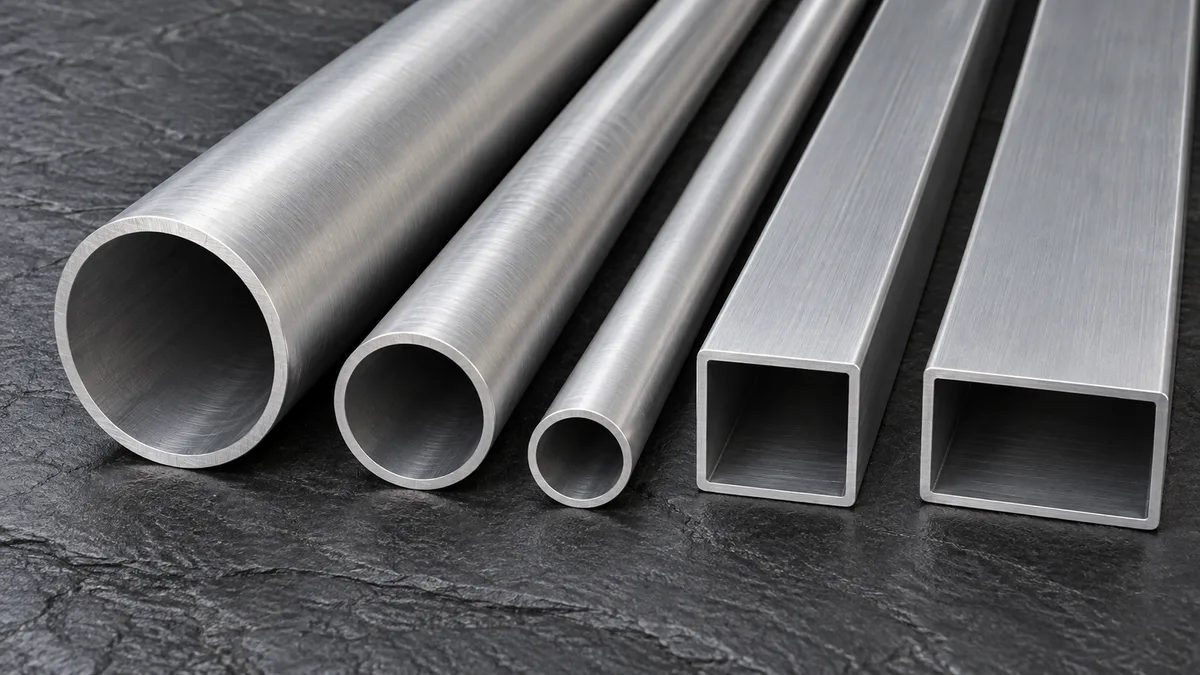
An elbow is the fitting that turns a pipeline. Every change of direction in a process line, a compressed-air ring main, a cryogenic transfer line, a ship’s piping system or a turbocharger intake needs one. In aluminium systems the elbow must match the pipe in alloy, wall thickness and end preparation, or it becomes the weak point of the line.
Two families of product share the name. Pipe elbows are standardised fittings sized by nominal pipe size (NPS or DN) and schedule, with fixed centre-to-end dimensions, and are welded, threaded or flanged into industrial piping. Tube bends (often called mandrel-bent elbows) are formed from tube sized by actual outside diameter and wall thickness, with a radius chosen by the designer, and are common in vehicles, HVAC, food processing and architecture.
Aluminium is chosen for elbows where the whole system benefits from low weight (about one third of the weight of steel), resistance to atmospheric and many chemical environments, non-sparking behaviour, good toughness at cryogenic temperatures and high thermal conductivity. Metline supplies aluminium pipe, tube, bar and forgings for elbow production, and finished elbows and bends to drawing, to buyers worldwide.
Centreline radius 1.5 × NPS. The default choice for process piping because it gives lower pressure drop and gentler flow than a short radius elbow.
Centreline radius 1.0 × NPS. Used where space is tight; higher pressure drop and, under pressure, higher stress at the inner wall, so check the pressure rating.
Turns the line by half a right angle. Two 45s with a short straight between them give a softer 90° turn for slurries or high-velocity flow.
Reverses the flow direction. Used in heat-exchanger coils, heaters and serpentine lines; available in long and short radius.
Changes direction and pipe size in one fitting, saving a separate reducer and a weld.
Bent from tube over an internal mandrel to keep the bore round. Any angle and radius from about 1D upward; used in intake, intercooler and exhaust ducting and in HVAC.
Fabricated from cut and welded pipe segments. Economical for large-diameter, low-pressure ducts and pipes where a formed elbow is not practical.
Small-bore fittings for quick assembly. Threaded aluminium joints suit low-pressure air and fluid lines; thin-wall pipe cannot be threaded without losing too much wall.
Flanged elbows bolt into a line for easy removal. Push-fit elbows with internal seals are the norm in modular aluminium compressed-air systems.
The manufacturing route affects wall thickness distribution, grain flow, cost and the sizes that can be produced. ASTM B361 allows the fittings to be made from rod, bar, forgings, sheet, plate, seamless pipe or seamless tube, provided the alloy and temper match the order.
| Method | How it works | Typical sizes | Notes |
|---|---|---|---|
| Hot mandrel (Hamburg) forming | Seamless pipe is pushed over a heated, horn-shaped mandrel that expands and bends it | NPS ½ to about 24 | The usual route for seamless butt-weld elbows; wall thickness controlled to B16.9 limits |
| Cold mandrel bending | Tube is drawn around a bend die with a mandrel inside to stop collapse | OD 6 – 150 mm typical | Tube bends with plain ends; radius from about 1D with mandrel and wiper die |
| Press forming and welding | Two half-shells pressed from plate are seam-welded | Large diameters | Welded seams must be radiographed where the code requires |
| Forging and machining | A forged block is machined to the elbow shape and bore | Small, thick-walled, high-pressure fittings | Good grain flow and density; higher cost |
| Segment fabrication | Pipe cut into wedge segments and welded | Large ducts and low-pressure lines | Higher pressure drop at the mitres |
| Casting | Molten alloy poured into a mould | Complex, low-pressure fittings | Cast alloys only; not covered by B361 |
After forming, heat-treatable alloys such as 6061 and 6063 are usually solution heat-treated and aged back to T6, because hot forming leaves the metal in an uncontrolled condition. Non-heat-treatable alloys such as 3003 and 5083 are supplied annealed (O) or in the as-fabricated (H112) condition. Ends are then machined to the required bevel, normally 37.5° for butt welding.
ASTM B361 designates fittings with a WP prefix followed by the alloy and temper, for example WP6061-T6 or WP5083-O. The alloy should normally be the same as, or weld-compatible with, the pipe it joins.
| Alloy | Condition | Properties | Where it is used |
|---|---|---|---|
| 6061 | T6 | High strength (typical 310 MPa tensile, 276 MPa yield), good corrosion resistance, weldable | General process piping, compressed air, structural and vehicle tube systems |
| 6063 | T5, T6 | Lower strength than 6061 but excellent surface and bending response | Architectural handrails, air piping, HVAC and decorative bends |
| 5083 / 5086 | O, H112 | Excellent seawater resistance, high as-welded strength, tough at cryogenic temperatures | Marine piping, LNG and cryogenic lines, offshore utilities |
| 3003 | O, H112 | Moderate strength, very formable, good corrosion resistance | Low-pressure fluid lines, heat-exchanger return bends, chemical service |
| 1060 / 1100 | O, H112 | Highest conductivity and corrosion resistance, low strength | Chemical and food handling, electrical bus pipe bends |
| 5052 / 7075 | O to T6 | 5052 forms well; 7075 is very strong but not weldable by fusion | Bent tube for vehicles, sports equipment and aerospace parts, not welded piping |
Typical properties above are Aluminum Association values; the order standard sets the guaranteed minimums. Remember that welding softens heat-treated alloys: the heat-affected zone of 6061-T6 drops to roughly 165 MPa tensile strength, so piping codes such as ASME B31.3 use reduced allowable stresses for welded 6061 unless the assembly is re-heat-treated. 5083 loses far less strength on welding, which is one reason it is preferred for marine and cryogenic lines.
Aluminium butt-weld elbows use the same centre-to-end dimensions as steel fittings, so they fit the same piping layouts. The pipe outside diameter follows ASME B36.10, and aluminium pipe wall thickness is normally ordered by schedule (5, 10, 40 or 80) to ASTM B241 or B241M. The table shows the main centre-to-end dimensions in millimetres.
| NPS | Pipe OD (mm) | 90° LR centre-to-end | 90° SR centre-to-end | 45° LR centre-to-end | 180° LR centre-to-centre |
|---|---|---|---|---|---|
| 1 | 33.4 | 38 | 25 | 22 | 76 |
| 1-1/2 | 48.3 | 57 | 38 | 29 | 114 |
| 2 | 60.3 | 76 | 51 | 35 | 152 |
| 2-1/2 | 73.0 | 95 | 64 | 44 | 190 |
| 3 | 88.9 | 114 | 76 | 51 | 229 |
| 4 | 114.3 | 152 | 102 | 64 | 305 |
| 6 | 168.3 | 229 | 152 | 95 | 457 |
| 8 | 219.1 | 305 | 203 | 127 | 610 |
| 10 | 273.0 | 381 | 254 | 159 | 762 |
| 12 | 323.8 | 457 | 305 | 190 | 914 |
Values rounded to the nearest millimetre from ASME B16.9 tables. Confirm against the current edition of the standard for design and fabrication drawings.
ASME B16.9 also requires that the wall thickness at any point of the fitting is at least 87.5 % of the nominal wall of the pipe it matches. Because forming stretches the outer wall (the extrados) and thickens the inner wall (the intrados), manufacturers start with heavier pipe or control the process to stay within that limit. Ask for wall-thickness measurements at the extrados on critical orders.
A good elbow is round, has the right wall thickness all the way round the bend, and is free of wrinkles and cracks. The following checks are standard for industrial orders:
| Sector | Typical elbow | Why aluminium |
|---|---|---|
| Compressed-air distribution | 6063 or 6061 push-fit or flanged elbows, 20 – 110 mm | No internal rust, low friction, light and fast to install |
| Cryogenic and LNG | 5083 or 6061 butt-weld elbows | Strength and toughness increase at low temperature; no ductile-brittle transition |
| Marine and offshore | 5083 / 5086 elbows matching hull-grade pipe | Seawater corrosion resistance and weldability |
| Chemical and food processing | 1060, 3003 or 5052 elbows | Resistance to nitric acid, many organics and food products |
| HVAC and refrigeration | 3003 and 6063 return bends and tube bends | Formability, conductivity and low weight |
| Automotive and motorsport | 6061 and 5052 mandrel bends | Intake, intercooler and coolant tubing with smooth bores |
| Architecture | 6063 bends for handrails and frames | Excellent anodised and powder-coated appearance |
| Electrical substations | 6063 or 6101 bus-pipe bends | High conductivity and corrosion resistance |
Aluminium is not suited to every service. Strong alkalis, mercury and some chlorinated solvents attack it, and its allowable stress falls above about 150 – 200 °C. For hot, high-pressure steam lines, steel or stainless elbows remain the right choice. Where aluminium piping meets steel equipment, use an insulating flange kit or a bimetallic transition joint to prevent galvanic corrosion.
A long-radius elbow has a centreline radius of 1.5 times the nominal pipe size; a short-radius elbow has 1.0 times. Long radius gives lower pressure drop and lower wall stress and is the default; short radius saves space where the layout is tight.
CLR is the distance from the centre of the bend arc to the centre line of the tube. A smaller CLR makes a more compact bend but thins the outer wall more, increases ovality and pressure loss, and needs a mandrel to avoid wrinkling. Choose the largest CLR the space allows.
ASTM B361 covers the material, manufacture and testing of factory-made wrought aluminium welding fittings, and refers to ASME B16.9 (and B16.11 for socket-weld fittings) for dimensions. Older documents cite ASME B16.28 for short-radius elbows; that standard was withdrawn and its content moved into B16.9.
Not directly. Aluminium and steel cannot be fusion welded together. Use a flanged joint with an insulating gasket kit, or a bimetallic transition joint made by explosion welding, then weld aluminium to aluminium on one side and steel to steel on the other.
Seamless elbows formed from seamless pipe avoid a longitudinal weld and are preferred for pressure and cyclic service. Welded elbows made from plate are economical in large diameters where seamless pipe is not available; their seams should be inspected as the piping code requires.
Mill finish is normal for process piping. Bends for architecture and vehicles can be polished, anodised or powder coated. Galvanising, which applies to steel, is not used on aluminium.
Tell us the size, angle, radius, alloy and quantity. We will confirm the manufacturing route, certification and a delivered price worldwide.





