Equal-wall tapered tube
Outside diameter tapers from one end to the other while the wall stays constant. Common in pantograph frames, masts and poles.



An aluminium reducer pipe is a tube whose outside diameter, wall thickness or cross-section changes along its length, either gradually as a taper or in steps at the ends. Engineers use it to put metal only where the load is, to join tubes of different sizes without a separate fitting, or to give a structure a cleaner aerodynamic or visual shape. This guide covers the main types, alloys, forming methods and how to specify them; Metline supplies reducer and tapered tube worldwide.
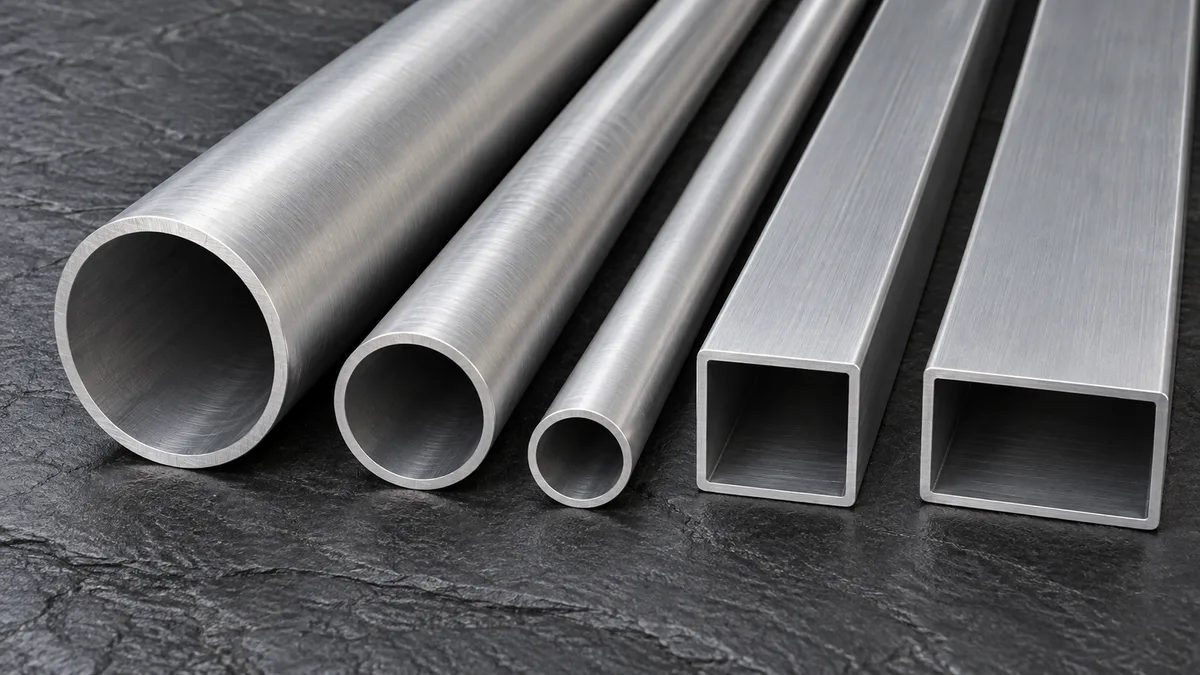
In aluminium tube supply, "reducer pipe" usually means a variable-section tube produced from one piece: diameter, wall or shape changes along the length. It is different from a butt-weld reducer fitting, a short concentric or eccentric cone welded between two pipe sizes in a piping system. Both exist in aluminium; this guide focuses on variable-section tube, with fittings covered in our pipe fittings guide.
A one-piece variable-section tube avoids welds and their heat-affected zones, which in heat-treatable alloys can lose a third or more of the parent strength. It also avoids the stress concentration at a joint and the extra weight of sleeves and fasteners. That is why tapered aluminium tube appears in pantograph arms, antenna masts, lighting poles, sports equipment and aircraft and vehicle struts.
Outside diameter tapers from one end to the other while the wall stays constant. Common in pantograph frames, masts and poles.
Constant section along most of the length, with reduced diameters at one or both ends to fit into bearings, bushes or adjoining tubes.
Outside size stays constant while the wall thins along the length, putting thickness where the bending moment is highest.
Elliptical or other non-circular sections that change in size, used for aerodynamic or stiffness reasons in rail and aircraft structures.
Several diameters stepping down along the length so sections telescope or nest together, typical of antenna and mast elements.
Large tapered tubes for street lighting and flagpoles, formed from straight tube by spinning or tapering machines.
The examples below show the kind of geometry and tolerances buyers specify. They are generic illustrations, not catalogue items: every reducer tube is made to a drawing.
| Application | Alloy & temper | Typical geometry | Notes |
|---|---|---|---|
| Rail pantograph arm | 7020-T6 | OD tapering from about 60 mm to 42 mm, 3 mm constant wall | High strength and fatigue resistance; weldable Al-Zn-Mg alloy |
| Structural strut, variable wall | 2024-T351 | 70 mm OD, wall tapering from about 11.5 mm to 3.5 mm over several metres | Wall tolerance agreed per section, OD around ±0.3 mm |
| Machine connector tube | 6061-T6 | OD stepping from 75 mm to 45 mm, thin constant wall | Tight end diameters and concentricity specified |
| Oval rail component | 7020-T6 | Elliptical section reducing along the length, constant wall | Shape and twist tolerances on the drawing |
| Antenna element | 2024-T4 / 2A12-T4 | Three diameters, for example 40, 35 and 31 mm, constant 2.5 mm wall | Dimensional accuracy for nesting and electrical contact |
For reference, EN 755-2 sets minimum properties for 7020-T6 extruded tube of about 350 MPa tensile and 290 MPa yield, with 10 % elongation; 6061-T6 tube to ASTM B221 has a minimum of 260 MPa tensile and 240 MPa yield. Properties in tapered zones depend on the forming route and any re-heat-treatment, so agree test locations on the drawing.
| Method | How it works | Best for |
|---|---|---|
| Drawing over a tapered mandrel | Tube is drawn through a die over a shaped mandrel to reduce diameter or wall progressively | Accurate tapers and variable wall in smaller diameters |
| Rotary swaging | Hammering dies rotate around the tube and reduce the diameter locally | Stepped ends, short tapers, antenna and sports tubes |
| Spinning and flow forming | A roller forms the tube over a rotating mandrel | Long tapers, poles, thin-walled cones |
| Push-pointing and end forming | Ends are pushed into a die to reduce diameter | Short reductions for joints and inserts |
| Variable-wall extrusion or machining | Wall is varied during extrusion or bored internally after extrusion | Inner-cone tubes with constant outside size |
| Hydroforming | Internal pressure expands tube into a shaped die | Complex shapes and oval transitions |
Heat-treatable alloys are often formed in a soft temper (O or W, freshly quenched) and then solution treated and aged to T6, or formed in T4 and artificially aged afterwards. Forming in the fully hard T6 temper is possible only for gentle tapers, because elongation is limited.
| Alloy | Strengths | Watch out for |
|---|---|---|
| 6061-T6 | Good strength, weldable, easy to form in O/T4 and age | Moderate strength compared with 7xxx |
| 6063-T5/T6 | Excellent surface for anodising; poles and decorative tapers | Lower strength |
| 7020-T6 | High strength, good fatigue and weldability; regains strength by natural ageing after welding | Needs correct heat treatment to avoid stress corrosion |
| 2024-T351 / T4 | High strength and fatigue resistance for struts and antenna parts | Poor weldability and corrosion resistance; anodise or paint |
| 5052 / 5083 | Excellent corrosion resistance, marine use | Non-heat-treatable; strength from cold work only |
A reducer tube is a single long tube whose diameter or wall changes along its length. A reducer fitting is a short cone welded between two pipes of different sizes in a piping system.
7020-T6 is widely used because it combines high strength and fatigue resistance with good weldability. 6061-T6 and 6082-T6 are alternatives for less demanding parts.
Yes. Heat-treatable alloys are often formed soft and then solution treated and aged, so the finished tube reaches full T6 properties along its length.
They depend on size and method. Drawn and machined ends can be held to a few hundredths of a millimetre on diameter; long tapers usually carry wider tolerances. The drawing sets the limits.
Yes. Send the drawing, alloy, temper and quantity and we confirm the forming route, inspection and delivery.
Send your drawing, alloy and quantity. We reply with the manufacturing route, certification and a delivered price.





