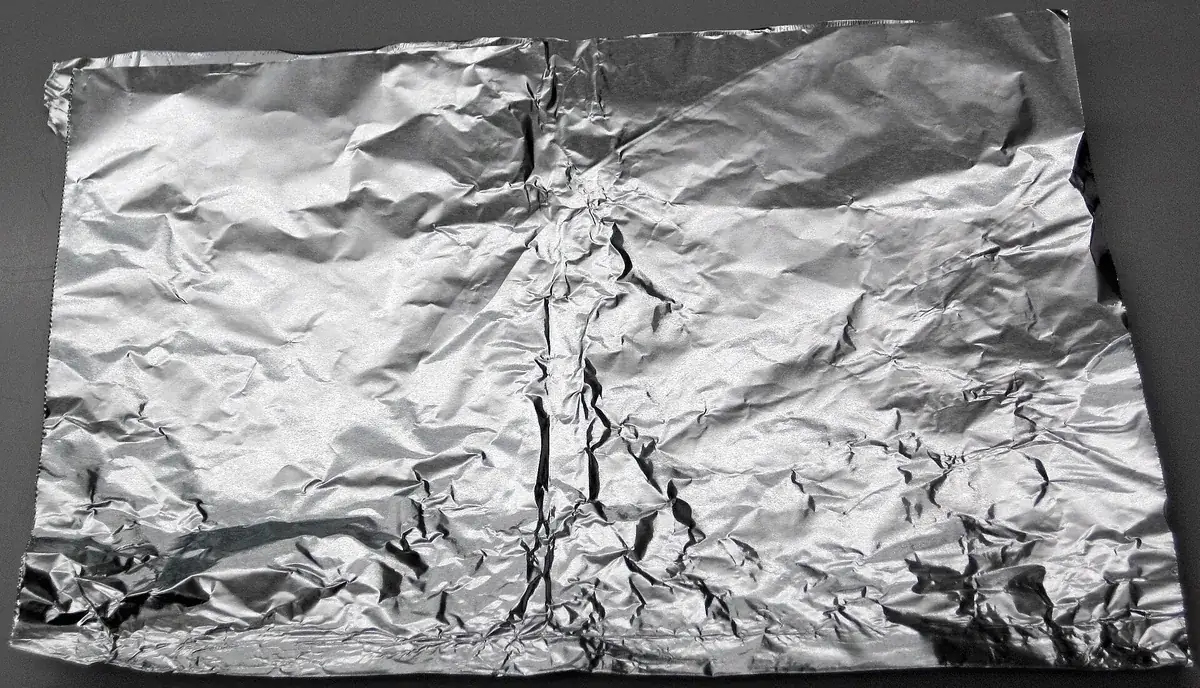
Cooking bag foil is soft, fully annealed (O temper) aluminium foil in alloys 1235, 8011 or 8079, used either as the barrier layer inside laminated cook-in and retort pouches or, in heavier gauges, as the wall of self-supporting foil grill and oven bags. The right choice depends on gauge: 1235 and 8079 for very thin laminating foil of about 6 – 9 µm, 8011 or 8079 from about 9 µm upwards. This guide covers alloys, properties, quality checks and how to specify foil for a cooking-bag line.
"Cooking bag foil" covers two related products. The first is thin foil laminated with plastic films or paper to make pouches that are filled, sealed and then cooked, sterilised or reheated: boil-in bags, retort pouches, steam-cook bags and microwave-safe sachets where the foil is shielded. The second is heavier plain or embossed foil folded and crimped into grill bags and oven bags that hold food directly over a barbecue or in an oven.
Both rely on what aluminium foil does better than any plastic film: it is a complete barrier to light, oxygen, moisture and aroma at practical gauges, it tolerates oven temperatures far above the melting point of polymer films, and it spreads heat evenly so food cooks without hot spots. Both also need the foil to be soft and ductile, which is why cooking-bag foil is supplied in the fully annealed O temper rather than the hard H18 temper used for some lidding and technical foils.
For the laminator or bag maker, the critical properties are not strength alone but a clean, dry, oil-free surface that bonds well to adhesives, a low pinhole count at thin gauges, consistent thickness across the web and coils that unwind flat at high line speeds.
Chemical composition
1235, 8011 and 8079: composition (wt %)
All three alloys are registered by the Aluminum Association and appear in ASTM B479 (annealed foil for flexible barrier and food-contact use) and EN 573-3. Their compositions also fall within EN 602, the European standard for the chemistry of aluminium semi-finished products intended for contact with food.
Element
1235
8011
8079
Silicon (Si)
Si + Fe ≤ 0.65
0.50 – 0.90
0.05 – 0.30
Iron (Fe)
(see Si + Fe)
0.60 – 1.00
0.70 – 1.30
Copper (Cu)
≤ 0.05
≤ 0.10
≤ 0.05
Manganese (Mn)
≤ 0.05
≤ 0.20
—
Magnesium (Mg)
≤ 0.05
≤ 0.05
—
Chromium (Cr)
—
≤ 0.05
—
Zinc (Zn)
≤ 0.10
≤ 0.10
≤ 0.10
Titanium (Ti)
≤ 0.06
≤ 0.08
—
Vanadium (V)
≤ 0.05
—
—
Others, each / total
0.03 / —
0.05 / 0.15
0.05 / 0.15
Aluminium (Al)
≥ 99.35
Remainder
Remainder
Registered limits; the mill certificate reports the actual analysis of each lot.
1235
Commercially pure aluminium (99.35 % min). Its low alloy content lets it be rolled to 6 – 7 µm with good conductivity and formability. The Fe/Si ratio, not just the total, affects work hardening during rolling and the final strength after annealing.
8011
Al-Fe-Si alloy with small Mn and Cu additions. Stronger and stiffer than 1235 at the same gauge, so it is the workhorse for 9 – 40 µm foil, grill-bag foil and container foil.
8079
High-iron, low-silicon alloy. Iron-rich particles refine the grain, giving foil that stays tough with fewer pinholes at very thin gauges. Preferred for 6 – 9 µm laminating foil where puncture resistance matters.
Supply range
Typical cooking bag foil specifications
Parameter
1235
8011
8079
Temper
O
O
O
Typical thickness
6 – 9 µm (laminating)
9 – 40 µm (laminating and grill bags)
6 – 12 µm (laminating)
Width
about 300 – 1,700 mm
about 300 – 1,600 mm
about 300 – 1,600 mm
Core inside diameter
76 mm (3 in) or 152 mm (6 in)
76 or 152 mm
76 or 152 mm
Surface
One side bright, one matt (double-rolled) or two sides bright
Two sides bright or one side matt
One side bright, one matt
Wettability
Class A (water brush test) for laminating
Class A
Class A
Gauges below about 9 µm are rolled in pairs ("doubled") on the final pass, which is why thin foil has one bright face (against the work roll) and one matt face (against the other foil). The matt side is usually laminated inwards.
Mechanical properties
Mechanical properties of O-temper foil
In O temper, foil strength is low and elongation rises sharply with thickness, because a thin foil has only a few grains across its section. The ranges below are typical for annealed 8xxx foil; the governing limits for each gauge band are in EN 546-2 or ASTM B479 and are reported on the certificate.
Thickness band
Typical tensile strength
Typical elongation
Comment
6 – 9 µm
about 50 – 100 MPa
about 1 – 4 %
Laminating foil; strength comes mainly from the film layers
9 – 18 µm
about 60 – 110 MPa
about 3 – 8 %
Laminating and household gauges
18 – 40 µm
about 70 – 120 MPa
about 6 – 15 %
Self-supporting grill and oven bags, container foil
Indicative values only. 8079 and 8011 generally show higher strength and elongation than 1235 at the same gauge.
For a self-supporting grill bag, elongation is as important as tensile strength: the foil has to survive folding, crimped seams and handling of hot food without cracking at the folds. For laminated pouches, the film layers carry most of the load, and the foil's job is to stay intact (pinhole-free and crack-free) through lamination, pouch making, filling and retorting.
Quality
Quality requirements that matter for cooking bags
What to specify and check
Pinholes
Counted on a light table per m² by gauge band (EN 546-4); thin laminating foil is specified with a maximum count and a maximum pinhole size
Surface cleanliness
Annealing removes rolling oil; a Class A water-brush result confirms the surface is fully wettable for adhesives and inks
Thickness tolerance
Per EN 546-3 or the agreed specification, typically checked by weight per area (g/m²)
Width and slitting
Clean, burr-free edges; width tolerance around ±1 mm or as agreed
Coil quality
No telescoping, loose wraps, creases, splices beyond the agreed number, or collapsed cores
Metallurgy
Low hydrogen and inclusion content in the melt, fine grain after annealing; both reduce pinholes
Food contact
Composition to EN 602; declaration of compliance with EU Regulation 1935/2004 or the destination's food-contact rules on request
Most pinholes in thin foil start from inclusions or gas pores in the cast strip that the foil becomes too thin to bridge. That is why foil rollers control melt filtration and degassing so tightly, and why 8079, with its finer grain, is chosen when a laminator needs low pinhole counts at 6 – 7 µm.
Applications
Common cooking and retort bag structures
Bag type
Typical structure (outside → inside)
Process temperature
Foil used
Retort pouch
PET 12 µm / Al foil 7 – 9 µm / (nylon) / CPP 70 – 80 µm
Sterilised at about 121 – 135 °C
8079 or 1235 O
Boil-in or steam-cook bag
PET / Al foil / PP or PE sealant
Up to about 100 – 121 °C
8079, 8011 or 1235 O
Oven or roasting bag with foil layer
Paper / Al foil, or plain foil
Oven temperatures, typically up to about 220 – 250 °C
8011 O
Grill or barbecue bag
Plain or embossed foil, folded and crimped
Direct grill heat
8011 O, heavier gauge
Stand-up pouch
PET / Al foil / PE, with gusset
Ambient or hot fill
8079 or 1235 O
Polymer layers set the upper temperature for laminated bags; plain foil itself withstands normal oven temperatures without change. Foil-containing pouches must not be heated in a microwave unless the package is specifically designed for it.
Ordering
How to order cooking bag foil
Define the end useRetort pouch, cook-in bag or grill bag, the laminate structure and the process temperature.
Choose alloy and gauge1235 or 8079 for 6 – 9 µm, 8011 or 8079 above; state temper O.
Set coil detailsWidth, coil outside diameter or weight, core size, splice limits and winding direction (bright side in or out).
Packing and shippingCoils in sealed, desiccated film inside wooden cases, eye-to-sky or eye-to-wall; EXW, FOB, CIF or DAP with an EN 10204 3.1 certificate.
EN 602 – Aluminium and aluminium alloys: wrought products, chemical composition of semi-finished products for food contact
EN 546-2 / -3 / -4 – Aluminium and aluminium alloys: foil, mechanical properties, tolerances and special requirements
EN 573-3 – Chemical composition and form of wrought products
Regulation (EC) No 1935/2004 on materials and articles intended to come into contact with food
FAQ
Cooking bag foil (aluminum foil for bags): FAQs
Which alloy is best for cooking bag foil?
For 6 – 9 µm laminating foil, 8079 gives the best toughness and pinhole performance, with 1235 as a common alternative. For 9 µm and above, and for self-supporting grill bags, 8011 is the usual choice.
Why is cooking bag foil supplied in O temper?
Annealing makes the foil soft and ductile so it folds, crimps and laminates without cracking, and it burns off rolling oil so adhesives bond properly.
Is 8011 or 8079 foil food safe?
Both alloys meet the food-contact composition limits of EN 602 and are covered by ASTM B479 for food-contact foil. A declaration of compliance for the destination market can be supplied with the shipment.
What thickness is used in retort pouches?
Usually 7 – 9 µm, laminated between a PET outer film and a CPP sealant layer. Heavier gauges add cost without improving the barrier.
Can foil cooking bags go in an oven?
Plain foil bags and paper-foil bags are made for oven and grill use. Laminated pouches are limited by their plastic layers, so follow the temperature stated for that structure.
How are cooking bag foil coils packed for export?
Each coil is wrapped in film with desiccant, fixed on a pallet or cradle and enclosed in a wooden case, with core plugs to prevent crushing.
Sourcing foil for cooking or retort bags?
Share the alloy, gauge, width, laminate build and quantity. We will confirm the specification, certification and delivered price.