


Aluminium Strip for Computer Radiators
Computer coolers, from CPU and GPU air coolers to server heat sinks and liquid-cooling radiators, dissipate heat through thin aluminium fins. Those fins are stamped or folded from high-conductivity aluminium strip, typically 1060, 1100, 1200 or 8011 in a half-hard H16 or H26 temper. This guide covers the grades, sizes, tolerances and properties that fin makers specify.
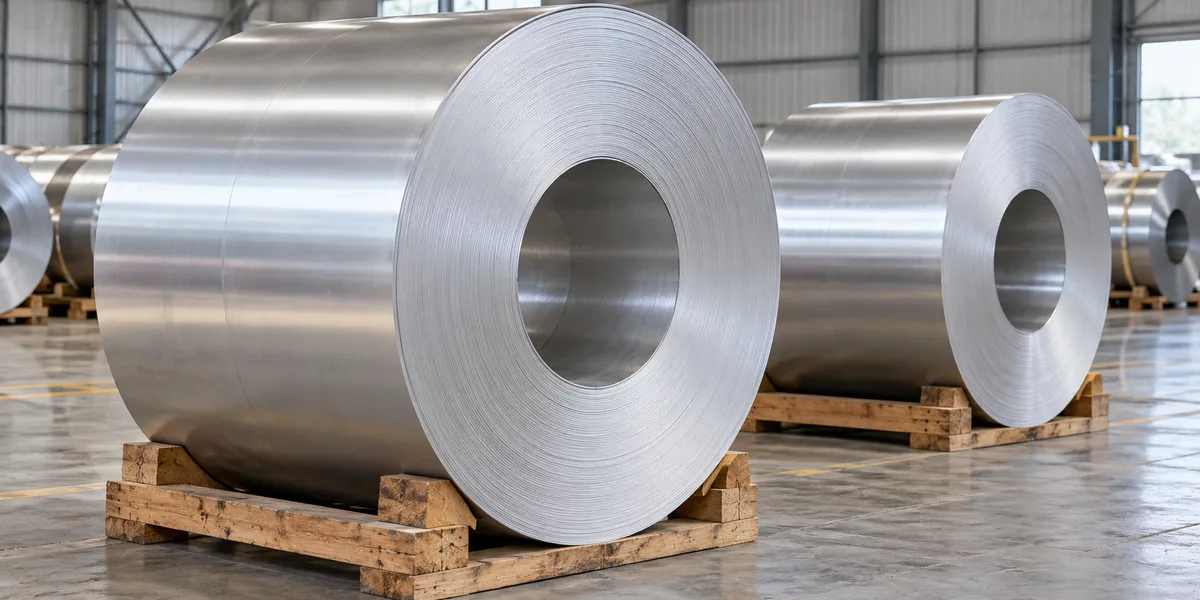
- Grades
- 1060, 1100, 1200, 8011
- Tempers
- H16, H26
- Thickness
- 0.21 – 1.5 mm
- Width
- 150 – 1,550 mm, slit narrower on request
Why aluminium strip is used for computer cooling
A processor can produce well over 100 W in a few square centimetres. A cooler spreads that heat through a copper base or heat pipes into a stack of fins, and air flowing between the fins carries it away. The fins make up most of the surface area and most of the weight of the cooler.
Aluminium is the default fin material because it offers about 55 – 60 % of the thermal conductivity of copper at roughly 30 % of the density, and at a much lower cost. For a fin, where heat only has to travel a few millimetres, high conductivity per kilogram matters more than absolute conductivity. Aluminium also stamps cleanly at high speed, resists corrosion indoors and takes coatings or anodising for colour.
Fin makers buy the aluminium as precision strip coils, which they feed into progressive dies to punch, form and stack "zipper" fins that interlock, or into folding machines that make corrugated fins. Consistent thickness, flatness and temper are essential, because tiny variations change fin pitch and stop the fins locking together.
Grades and why they are chosen
| Grade | Composition | Thermal conductivity (typical, O temper) | Why it is used |
|---|---|---|---|
| 1060 | Al ≥ 99.60 % | About 234 W/m·K | Highest conductivity of the common grades; soft and easy to stamp |
| 1100 | Al ≥ 99.00 %, Cu 0.05 – 0.20 % | About 222 W/m·K | Slightly stronger than 1060 with good conductivity |
| 1200 | Al ≥ 99.00 % | Similar to 1100 | European equivalent pure grade with a good balance of cost and conductivity |
| 8011 | Fe 0.6 – 1.0 %, Si 0.5 – 0.9 % | Lower than pure grades | Higher strength and stiffness for thin, tall fins that must not bend |
Conductivity drops a little with cold work, so H16 and H26 strip conducts slightly less than annealed metal, but the extra stiffness keeps thin fins straight during stamping and handling. Copper fins (around 390 W/m·K) are used only where every degree matters, such as in compact high-end coolers, because they are over three times heavier.
Typical specification of radiator strip
| Grade | Temper | Thickness (mm) | Width (mm) | Coil ID (mm) | Coil OD (mm) |
|---|---|---|---|---|---|
| 1060, 1100, 1200, 8011 | H16, H26 | 0.21 – 1.50 | 150 – 1,550 | 400, 500 | 700 – 1,400 |
H16 is strain-hardened to about three-quarters hard. H26 reaches a similar strength by rolling harder and then partially annealing, which gives slightly better elongation and is often preferred for fins with deep collars or louvres. Narrow slit widths for specific fin dies can be supplied on request.
Thickness and width tolerances
Fin strip is ordered to tighter tolerances than general sheet. The values below are typical agreed tolerances for precision radiator strip; the general cold-rolled tolerances of EN 485-4 or ASTM B209 are wider and should not be relied on for fin stamping.
| Thickness (mm) | Thickness tolerance (mm) | Variation within one coil (mm) |
|---|---|---|
| 0.21 – 0.30 | ± 0.010 | ≤ 0.020 |
| > 0.30 – 0.60 | ± 0.015 | ≤ 0.020 |
| > 0.60 – 1.50 | ± 0.020 | ≤ 0.020 |
| Width (mm) | Width tolerance (mm) |
|---|---|
| 150 – 600 | ± 0.5 |
| > 600 – 1,550 | ± 1.0 |
Also specify flatness (coil set and edge wave), burr height on slit edges and surface cleanliness. Oil residues interfere with stamping lubricants, adhesive bonding and soldering of fins to heat pipes.
Mechanical properties
Typical values from the Aluminum Association for the pure grades show how cold work raises strength. Specified ranges for H16 and H26 strip depend on the order standard and thickness, and are reported on the mill certificate.
| Grade-temper | Typical tensile strength | Typical yield strength | Comment |
|---|---|---|---|
| 1060-O | 69 MPa | 28 MPa | Fully soft reference |
| 1060-H16 | 110 MPa | 103 MPa | Common fin temper |
| 1100-O | 90 MPa | 34 MPa | Fully soft reference |
| 1100-H16 | 145 MPa | 138 MPa | Stiffer fins |
Typical values, not specified minimums. Elongation of H16/H26 fin strip is low (a few per cent at thin gauges) and rises with thickness; H26 generally gives more elongation than H16 at similar strength.
Where radiator strip is used
- CPU and GPU air coolers: stacked zipper fins on heat pipes, typically 0.3 – 0.5 mm
- Server and data-centre heat sinks: dense fin stacks for high airflow chassis
- Laptop and console cooling modules: thin fin stacks at the blower outlet
- Power electronics: fin stacks on inverter, LED driver and power supply heat sinks
- Liquid-cooling radiators: folded fins; brazed radiators use clad brazing strip rather than bare strip
For brazed radiators, where fins and tubes are joined in a furnace, the fin is made from brazing sheet with an aluminium-silicon cladding, or bare fin is combined with clad tubes. Bare 1xxx and 8011 strip suits mechanically assembled, soldered or bonded fin stacks.
How to order radiator strip
- Grade and temperFor example 1060-H26 or 1100-H16.
- DimensionsThickness and tolerance, slit width, coil ID and maximum OD or coil weight.
- QualityFlatness, burr limits, surface cleanliness and mechanical property range.
- Documents and packingEN 10204 3.1 mill certificate; coils packed eye-to-wall or eye-to-sky with moisture protection; EXW, FOB, CIF or DAP.
References and standards
- ASTM B209 – Aluminium and aluminium-alloy sheet and plate
- EN 485-2 and EN 485-4 – Sheet, strip and plate: mechanical properties and tolerances for cold-rolled products
- EN 573-3 – Chemical composition and form of wrought products
- The Aluminum Association – Aluminum Standards and Data (typical properties)
Aluminium (aluminum) strip for computer radiators: FAQ
Which aluminium grade is best for heat sink fins?
1060 gives the highest thermal conductivity of the common grades. 1100 and 1200 are slightly stronger, and 8011 is chosen for thin, tall fins that need extra stiffness.
Why use H16 or H26 instead of soft O temper?
Half-hard to three-quarter-hard tempers keep thin fins flat and rigid during stamping and handling. The small loss of conductivity is outweighed by better fin geometry.
What thickness are computer cooler fins?
Most stacked fins on desktop coolers are about 0.3 – 0.5 mm. Thinner gauges are used in laptops and thicker ones on large power-electronics heat sinks.
Is aluminium or copper better for fins?
Copper conducts heat better, but aluminium fins are far lighter and cheaper and perform well because heat only travels a short distance in a fin. Many coolers combine a copper base or heat pipes with aluminium fins.
Can you slit strip to my fin die width?
Yes. Strip can be slit to the width your progressive die needs, with burr and width tolerances agreed in the order.
Sourcing strip for cooler fins?
Send grade, temper, thickness and slit width. We will reply with availability, tolerances and a delivered price.





