Extruded
One-piece profile with integral fins. Lowest cost per metre once the die exists; the right choice for most LED, drive and inverter cooling.



An aluminium heat sink extrusion is a finned profile, usually in 6063-T5 or 6063-T6, that pulls heat out of a power device and passes it to the surrounding air. Metline supplies standard and custom heat sink profiles cut to length, machined and anodised to your drawing, with certified material, to customers worldwide.
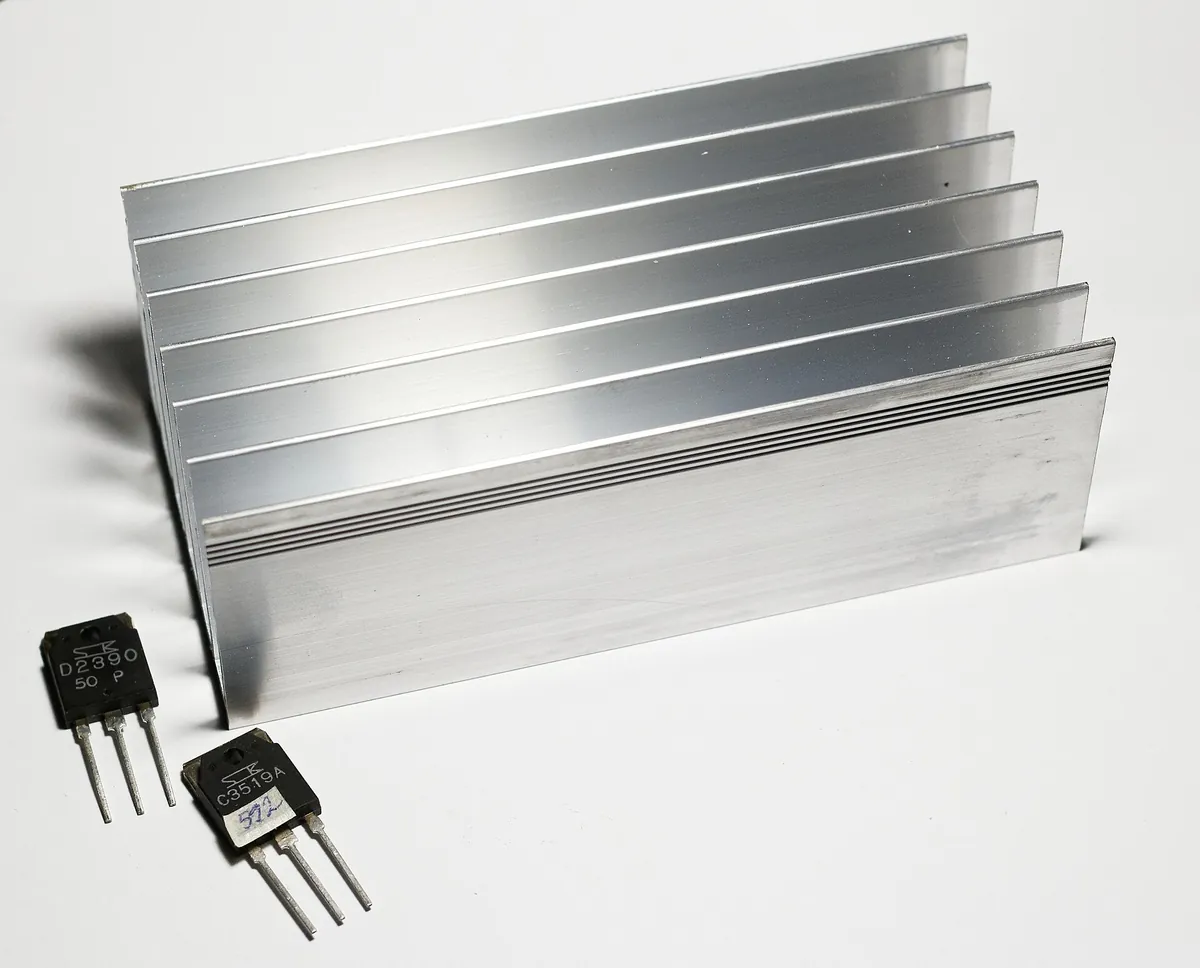
A heat sink is a heat exchanger in its simplest form: a solid base that collects heat from a component, and fins that spread that heat over a large surface where air can carry it away. Extrusion makes the base and the fins in one piece, so there is no joint between them to add thermal resistance.
Aluminium dominates this market because it combines good thermal conductivity with low density, low cost and easy extrusion. Copper conducts roughly twice as well, but it is more than three times as heavy and far harder to extrude into thin fins. For most power electronics, LED lighting and drive enclosures, an aluminium profile with well-chosen fin geometry outperforms a heavier copper part of the same cost.
The important point for buyers is that alloy conductivity is only one link in the thermal chain. Cooling performance is set by the whole path: junction to case, the thermal interface material, spreading through the base, conduction along each fin, and convection from the fin surface to the air. A heat sink in a higher-conductivity alloy with poor fin spacing for its airflow will run hotter than a well-designed 6063 profile. The material is chosen to make a good geometry possible, and the geometry does most of the work.
Thermal conductivity in aluminium falls as alloying elements are added and rises slightly as the alloy is aged towards equilibrium. The values below are typical room-temperature figures from published handbook data; they are not guaranteed minimums, and you should design with a margin.
| Alloy / temper | Thermal conductivity (W/m·K) | Electrical conductivity (% IACS) | Where it fits |
|---|---|---|---|
| 6063-T5 | ≈ 209 | ≈ 55 | Standard extruded heat sinks; best balance of conductivity, extrudability and cost |
| 6063-T6 | ≈ 200 | ≈ 53 | Where slightly higher strength is needed for clamping or fixing points |
| 6060-T5 / T6 | ≈ 200 – 210 | ≈ 52 – 56 | European equivalent of 6063 with leaner chemistry; very fine surface finish |
| 6061-T6 | ≈ 167 | ≈ 43 | Machined heat sinks and structural cooling plates where strength matters more |
| 1050A / 1070A | ≈ 220 – 230 | ≈ 60 – 62 | Cold-forged pin fins, stamped and skived fins; too soft for tall extruded fins |
| Die-cast alloys (e.g. A380 / ADC12) | ≈ 90 – 100 | ≈ 23 – 27 | Complex 3D housings with integral fins; much lower conductivity |
| Copper C11000 (for comparison) | ≈ 390 | ≈ 100 | Heat spreaders and inserts where heat flux is very high |
Values are typical and vary with exact chemistry and temper. Ask for a material certificate and, where performance is critical, test the finished assembly rather than relying on handbook conductivity.
Both alloys follow the Aluminum Association registration and EN 573-3. The leaner magnesium and silicon content compared with 6061 is what keeps conductivity high and extrusion speeds fast.
| Element | 6063 (EN AW-6063) | 6060 (EN AW-6060) |
|---|---|---|
| Silicon (Si) | 0.20 – 0.60 | 0.30 – 0.60 |
| Iron (Fe) | ≤ 0.35 | 0.10 – 0.30 |
| Copper (Cu) | ≤ 0.10 | ≤ 0.10 |
| Manganese (Mn) | ≤ 0.10 | ≤ 0.10 |
| Magnesium (Mg) | 0.45 – 0.90 | 0.35 – 0.60 |
| Chromium (Cr) | ≤ 0.10 | ≤ 0.05 |
| Zinc (Zn) | ≤ 0.10 | ≤ 0.15 |
| Titanium (Ti) | ≤ 0.10 | ≤ 0.10 |
| Others, each / total | ≤ 0.05 / 0.15 | ≤ 0.05 / 0.15 |
| Aluminium | Remainder | Remainder |
Strength rarely limits a heat sink, but it matters at clip slots, screw bosses and where the profile is clamped against a module. EN 755-2 minimums depend on wall thickness; the figures below are for thin sections up to about 10 mm.
| Alloy / temper | Tensile strength | Yield strength (0.2 %) | Elongation | Basis |
|---|---|---|---|---|
| 6063-T5 | 186 MPa | 145 MPa | 12 % | Typical (AA / ASM) |
| 6063-T5 | 175 MPa | 130 MPa | 6 – 8 % | EN 755-2 minimum, thin walls |
| 6063-T6 | 241 MPa | 214 MPa | 12 % | Typical (AA / ASM) |
| 6063-T6 | 215 MPa | 170 MPa | 6 – 8 % | EN 755-2 minimum, thin walls |
| 6060-T5 | 160 MPa | 120 MPa | 6 – 8 % | EN 755-2 minimum, thin walls |
| 6061-T6 | 310 MPa | 276 MPa | 12 % | Typical (AA / ASM) |
The die, not the alloy, sets the practical limits of a heat sink profile. Tall, thin, closely spaced fins create long die "tongues" that can deflect or break under extrusion pressure. The guidance below reflects common extrusion practice; the final limits depend on the profile size, the circle diameter of the die and the press, so treat them as starting points to confirm with die design.
| Design feature | Common starting point | Why it matters |
|---|---|---|
| Fin aspect ratio (fin height ÷ gap) | about 6:1 – 10:1 for standard dies; higher needs special tooling or bonded fins | Tall narrow gaps weaken the die tongue and raise scrap |
| Minimum fin thickness | about 1.0 – 1.5 mm at the tip for most sizes | Thinner fins tear or vary in thickness along the length |
| Fin taper | Thicker at the root than at the tip | Improves conduction where heat flow is highest and strengthens the die |
| Base thickness | Thick enough to spread heat from the source footprint; typically several times the fin thickness | A thin base leaves fins far from the heat source doing little work |
| Fin spacing | Wider for natural convection, closer for forced air | Too tight a gap chokes natural airflow; too wide wastes surface in fan-cooled designs |
| Mounting face | Machine if interface flatness is critical | As-extruded flatness is not good enough for thin thermal interface layers |
One-piece profile with integral fins. Lowest cost per metre once the die exists; the right choice for most LED, drive and inverter cooling.
Fins inserted into a grooved base and bonded with epoxy or brazed. Allows much higher fin density and taller fins than a single extrusion.
Fins sliced and lifted from a solid block of 1xxx or 6063 aluminium (or copper). Very thin, dense fins with no interface.
Corrugated sheet fins brazed or bonded to a base. High surface area for ducted, fan-driven airflow.
Pins forged from 1050/1070 or 6063 slugs. Works well where airflow direction is uncertain.
Liquid cold plates and heat spreaders machined from 6061 or 6082 plate, often with pressed tube or friction-stir welded lids.
Dimensional tolerances for extruded heat sinks follow EN 755-9 (profiles) or ANSI H35.2 for ASTM B221 orders. These standards control cross-section, straightness, twist and flatness, but the flatness they allow is coarse compared with a 0.1 mm thermal interface. When a power module sits on the base, specify a machined mounting face with a flatness tolerance and surface roughness on the drawing.
Theoretical weight is the net metal cross-section in mm² multiplied by 0.0027 kg per metre. A heat sink with a 2,400 mm² section therefore weighs about 6.5 kg per metre. Use the actual net area from the CAD model, not the envelope, because fins and gaps can make the envelope several times larger than the metal area.
Bare extruded aluminium has very low emissivity, so it radiates little heat. Black anodising lifts emissivity to around 0.8 – 0.9, which helps noticeably in natural convection, where radiation can carry a meaningful share of the heat. In fan-cooled designs convection dominates and the finish matters much less, so clear anodising or a conversion coating is often enough.
Anodic film is an electrical insulator and a thin thermal barrier. Where a device must be earthed through the heat sink, or where the interface must be as thin as possible, mask the mounting face or machine it after anodising. Trivalent or chromate-free conversion coatings protect the surface while keeping it electrically conductive.
| Factor | Extruded 6063 | Machined 6061 | Die-cast aluminium | Copper |
|---|---|---|---|---|
| Thermal conductivity | About 200 – 209 W/m·K | About 167 W/m·K | About 90 – 100 W/m·K | About 390 W/m·K |
| Tooling cost | Low (extrusion die) | None | High (casting die) | Low – medium |
| Unit cost at volume | Low | High | Low | High |
| Geometry freedom | 2D profile, cut and machined | Full 3D | Full 3D | Limited |
| Weight | Light | Light | Light | About 3.3 × heavier |
| Best use | Most electronics cooling | Prototypes, cold plates | Integrated housings at high volume | Very high heat flux spots |
A common hybrid is an extruded 6063 heat sink with a copper insert or embedded heat pipes under the hottest device. This spreads a concentrated heat load across the aluminium base while keeping the weight and cost of an aluminium part. For more on choosing between the two main 6xxx alloys, see 6061 vs 6063.
6063 in T5 or T6 temper for extruded heat sinks. It has thermal conductivity of about 200 – 209 W/m·K, extrudes into thin fins easily and anodises well. 1050 or 1070 conducts a little better but is too soft for tall extruded fins, and 6061 is stronger but about 20 % less conductive.
T5 has slightly higher thermal conductivity and lower cost because it is press-quenched and aged without a separate solution treatment. T6 is stronger. Unless the profile carries mechanical load or clamping force, T5 is the usual choice.
In natural convection, yes: raising emissivity from about 0.05 – 0.1 to about 0.8 – 0.9 increases radiated heat, which can be a meaningful share of the total. In forced-air designs the gain is small, because convection does most of the work.
As-extruded flatness follows EN 755-9 or ANSI H35.2 and is too coarse for a thin thermal interface. Specify a machined mounting face with a flatness and roughness tolerance on the drawing where a power module or LED board sits.
Multiply the net metal cross-section in mm² by 0.0027 to get kg per metre. A 2,400 mm² section weighs about 6.5 kg/m. Always use the net area of the metal, not the overall envelope.
Yes. Metline supplies heat sink profiles cut to length, CNC machined, anodised or conversion coated and packed to protect the fins, with material certificates, to customers worldwide.
Send the profile drawing, length, machining and finish. We will reply with material, tolerance and finish options and a delivered price.





