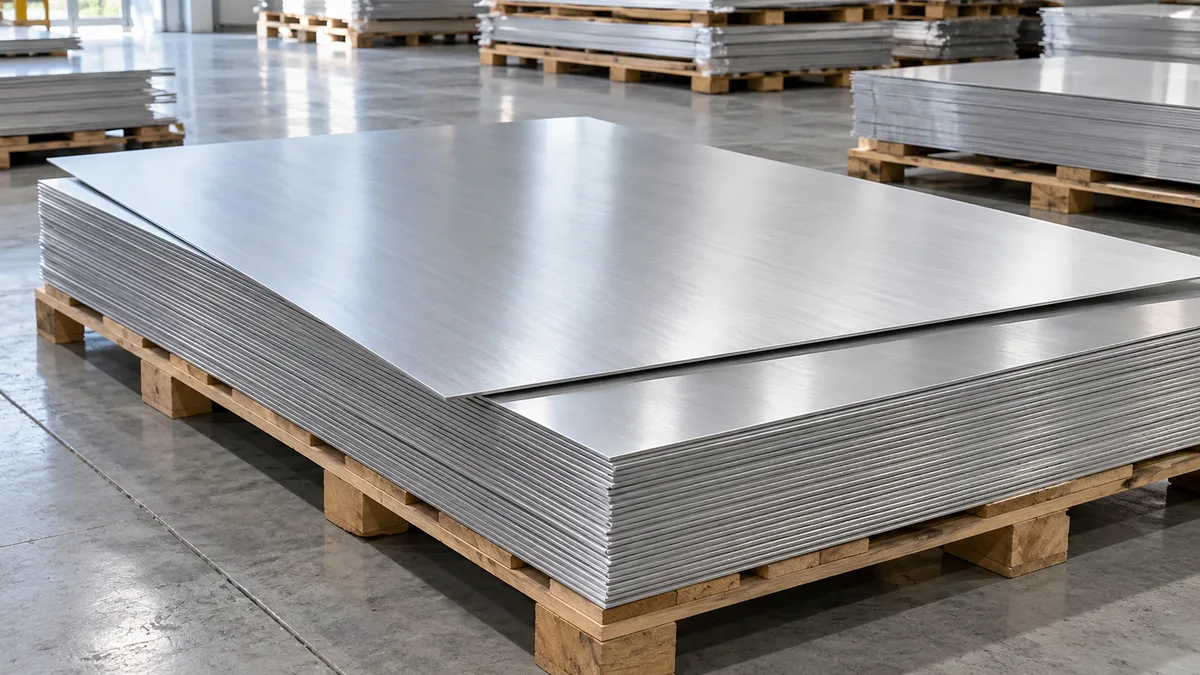
A sign blank is a flat aluminium panel, cut to the finished shape of a sign, with rounded corners, deburred edges and mounting holes, ready for the sign maker to apply retroreflective sheeting or print. Road authorities typically call for 5052-H38 or 6061-T6 sheet to ASTM B209 at 0.080 in or 0.100 in, while 3003, 1100 and 5754 are used for lighter-duty and European signs. Metline supplies sign-grade sheet and cut-to-size blanks to sign fabricators worldwide.
Almost every permanent road, traffic, parking and facility sign is built on an aluminium substrate. The substrate, called a blank, is sheet that has been sheared or routed to shape, given radiused corners, deburred and, where needed, punched with mounting holes. The sign fabricator then cleans it, applies retroreflective sheeting or a printed film, and adds the legend.
Aluminium replaced steel and wood for signs because it does not rust, is about one third the weight of steel for the same volume, and holds a flat, smooth surface that sheeting adheres to for many years. A lighter panel also means lighter posts and brackets and makes breakaway and crash-safe sign supports easier to design.
The blank itself is a simple product, but small details decide how well the finished sign performs: the alloy and temper determine whether a large panel stays flat in wind, the surface treatment determines whether the sheeting stays bonded, and the edge and hole quality determine whether the sign can be handled and mounted safely. Metline supplies the aluminium sheet and the cut-to-size blanks; finished signs, sheeting and legends are produced by the sign maker.
Alloy selection
Alloys and tempers used for sign blanks
The table compares the alloys most often specified. Typical tensile and yield strengths are Aluminum Association typical values for sheet; specified minimums under ASTM B209 or EN 485-2 are lower and are reported on the mill certificate.
Similar corrosion behaviour to 5052 with slightly higher strength in some tempers
The H38 temper of 5052 is strain-hardened and stabilised, which gives the stiffness and strength needed to keep a 30 or 36 in panel flat under wind load without a heavy gauge. 6061-T6 reaches similar strength by heat treatment. 3003 and 1100 are softer; they are perfectly adequate for parking and facility signs that are smaller, closer to the ground and often riveted to a frame.
A common specification in US state transportation departments reads: 5052-H38 for 0.080 in and thinner, and 6061-T6 or 5052-H38 for 0.100 in and thicker, all to ASTM B209. Always follow the wording of the contract you are supplying, because states and countries differ.
Specification
Thicknesses, holes, corner radii and shapes
Typical sign blank specification
Thickness
0.040, 0.063, 0.080, 0.100 and 0.125 in (about 1.0, 1.6, 2.0, 2.5 and 3.2 mm); metric 1.5, 2.0 and 3.0 mm for European and Asian signs
Common DOT tolerance
Example from one state specification: 0.080 in ± 0.005 in and 0.100 in ± 0.006 in
Shapes
Horizontal or vertical rectangle, square, diamond, octagon, equilateral triangle, circle, pentagon (school), pennant and custom outlines
Corner radius
Commonly 3/8, 1/2, 3/4, 1, 1-1/2, 1-7/8, 2-1/4 or 3 in (9.5 – 76 mm), scaled with sign size
Mounting holes
Usually 3/8 in (9.5 mm) or 5/16 in (7.9 mm), centred top and bottom; 1/8 – 1/2 in and custom patterns on request, or no holes for bracket or rivet mounting
Edges
Sheared or routed, deburred, free of sharp edges and burrs
Flatness
Flat within commercial tolerances, so sheeting can be applied without bubbles and the sign hangs true
Surface
Mill finish degreased, conversion coated, anodised or pre-painted, as specified
Shape carries meaning in road signing, and the blank must match the standard of the country where the sign will stand. In the US Manual on Uniform Traffic Control Devices (MUTCD) system, the octagon is reserved for STOP, the downward equilateral triangle for YIELD, the diamond for warnings, the pentagon for school zones, the circle for railway crossing advance warning, and rectangles for regulatory and guide signs. In the Vienna Convention system used across Europe, Asia and much of Africa, triangles warn, circles prohibit or instruct, and rectangles inform.
Weights of common square and rectangular blanks follow; they are calculated from 0.0975 lb/in³ and ignore holes and corner radii, which remove only a small fraction of the mass.
Thickness
Size
Weight (lb)
Weight (kg)
0.063 in (1.60 mm)
12 × 18 in
1.33
0.60
0.063 in (1.60 mm)
18 × 24 in
2.65
1.20
0.063 in (1.60 mm)
24 × 24 in
3.54
1.60
0.063 in (1.60 mm)
24 × 30 in
4.42
2.01
0.063 in (1.60 mm)
30 × 30 in
5.53
2.51
0.063 in (1.60 mm)
36 × 36 in
7.96
3.61
0.063 in (1.60 mm)
48 × 48 in
14.15
6.42
0.080 in (2.03 mm)
12 × 18 in
1.68
0.76
0.080 in (2.03 mm)
18 × 24 in
3.37
1.53
0.080 in (2.03 mm)
24 × 24 in
4.49
2.04
0.080 in (2.03 mm)
24 × 30 in
5.62
2.55
0.080 in (2.03 mm)
30 × 30 in
7.02
3.18
0.080 in (2.03 mm)
36 × 36 in
10.11
4.59
0.080 in (2.03 mm)
48 × 48 in
17.97
8.15
0.100 in (2.54 mm)
12 × 18 in
2.11
0.96
0.100 in (2.54 mm)
18 × 24 in
4.21
1.91
0.100 in (2.54 mm)
24 × 24 in
5.62
2.55
0.100 in (2.54 mm)
24 × 30 in
7.02
3.18
0.100 in (2.54 mm)
30 × 30 in
8.78
3.98
0.100 in (2.54 mm)
36 × 36 in
12.64
5.73
0.100 in (2.54 mm)
48 × 48 in
22.46
10.19
0.125 in (3.17 mm)
12 × 18 in
2.63
1.19
0.125 in (3.17 mm)
18 × 24 in
5.27
2.39
0.125 in (3.17 mm)
24 × 24 in
7.02
3.18
0.125 in (3.17 mm)
24 × 30 in
8.78
3.98
0.125 in (3.17 mm)
30 × 30 in
10.97
4.98
0.125 in (3.17 mm)
36 × 36 in
15.79
7.16
0.125 in (3.17 mm)
48 × 48 in
28.08
12.74
Surface preparation
Surface treatment: why it matters for sheeting adhesion
Retroreflective sheeting is bonded with a pressure-sensitive or heat-activated adhesive, and the bond is only as good as the aluminium surface underneath. Rolling oils, the natural oxide film and handling marks all reduce adhesion, so specifications require the blank to be degreased, etched and given a conversion coating before sheeting is applied.
Chromate conversion (ASTM B449)
The traditional treatment, often Class 2, which leaves a thin, adherent film ranging from iridescent silver to pale yellow. Many authorities still name it, but hexavalent chromium is being phased out for health and environmental reasons.
Non-chromate conversion (ASTM B921)
Trivalent or chromium-free coatings that meet the same adhesion and corrosion purposes. Several US states adopted ASTM B921 Class 1 in place of B449; check which one your contract calls for.
Degrease only
Some sign shops prefer mill-finish blanks and run their own cleaning and treatment line just before sheeting. In that case order clean, oil-free mill finish.
Anodised blanks
Anodising gives a durable, decorative finish for architectural and wayfinding signs where the metal itself is visible.
Pre-painted sheet
Polyester or PVDF painted coil, often white on the back, used for screen-printed or vinyl-applied signs. See colour-coated sheet.
Back face
Specifications sometimes require a degreased or painted back to resist corrosion and staining; state it on the order.
Standards
Standards that apply to aluminium signs
Standard
Scope
Relevance to the blank
ASTM B209
Aluminium and aluminium-alloy sheet and plate
Chemistry, temper, mechanical properties and thickness tolerance of the substrate
ASTM B449 / ASTM B921
Chromate and non-chromate conversion coatings on aluminium
Pre-treatment before sheeting
ASTM D4956
Retroreflective sheeting for traffic control
Sheeting types applied by the sign maker; affects how the blank must be prepared
MUTCD (US FHWA)
Shapes, sizes and colours of US traffic signs
Blank dimensions and corner radii follow the sign size tables
EN 12899-1
Fixed vertical road traffic signs, Europe
Performance classes for plates, including deflection under wind load
IRC:67 (India)
Code of practice for road signs
Sign layout and materials for Indian roads
In Europe, EN 12899-1 sets performance classes rather than prescribing an alloy: the plate must meet wind load and temporary deflection classes, and the manufacturer chooses thickness and stiffeners to achieve them. Large European sign plates are therefore often 2 – 3 mm sheet with extruded aluminium stiffening channels on the back.
Benefits
Why aluminium is the standard sign material
Corrosion resistance: 5xxx alloys in particular resist road salt and coastal air without rust staining that would spoil the sign face.
Low weight: a 30 × 30 in 0.080 in blank weighs about 7 lb (3.2 kg), so it can be handled by one person and mounted on light posts.
Flat, smooth substrate: rolled sheet gives a uniform surface for sheeting and printing.
Easy to cut and punch: blanks are sheared, routed or punched with standard tools, and holes can be added on site.
Non-magnetic: useful near sensitive instruments, rail signalling and some industrial environments.
Long life: the panel typically outlasts several sheeting replacements; sign service life is usually limited by the sheeting warranty, not the aluminium.
Recyclable: old sign blanks are stripped and recycled into new aluminium with only a small fraction of the energy needed for primary metal.
Ordering
How to order sign blanks from Metline
SpecifyAlloy and temper (e.g. 5052-H38), thickness, the governing specification (ASTM B209, DOT contract or EN 12899-1), and whether you need sheet, coil or cut blanks.
Define blanksShape, size, corner radius, hole diameter and pattern, and quantity of each size.
SurfaceMill finish degreased, conversion coated to ASTM B449 or B921, anodised or pre-painted.
Quote and confirmWe confirm feasibility, tolerances, certification (EN 10204 3.1 mill certificate) and delivery terms (EXW, FOB, CIF or DAP).
Pack and shipBlanks are interleaved to protect the face, stacked on pallets or in wooden cases, and shipped worldwide.
Many US highway specifications use 0.080 in (about 2 mm) for signs up to around 9 sq ft and 0.100 in (about 2.5 mm) or 0.125 in for larger panels. Parking and property signs are often 0.063 or 0.040 in. In Europe, 2 – 3 mm is common, with stiffeners on large plates.
Is 5052-H38 or 6061-T6 better for signs?
Both are accepted by most authorities. 5052-H38 has slightly better corrosion resistance and is the usual choice for 0.080 in blanks; 6061-T6 is slightly stronger and is common for 0.100 in and thicker panels. Use whichever your specification names.
Why do sign blanks need a conversion coating?
The coating gives a clean, chemically stable surface that sheeting adhesive bonds to and that resists corrosion creeping under the sheeting. Without it, sheeting can lift at edges and holes. ASTM B449 (chromate) and ASTM B921 (non-chromate) are the usual references.
Can I get blanks with custom shapes and hole patterns?
Yes. Blanks can be cut to any outline from a drawing, with your corner radius and hole sizes and positions, or supplied without holes for bracket or rivet mounting.
Does Metline make finished signs?
No. Metline supplies sign-grade aluminium sheet, coil and cut-to-size blanks. Sheeting, printing and legends are applied by the sign manufacturer.
Need aluminium for sign production?
Tell us the alloy, thickness, blank sizes and surface treatment. We will reply with availability and a delivered price for your location.