Square and rectangular tube
The simplest carcass frame: 20 × 20 to 50 × 50 mm tube cut to length and joined with corner brackets or welded. Wall thickness of 1.2 – 2 mm is common for furniture.



An aluminium cabinet is built from three groups of material: extruded frame and door profiles (usually 6063-T5 or T6), flat sheet or sandwich panels for the carcass and shelves (5052, 3003, honeycomb or composite panels), and aluminium fittings. This guide explains which grade and form suits each part of kitchen, wardrobe, bathroom, tool and outdoor cabinets, and what to specify when you buy the material.
Wood, MDF and particleboard swell when they absorb water, can be attacked by termites and lose screw-holding strength over time. An aluminium cabinet does none of these things. That is why aluminium has become a common choice for kitchens and bathrooms in humid and coastal climates, for outdoor kitchens, laboratories, hospitals, boats and caravans, and for industrial tool and storage cabinets.
Aluminium is about one third the weight of steel and does not rust, so a cabinet carcass can be light without needing paint for protection. It is non-combustible, does not emit formaldehyde or other volatile compounds as some board products can, and is fully recyclable at the end of the cabinet's life. The extrusion process also lets a designer build grooves for panels, hinges, slides and seals directly into the profile, which cuts assembly time.
The trade-offs are cost per square metre, which is higher than particleboard, and a different look and feel. Wood-grain transfer coatings and laminate-faced honeycomb panels close much of the appearance gap; the cost is usually justified by a service life measured in decades rather than years in wet areas.
| Cabinet part | Usual material | Why |
|---|---|---|
| Carcass frame and uprights | 6063-T5 or T6 extruded profiles, square and rectangular tube | Extrudes complex grooved shapes with a fine surface; strong enough for furniture loads |
| Heavy-duty or tool cabinet frames | 6061-T6 or 6082-T6 profiles and tube | Higher strength for heavy drawers, castors and lifting |
| Door frames and glass-door profiles | 6063-T5 slim profiles with glazing grooves | Clean edges and an even anodised or coated finish |
| Side panels, backs and shelves | 5052-H32 or 3003-H14 sheet; honeycomb or composite panels | Flat, bendable and corrosion resistant; panels add stiffness at low weight |
| Drawer boxes | Bent 5052-H32 sheet or extruded drawer-side profiles | 5052 bends tightly without cracking |
| Handles and edge trims | 6063 extruded handle profiles | Shaped in one piece; anodise to match the frame |
| Worktop and marine-grade parts | 5083 or 5754 sheet | Better resistance to salt water and cleaning chemicals |
For most domestic cabinets, a 6063 frame with 3003 or 5052 sheet panels is the standard combination. Choose 6061-T6 only where loads justify it: it costs more, its surface after extrusion is less refined and it anodises with a slightly less uniform colour than 6063.
Values below are specified minimums from EN 755-2 (extrusions) and typical data for sheet. Furniture design is normally governed by stiffness and appearance rather than strength, but the figures help when comparing grades for heavy-duty cabinets.
| Alloy / temper | Form | Tensile strength | Yield strength | Notes |
|---|---|---|---|---|
| 6063-T5 | Extrusion, wall ≤ 3 mm | ≥ 175 MPa | ≥ 130 MPa | Most common furniture profile temper |
| 6063-T6 | Extrusion, wall ≤ 10 mm | ≥ 215 MPa | ≥ 170 MPa | For larger, more loaded sections |
| 6061-T6 | Extrusion, wall ≤ 5 mm | ≥ 260 MPa | ≥ 240 MPa | Heavy-duty frames and tool cabinets |
| 5052-H32 | Sheet | About 230 MPa typical | About 195 MPa typical | Bends well; good in humid and marine air |
| 3003-H14 | Sheet | About 150 MPa typical | About 145 MPa typical | Economical panel and back sheet |
Extrusion values: EN 755-2 minimums. Sheet values: typical properties per the Aluminum Association and ASM; ASTM B209 and EN 485-2 set the minimums that appear on the mill certificate.
Sheet weight is 2.70 kg per square metre per millimetre of thickness. The table shows weights for a standard 1220 × 2440 mm sheet, the size most cabinet shops nest their parts on.
| Thickness (mm) | kg per m² | 1220 × 2440 mm sheet (kg) |
|---|---|---|
| 0.8 | 2.16 | 6.4 |
| 1 | 2.70 | 8.0 |
| 1.2 | 3.24 | 9.6 |
| 1.5 | 4.05 | 12.1 |
| 2 | 5.40 | 16.1 |
| 2.5 | 6.75 | 20.1 |
| 3 | 8.10 | 24.1 |
The simplest carcass frame: 20 × 20 to 50 × 50 mm tube cut to length and joined with corner brackets or welded. Wall thickness of 1.2 – 2 mm is common for furniture.
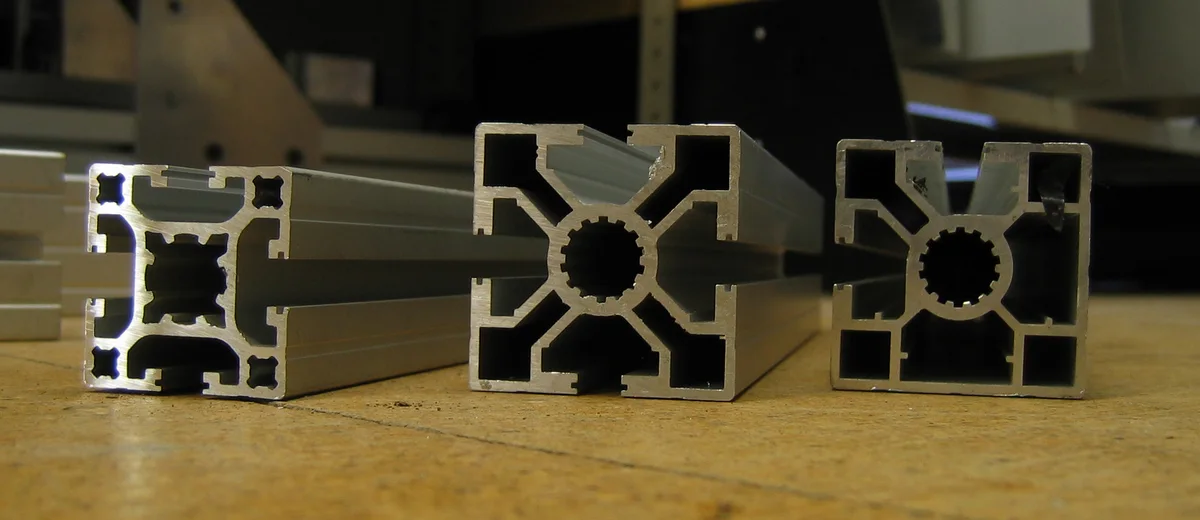
Metric 20, 30, 40 series and inch 10 and 15 series T-slot profiles. Panels drop into the slots and brackets bolt anywhere along the length, which suits workshop and industrial cabinets that may be reconfigured.
U, C, J, F, H and hat channels hold panel edges, form door tracks and act as shelf supports.
Equal and unequal angles reinforce corners, edge exposed panels and act as shelf ledges.
Custom sections combining a panel groove, hinge channel, seal slot and handle in one extrusion. A die costs money once but removes many fabrication steps on every cabinet.
J-pull, G-pull and edge-pull handles extruded in 6063 and fixed along the top edge of doors and drawer fronts for handle-free styling.
Ask for profiles cut to finished length and pre-punched for hinges and connectors when the volume justifies it: precise cutting at the material stage removes the most error-prone step from the cabinet shop.
| Panel type | Construction | Strengths | Watch-outs |
|---|---|---|---|
| Solid aluminium sheet | 0.8 – 3 mm 3003, 5052 or 5754 sheet, flat or bent | Simple, bendable, fully recyclable | Thin sheet can drum or dent on large doors |
| Aluminium honeycomb panel | Two aluminium skins bonded to an aluminium honeycomb core | Very stiff and flat for its weight; stays flat in humidity | Edges must be sealed and trimmed; core dents under point impact |
| Aluminium composite panel (ACP) | Two thin aluminium skins with a polymer or mineral-filled core, typically 3 – 6 mm | Low cost, smooth painted face, easy to route and fold | Choose a fire-rated core where building rules require it |
| Laminate-faced honeycomb | Honeycomb panel with HPL or veneer faces | Wood or stone appearance with an aluminium structure | Cost; laminate adhesion must suit wet areas |
An oxide layer grown from the metal itself, clear or coloured (champagne, bronze, black). For indoor furniture 10 – 15 µm is typical; 20 µm or more for outdoor and wet-area use. Specify to ISO 7599 or an equivalent class.
Polyester powder in any RAL colour and in matt, satin or textured finishes. Pre-treatment quality decides how well the coating resists blistering in kitchens and bathrooms.
A powder base coat with a sublimated wood pattern. Gives oak, walnut or teak looks on profiles and sheet while keeping aluminium underneath.
Mechanical finishes, usually followed by clear anodising to protect them from fingerprints and corrosion.
A thin, even lacquer often applied over anodising for a smooth, durable surface on visible profiles.
Applied at the mill or after finishing to protect sheets and profiles during cutting, transport and assembly.
Many cabinet fittings are themselves aluminium extrusions, castings or pressings. Matching their alloy and finish to the frame avoids colour mismatch and galvanic corrosion.
Use stainless steel (A2 or A4) fasteners rather than plain carbon steel, which corrodes in contact with aluminium in damp conditions.
6063 in T5 or T6 temper. It extrudes the thin, grooved shapes cabinet frames need, has a smooth surface and gives an even colour when anodised or powder coated.
Back panels and small shelves commonly use 0.8 – 1.2 mm; side panels and doors 1.5 – 2 mm sheet, or a honeycomb or composite panel for large doors that must stay flat. The right thickness depends on panel size and how it is supported.
The aluminium itself is unaffected by water and will not swell or rot. Joints, edges and fittings still need correct sealing and stainless fasteners to keep water out of the cabinet interior.
Yes. Wood-grain transfer coatings on profiles and sheet, or laminate-faced honeycomb panels, give a timber appearance while the structure stays aluminium.
For large doors, yes: a honeycomb panel is much stiffer and flatter for the same weight. Solid sheet is cheaper and easier to bend, and suits smaller doors, drawer fronts and backs.
No. Metline supplies the aluminium materials: profiles, tubes, sheet, honeycomb and composite panels, cut and finished to your specification, for cabinet manufacturers and project buyers worldwide.
Tell us the profiles, panels, finishes and quantities you need. Metline will reply with availability, finishing options and a delivered price.





