Household and food foil
Soft O-temper foil around 9 – 25 µm for wrapping, baking and food service rolls.



8111 is an aluminium-iron-silicon alloy, close to 8011 in composition but with wider silicon limits, used mainly for packaging, household and technical foil and thin strip. Buyers in Russia and the CIS often order it against ГОСТ 745 (packaging foil) or ГОСТ 618 (technical foil), while ASTM B479 lists it for flexible barrier foil elsewhere. This guide explains its chemistry, tempers, products, how it compares with 8011 and how to order it.
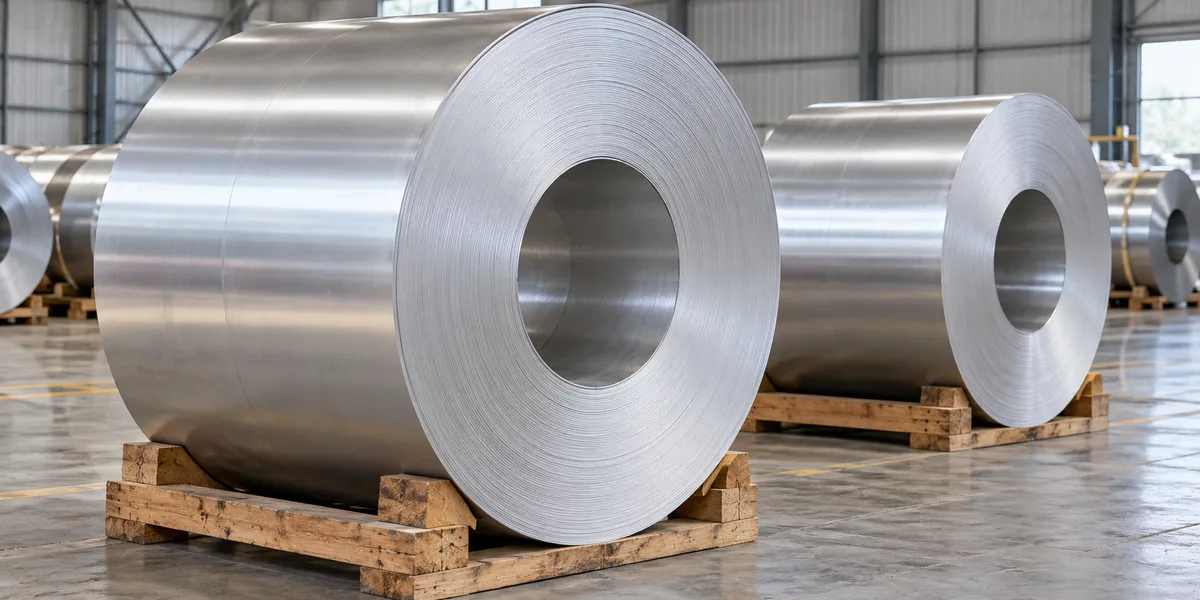
8111 belongs to the 8xxx family of "other element" alloys. Like 8011 and 8079, it relies on iron and silicon rather than magnesium or copper. These elements form fine intermetallic particles that strengthen thin foil, refine grain and reduce the risk of pinholes and tearing during rolling, without any heat treatment.
The practical result is a foil alloy that can be rolled thin, annealed soft for wrapping and lamination, or left hard for lids, caps and fin-type uses. Its silicon range is wider than that of 8011, which gives mills flexibility in raw material while keeping very similar properties in the finished foil.
In Russian and CIS documentation, 8111 appears in contracts for packaging and technical foil, where buyers specify the ГОСТ product standard and the alloy together. Outside that region the same alloy is named in ASTM B479 for annealed flexible-barrier foil, alongside 1100, 1145, 1235, 8011 and 8079.
| Element | 8111 (wt %) | 8011 for comparison (wt %) |
|---|---|---|
| Silicon (Si) | 0.30 – 1.10 | 0.50 – 0.90 |
| Iron (Fe) | 0.40 – 1.00 | 0.60 – 1.00 |
| Copper (Cu) | ≤ 0.10 | ≤ 0.10 |
| Manganese (Mn) | ≤ 0.10 | ≤ 0.20 |
| Magnesium (Mg) | ≤ 0.05 | ≤ 0.05 |
| Chromium (Cr) | ≤ 0.05 | ≤ 0.05 |
| Zinc (Zn) | ≤ 0.10 | ≤ 0.10 |
| Titanium (Ti) | ≤ 0.08 | ≤ 0.08 |
| Others each / total | ≤ 0.05 / 0.15 | ≤ 0.05 / 0.15 |
| Aluminium | Remainder | Remainder |
Limits per the registered Aluminum Association compositions. The contract standard and the mill certificate for each lot govern.
| Temper | Condition | Behaviour | Typical uses |
|---|---|---|---|
| O | Fully annealed, often dry (oil-free) | Softest and most ductile; folds, wraps and laminates easily | Household foil, food wrapping, laminates, insulation facings |
| H22 / H24 | Strain-hardened and partly annealed | Moderate strength with useful elongation | Containers, lids, semi-rigid packaging |
| H18 / H19 | Fully hard as rolled | Highest strength, little elongation | Lidding, technical foil, fin and strip uses |
Tensile strength and elongation for foil are specified by gauge and temper in the product standard (ГОСТ 745, ГОСТ 618, ASTM B479 or EN 546-2). Elongation rises with thickness, so a 9 µm household foil and a 100 µm container foil in the same temper have quite different values. Rather than rely on a single generic figure, check the limits for your gauge in the contract standard and the results on the mill certificate.
| Standard | Covers | What to agree in the contract |
|---|---|---|
| ГОСТ 745-2014 | Cold-rolled aluminium foil for packaging food, medicines, medical products and cosmetics | Alloy, temper, thickness and width, surface (bright/matt), food-contact requirements |
| ГОСТ 618-2014 | Rolled aluminium foil for technical purposes such as thermal, moisture and sound insulation (not capacitor foil) | Alloy, temper, thickness, width, roll size, surface condition |
| ASTM B479 | Annealed aluminium and aluminium alloy foil for flexible barrier, food contact and other uses; lists 8111 | Alloy, gauge, tolerances, pinhole and wettability requirements |
| EN 546 / EN 573-3 | European foil properties and tolerances; chemical composition of wrought alloys | Used when the contract follows EN practice |
Interstate (ГОСТ) standards are revised periodically and 2025 editions of both foil standards have been reported. Confirm which edition the contract cites and that it lists 8111 for your product.
Soft O-temper foil around 9 – 25 µm for wrapping, baking and food service rolls.
Thicker semi-rigid foil, typically about 30 – 200 µm in H22/H24, for trays, containers and lids.
Clean, wettable soft foil for paper and film laminates in flexible packaging and insulation.
Foil for heat, moisture and sound insulation facings and industrial wrapping, ordered to ГОСТ 618 where required.
Slit strip for caps, closures and stamped parts, in hard or partly annealed tempers.
Large rolls for converters who slit and rewind into smaller consumer or industrial rolls.
Chemically the two alloys overlap heavily: 8111 allows a wider silicon range and a slightly lower minimum iron, while 8011 allows a little more manganese. In finished foil of the same gauge and temper, their properties are very similar, and many converters accept either.
| Aspect | 8111 | 8011 |
|---|---|---|
| Composition | Si 0.30 – 1.10, Fe 0.40 – 1.00 | Si 0.50 – 0.90, Fe 0.60 – 1.00 |
| Main standards | ГОСТ contracts, ASTM B479 | EN 546 / EN 573-3, ASTM B479, ГОСТ contracts |
| Typical products | Household, packaging and technical foil, thin strip | Household, pharmaceutical, container and closure foil; closure sheet |
| Availability | Common in CIS-specified orders | Most widely produced foil alloy worldwide |
| Interchangeability | Accepted as 8011 alternative where the customer allows | Accepted as 8111 alternative where the customer allows |
A common mistake is to treat the alloy name as the specification. What matters is that gauge, temper, mechanical limits, surface and food-contact requirements are written into the order. If your drawing or tender names 8111 specifically, supply must be certified as 8111; if it allows equivalents, 8011 may widen the choice.
No, but they are close. Both are Al-Fe-Si foil alloys; 8111 allows a wider silicon range (0.30 – 1.10 %) and slightly lower iron. In the same gauge and temper they behave very similarly, and many buyers accept either where the specification allows.
Packaging foil is ordered to ГОСТ 745 and technical (insulation and industrial) foil to ГОСТ 618. The contract should state the edition and confirm the alloy is listed for the product.
Yes, when produced and certified to a packaging-foil standard such as ГОСТ 745 or ASTM B479 and the food-contact rules of the destination market.
Soft O for wrapping and laminating, H22/H24 for containers and semi-rigid packaging, and H18/H19 for hard lidding and technical uses.
Each lot ships with an EN 10204 3.1 mill certificate showing chemistry and mechanical results; it can reference the ГОСТ product standard named in your order, and third-party inspection can be arranged.
Send the gauge, temper, width and standard. Our team will reply with a specification and delivered price.





