7005-T6 / T651
Standard tempers for rolled sheet and plate; T651 is stretched for flatness during machining.



7005 is a weldable Al-Zn-Mg alloy: stronger than 6061, and unlike 7075 it can be fusion-welded, with the heat-affected zone recovering much of its strength by natural ageing after welding. It is best known for bicycle frames and extrusions, and 7005 sheet and plate are used for welded brackets, frames and transport parts. Metline supplies 7005 plate and sheet in T6 and T651, cut to size, worldwide.
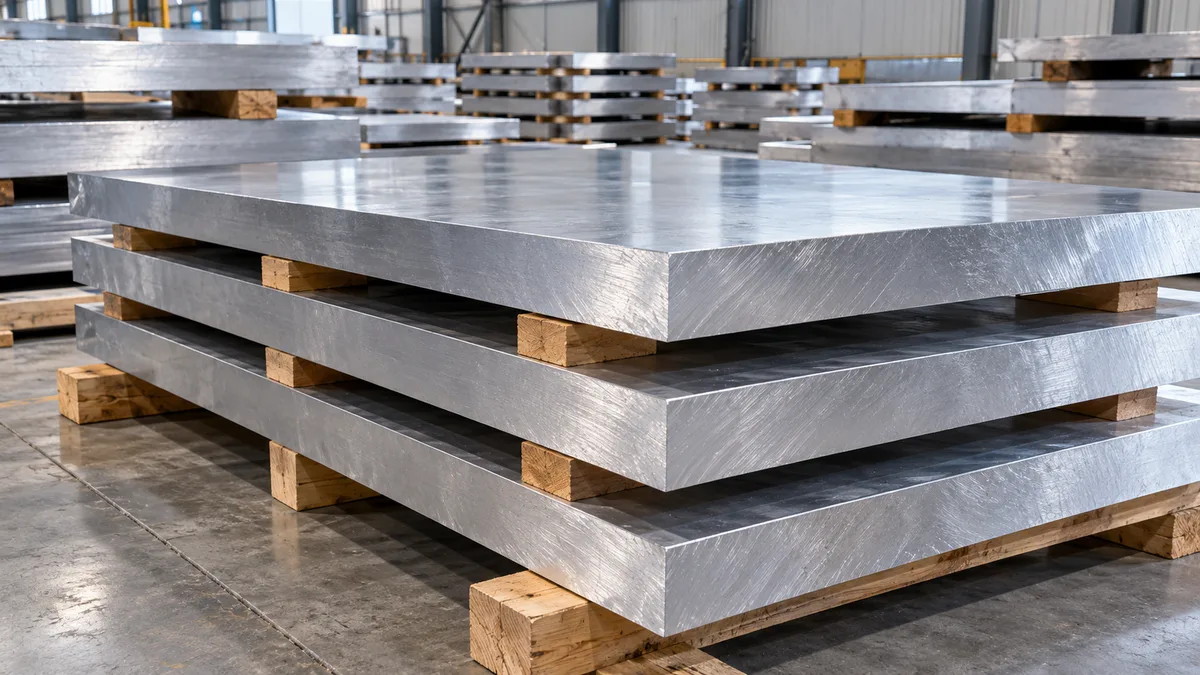
7005 contains about 4.5 % zinc and 1.4 % magnesium with no significant copper. Copper-free Al-Zn-Mg alloys are the weldable branch of the 7xxx family: the strengthening precipitates dissolve in the weld heat but re-form at room temperature over the following weeks, so a welded 7005 joint regains a large share of its strength without post-weld heat treatment.
Zirconium, chromium and manganese control grain structure and improve resistance to stress corrosion. The alloy is also quench-insensitive: it reaches good properties after air or mild water quenching, which is why it extrudes well and why welded frames can be aged without a separate solution treatment.
7005 is primarily an extrusion and tube alloy. Rolled sheet and plate are made to order, usually in T6 or T651, for parts that must be welded to 7005 tubes or extrusions, or for welded structures that need more strength than 6061 or 6082 can give.
| Element | Minimum | Maximum |
|---|---|---|
| Zinc (Zn) | 4.0 | 5.0 |
| Magnesium (Mg) | 1.0 | 1.8 |
| Manganese (Mn) | 0.20 | 0.70 |
| Chromium (Cr) | 0.06 | 0.20 |
| Zirconium (Zr) | 0.08 | 0.20 |
| Titanium (Ti) | 0.01 | 0.06 |
| Silicon (Si) | — | 0.35 |
| Iron (Fe) | — | 0.40 |
| Copper (Cu) | — | 0.10 |
| Others, each / total | — | 0.05 / 0.15 |
| Aluminium (Al) | Remainder |
Typical values for comparison; minimums depend on form, thickness and the order specification.
| Temper | Tensile strength | Yield strength (0.2 %) | Elongation |
|---|---|---|---|
| O | about 195 MPa | about 85 MPa | about 20 % |
| T6 / T651 | about 350 MPa | about 290 MPa | about 13 % |
| T53 (extrusions) | about 390 MPa | about 345 MPa | about 15 % |
Standard tempers for rolled sheet and plate; T651 is stretched for flatness during machining.
Press-quenched and artificially aged extrusion temper, common for tube and frame sections.
Annealed for forming; age after forming and welding.
| Thickness (mm) | kg per m² | 1250 × 2500 mm (kg) | 1500 × 3000 mm (kg) |
|---|---|---|---|
| 1 | 2.78 | 8.7 | 12.5 |
| 2 | 5.56 | 17.4 | 25.0 |
| 3 | 8.34 | 26.1 | 37.5 |
| 4 | 11.12 | 34.8 | 50.0 |
| 5 | 13.90 | 43.4 | 62.5 |
| 6 | 16.68 | 52.1 | 75.1 |
| 8 | 22.24 | 69.5 | 100.1 |
| 10 | 27.80 | 86.9 | 125.1 |
| 12 | 33.36 | 104.2 | 150.1 |
| 16 | 44.48 | 139.0 | 200.2 |
| 20 | 55.60 | 173.7 | 250.2 |
| 25 | 69.50 | 217.2 | 312.8 |
| 30 | 83.40 | 260.6 | 375.3 |
| 40 | 111.20 | 347.5 | 500.4 |
| 50 | 139.00 | 434.4 | 625.5 |
MIG and TIG weld with 5356 or 5183 filler. The heat-affected zone softens at first and recovers much of its strength by natural ageing over about 30 days at room temperature, or faster with an artificial ageing cycle.
Like all Al-Zn-Mg alloys, 7005 can be sensitive to stress corrosion where welds carry high residual or sustained tensile stress, especially in the short-transverse direction. Good joint design and a post-weld ageing step reduce the risk.
Machines well in T6/T651, with better chip control than 6xxx alloys. T651 plate stays flat during pocketing.
Takes protective anodising and paint well. Zinc content can give a slightly yellow tint, so it is less suited to decorative clear finishes.
| Property | 6061-T6 | 7005-T6 | 7020-T6 | 7075-T6 |
|---|---|---|---|---|
| Typical tensile strength | 310 MPa | about 350 MPa | about 360 – 380 MPa | 570 MPa |
| Fusion weldability | Good | Good | Good | Poor |
| HAZ recovery after welding | Limited | Good (natural ageing) | Good (natural ageing) | Not welded |
| Main form | All forms | Extrusions, tube | Plate, extrusions | Plate, bar |
7005 and 7020 are close relatives; 7020 is the European plate standard, while 7005 is more common for tube and extrusions.
Yes. It is one of the weldable 7xxx alloys. Use 5356 or 5183 filler; the heat-affected zone recovers much of its strength by natural ageing after welding.
Yes, by roughly 10 – 25 % depending on temper, and its welded joints retain more strength than welded 6061.
It combines good strength with weldability and does not need full solution heat treatment after welding, so frames can be welded and simply aged.
No. 7075-T6 is much stronger but cannot be fusion-welded reliably. 7005 is chosen when the part must be welded.
7005 is mainly an extrusion alloy, so plate and sheet are usually made to order.
Send the temper, thickness, size and quantity. We will confirm availability and a delivered price.





