T6 / T6511
Solution heat-treated, quenched and artificially aged; T6511 is also stretched and may receive minor straightening. Uniform properties for profiles and tubes.



7005 is an aluminium-zinc-magnesium alloy designed for welded structures: it extrudes into tubes and profiles, welds without filler cracking problems when the right wire is used, and regains strength in the weld zone by natural ageing. In T6 and T53 it gives around 290 – 345 MPa yield, making it a popular choice for vehicle frames, trailers, motorcycle and bicycle frames. Metline supplies 7005 profiles and tubes to drawing, worldwide.
Most high-strength aluminium alloys lose much of their strength next to a weld. 7005 is different: its zinc-magnesium precipitates dissolve in the heat-affected zone and then re-form at room temperature, so a welded 7005 frame steadily recovers strength over the weeks after welding, without a full re-heat treatment.
The alloy carries about 4.5 % zinc and 1.4 % magnesium, with manganese, chromium and zirconium to control grain structure. Copper is kept very low, which helps weldability and general corrosion resistance. 7005 is moderately quench-insensitive, so it can be supplied as T5 or T53 (press-quenched and aged) as well as the fully heat-treated T6.
In vehicles, 7005 is used where 6061 or 6082 would be heavier and where the structure is fabricated by welding: frames, sub-frames, trailer chassis, roll cages, racks and battery-protection members. It is also a classic bicycle and motorcycle frame tube alloy, which gives a large base of proven welding practice.
Registered Aluminum Association limits, also used in EN 573-3 for EN AW-7005. Some published tables show 7005 with 1 – 2 % copper and 0.35 – 0.80 % silicon; those values are incorrect for this alloy, whose copper limit is 0.10 % maximum.
| Element | Minimum | Maximum | Role |
|---|---|---|---|
| Zinc (Zn) | 4.0 | 5.0 | Strengthening with Mg |
| Magnesium (Mg) | 1.0 | 1.8 | Strengthening with Zn |
| Manganese (Mn) | 0.20 | 0.70 | Grain-structure control, toughness |
| Chromium (Cr) | 0.06 | 0.20 | Grain control, SCC resistance |
| Zirconium (Zr) | 0.08 | 0.20 | Inhibits recrystallisation |
| Titanium (Ti) | 0.01 | 0.06 | Grain refiner |
| Copper (Cu) | — | 0.10 | Kept low for weldability |
| Silicon (Si) | — | 0.35 | Impurity |
| Iron (Fe) | — | 0.40 | Impurity |
| Others, each / total | — | 0.05 / 0.15 | |
| Aluminium (Al) | Remainder |
7005 does not reach 7075-type strengths; claims of 500 MPa or more for 7005-T6 are not realistic. The values below reflect published typical data and ASTM B221 minimums.
| Temper / basis | Tensile strength | Yield strength (0.2 %) | Elongation |
|---|---|---|---|
| T53, specified minimum (ASTM B221, thin sections) | 345 MPa / 50 ksi | 303 MPa / 44 ksi | 10 % |
| T53, typical | about 390 MPa | about 340 MPa | about 15 % |
| T6 / T6511, typical | about 350 MPa | about 290 MPa | about 13 % |
Solution heat-treated, quenched and artificially aged; T6511 is also stretched and may receive minor straightening. Uniform properties for profiles and tubes.
Cooled from the extrusion temperature and given a controlled artificial ageing. Higher strength than T6 in thin sections and a common choice for frame tubing.
Press-quenched and aged; a cost-effective temper for open profiles where the highest strength is not required.
After welding, store assemblies at room temperature for several weeks, or apply an agreed artificial ageing cycle, before full loading.
| System | Designation | Typical product standard |
|---|---|---|
| Aluminum Association / UNS | 7005 / A97005 | ASTM B221 (extrusions and tube) |
| European (EN) | EN AW-7005 / AlZn4.5Mg1.5Mn | EN 755-2, EN 573-3 |
| China (GB) | 7005 | GB/T 3190, GB/T 6892, GB/T 33910 |
| Section | Typical size range |
|---|---|
| Round tube | OD about 10 – 300 mm, wall 1 – 20 mm |
| Square tube | About 10 × 10 to 150 × 150 mm, wall 1 – 10 mm |
| Rectangular tube | About 10 × 20 to 200 × 300 mm, wall 1 – 10 mm |
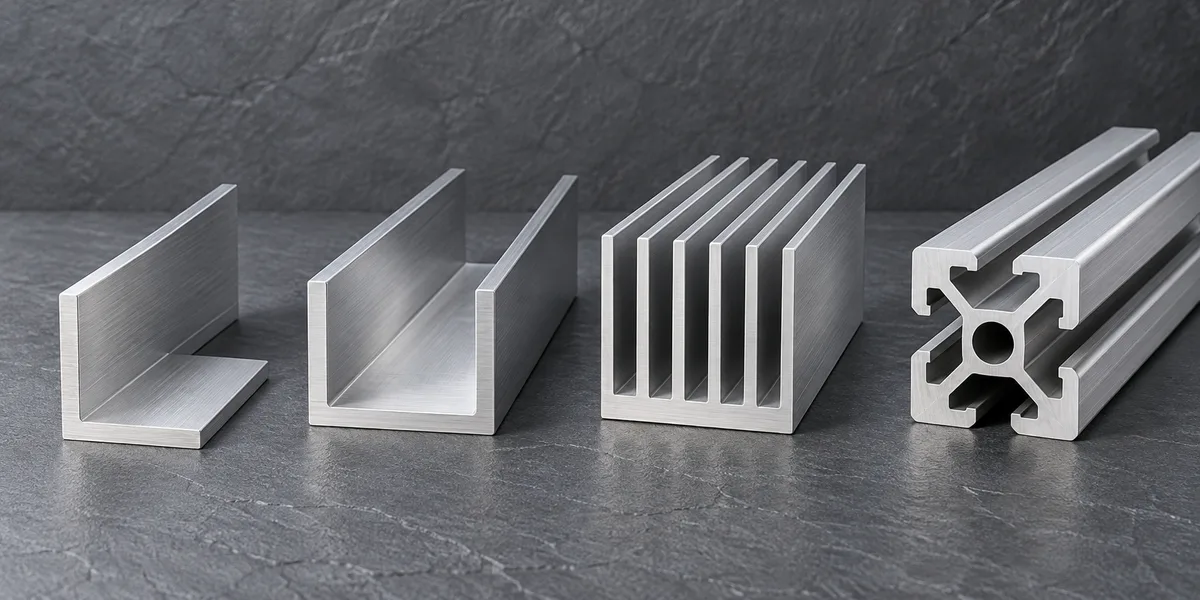
| Angle, channel and custom profiles | To drawing |
Extrusion dies are made to your drawing. Send the section with critical dimensions and tolerances.
TIG and MIG weld well with ER5356 or ER5556 filler. Avoid 4043: silicon-rich weld metal on Al-Zn-Mg base gives low ductility. Keep heat input low, clean the oxide immediately before welding and allow natural ageing before proof loading.
Like all Al-Zn-Mg alloys, 7005 can crack under sustained tensile stress in damp or salty service if the temper, residual stress and grain structure are wrong. Specify a controlled ageing practice, avoid cold forming after ageing, keep assembly stresses low, and ask for SCC test data (for example ASTM G47 alternate immersion) on critical parts.
Stretch bending and rotary-draw bending are best done in the freshly quenched (W) or T4 condition, then aged to T5 or T6. Bending in the fully aged condition needs generous radii and raises residual stress.
Machines more cleanly than 6xxx alloys in the aged condition, with short chips and a good finish using sharp carbide tools and flood coolant.
Accepts anodising, e-coating and powder coating. Zinc-rich alloys anodise with a slight yellow-grey tint, so check colour needs for visible parts. Coatings also add a barrier against galvanic and stress corrosion.
Isolate 7005 from steel, carbon fibre and copper with sealants, coatings or insulating washers, and use coated fasteners, to avoid galvanic corrosion in wet road environments.
7005 is an extrusion and tube alloy. It is not normally used for cylinder heads, crankcases or cast wheels, which are made from casting alloys such as A356, nor for outer body panels, which use 5xxx and 6xxx sheet.
| Property | 7005-T6 | 6061-T6 | 7003-T5 | 7020-T6 |
|---|---|---|---|---|
| Typical yield strength | about 290 MPa | about 276 MPa | about 300 MPa | about 280 – 320 MPa |
| Weld-zone recovery by natural ageing | Yes | No | Yes | Yes |
| Post-weld heat treatment needed | Usually no | For full strength | Usually no | Usually no |
| SCC sensitivity | Moderate | Very low | Moderate | Moderate |
| Typical market | Frames, tube | General | Bumper beams | Welded structures (Europe) |
7020 is the closest European relative and is often specified interchangeably for welded structures; see our 7020 tube page.
Moderately. Typical 7005-T6 yield is about 290 MPa against 276 MPa for 6061-T6, and T53 reaches about 340 MPa. The bigger advantage is in welded parts, where 7005 recovers strength by natural ageing.
Usually not. The weld zone regains much of its strength at room temperature over several weeks. Some makers apply a short artificial ageing cycle to speed this up.
ER5356 or ER5556. Avoid ER4043, which gives brittle welds on Al-Zn-Mg alloys.
A temper where the extrusion is cooled from the press and then given a controlled artificial ageing. ASTM B221 guarantees 345 MPa tensile and 303 MPa yield for thin sections.
No. Engine blocks and heads are cast alloys. 7005 is used for extruded and welded structures.
Yes, cut to length and deburred, with mill certificates, shipped worldwide.
Send tube sizes or profile drawings and quantities. We will confirm availability, certification and a delivered price.





