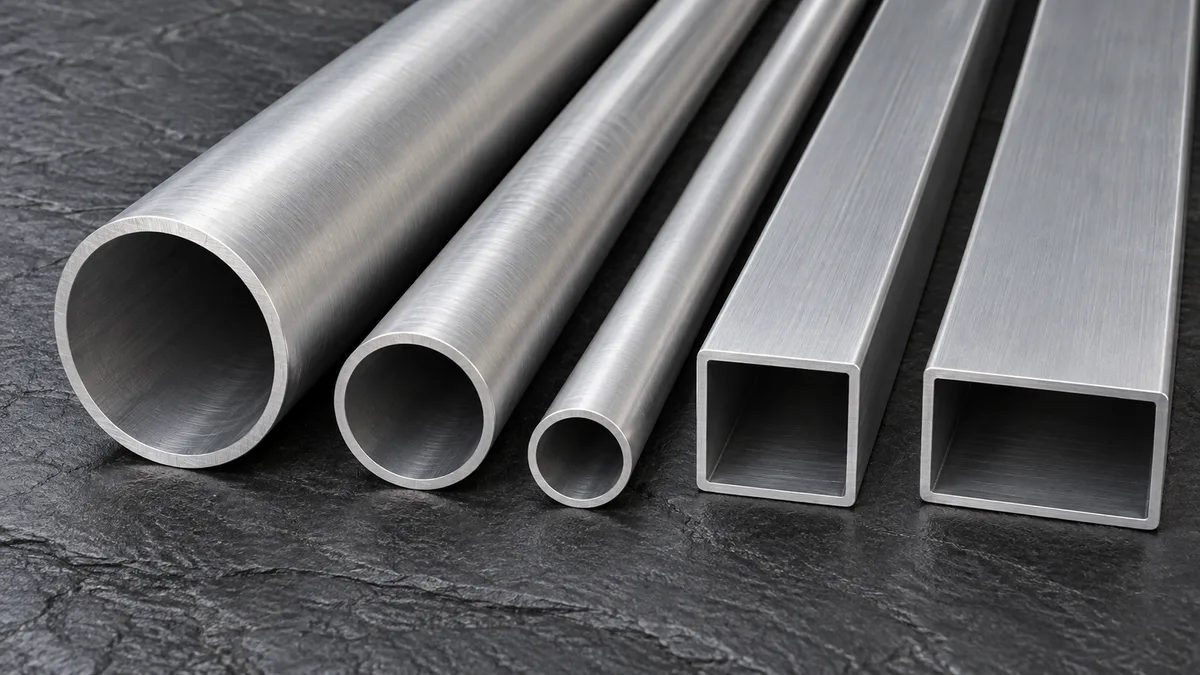
Round tube
Extruded seamless or porthole tube from about 20 mm to 250 mm OD. Even stress distribution for members loaded in several directions.



6066-T6 is the strongest of the common 6xxx extrusion alloys, with a typical yield strength around 350 MPa, roughly 25 % more than 6061-T6. It is chosen for extruded tube and hollow sections that must carry high loads in thin walls, where 7xxx alloys would be too costly or difficult. Metline supplies 6066 tube in round, square, rectangular and custom hollow sections to customers worldwide.
6066 is an aluminium-magnesium-silicon alloy with deliberate additions of copper and manganese. The extra silicon, copper and manganese raise its T6 strength well above 6061 and 6082, while the alloy can still be extruded into tubes and hollow sections and heat-treated like other 6xxx grades.
The alloy fills a gap between general structural grades and the high-strength aerospace alloys. 6061-T6 tube has a typical yield of about 276 MPa; 7075-T6 reaches about 505 MPa but is hard to extrude into hollows, difficult to weld and sensitive to stress corrosion. 6066-T6 sits at about 350 MPa, so designers can reduce wall thickness by around a fifth compared with 6061 for the same bending stress, without moving to a 7xxx alloy.
The price of that strength is in fabrication and corrosion. 6066 extrudes more slowly than 6061, it is more prone to weld cracking, and its copper content (0.7 – 1.2 %) makes it more susceptible to intergranular corrosion in aggressive environments. Used where those limits are understood, it is an efficient structural tube for frames, booms, vehicle members and forged or extruded load-bearing parts.
| Element | Min | Max | Role |
|---|---|---|---|
| Silicon (Si) | 0.90 | 1.80 | Excess Si above Mg2Si balance boosts ageing response |
| Iron (Fe) | — | 0.50 | Impurity |
| Copper (Cu) | 0.70 | 1.20 | Adds strength; reduces corrosion resistance |
| Manganese (Mn) | 0.60 | 1.10 | Strength and grain control |
| Magnesium (Mg) | 0.80 | 1.40 | Strengthening with Si |
| Chromium (Cr) | — | 0.40 | Grain structure control |
| Zinc (Zn) | — | 0.25 | |
| Titanium (Ti) | — | 0.20 | Grain refiner |
| Others each / total | — | 0.05 / 0.15 | |
| Aluminium | Remainder |
These are the registered Aluminum Association limits. Some published sources show lower copper and manganese ranges for 6066; those figures do not match the registered alloy, so always check composition against the mill certificate and your order specification.
| Temper / basis | Tensile strength | Yield strength (0.2 %) | Elongation | Hardness |
|---|---|---|---|---|
| O, typical | 150 MPa / 22 ksi | 83 MPa / 12 ksi | 18 % | 43 HB |
| T4, typical | 360 MPa / 52 ksi | 207 MPa / 30 ksi | 18 % | 90 HB |
| T6, typical | 390 – 395 MPa / 57 ksi | 350 – 360 MPa / 51 – 52 ksi | 12 % | 120 HB |
| T6 extruded, ASTM B221 minimum | 345 MPa / 50 ksi | 310 MPa / 45 ksi | 8 % | — |
Stiffness is the same as other aluminium alloys, so 6066 does not reduce deflection; its benefit is higher allowable stress. If a 6061 tube fails on deflection rather than strength, increase the section depth instead of changing alloy.
| System | Designation / standard |
|---|---|
| Aluminum Association | 6066 |
| UNS | A96066 |
| ASTM | B221 (extruded bar, rod, profiles and tube) |
| Aerospace / military | AMS-QQ-A-200/10 (extrusions), forgings to AMS-QQ-A-367 |
| ISO name | AlSi1Mg1CuMn (descriptive) |
6066 is not listed in EN 573-3, so European projects normally specify 6082-T6 or a 7xxx weldable grade such as 7020 for similar duties.
Extruded seamless or porthole tube from about 20 mm to 250 mm OD. Even stress distribution for members loaded in several directions.
Flat faces for bolting and brackets; rectangular sections aligned with the main load path.
Multi-cavity and ribbed sections designed to the load; send a drawing for die review.
Oval, hexagonal or D-shaped tubes for directional stiffness or anti-rotation.
Weight in kg/m = π × (OD − wall) × wall × 2.72 / 1000 for round tube. Typical structural sizes:
| OD × wall (mm) | kg/m | I (cm⁴) | Z (cm³) |
|---|---|---|---|
| 25 × 3 | 0.56 | 1.3 | 1.02 |
| 30 × 3 | 0.69 | 2.3 | 1.56 |
| 40 × 4 | 1.23 | 7.4 | 3.71 |
| 50 × 5 | 1.92 | 18.1 | 7.25 |
| 60 × 5 | 2.35 | 32.9 | 10.98 |
| 80 × 6 | 3.79 | 96.1 | 24.03 |
| 100 × 8 | 6.29 | 246.5 | 49.30 |
| 120 × 10 | 9.40 | 527.0 | 87.83 |
| 150 × 12 | 14.15 | 1247.8 | 166.38 |
| 200 × 15 | 23.71 | 3754.2 | 375.42 |
Machines well in T6, with better chip breaking than 6061 thanks to higher hardness. Use carbide tools and flood coolant.
Weldability is rated only fair: the alloy is more susceptible to hot cracking than 6061. Use 4xxx filler (ER4043 or ER4145) and expect a large strength loss near the weld; mechanical fastening or bonding is often preferred.
Limited ductility in T6. Bend in O or T4 and then age, or use large radii.
Copper lowers resistance to intergranular corrosion. Anodise, paint or powder coat tube used outdoors or near the sea.
Solution treat at about 530 °C, quench, and age at about 175 °C for T6; follow the governing specification for exact cycles.
Like other 6xxx alloys, prolonged service above about 150 °C over-ages the material and reduces strength.
| 6063-T6 | 6061-T6 | 6082-T6 | 6066-T6 | |
|---|---|---|---|---|
| Typical tensile | 241 MPa | 310 MPa | 310 – 340 MPa | 390 – 395 MPa |
| Typical yield | 214 MPa | 276 MPa | 260 – 310 MPa | 350 – 360 MPa |
| Extrudability | Excellent | Good | Good | Fair |
| Weldability | Good | Good | Good | Fair |
| Corrosion resistance | Very good | Good | Good | Fair |
| Best for | Appearance | General structures | European structures | Highest-strength 6xxx sections |
Typical yield strength is about 350 – 360 MPa for 6066-T6 against 276 MPa for 6061-T6, roughly 25 – 30 % higher. Guaranteed minimums under ASTM B221 are 310 MPa yield for 6066-T6 and 240 MPa for 6061-T6 extrusions.
It can, but it is more crack-prone than 6061 and loses much of its strength near the weld. Use 4xxx filler, qualify the procedure, and consider bolted or bonded joints for highly stressed parts.
Less so than 6061 or 6063, because of its copper content. It performs well when anodised, painted or used indoors; avoid bare 6066 in marine or industrial atmospheres.
No direct EN equivalent is listed. European designs usually use 6082-T6 for slightly lower strength or 7020-T6 where a weldable higher-strength alloy is needed.
6066 is normally supplied extruded. Drawn tube and special sizes can be discussed on enquiry; send the dimensions and tolerances you need.
Send the section, wall, length, temper and destination, and we will reply with availability, certification and a delivered price.





