5052-O
Annealed, fully soft. The only temper normally used for aircraft fluid lines that are bent and flared, because it tolerates tight radii and 37° flares without cracking.



5052 tube is drawn, seamless aluminium-magnesium tubing used in aircraft for low and medium-pressure fuel, oil, vent, pneumatic and instrument lines, and for welded ducting and frames. It bends and flares easily in the annealed O temper, resists corrosion without coating and welds well. Metline supplies 5052 tube in O, H32, H34 and harder tempers to AMS 4069, AMS 4071 and ASTM B210, with full certification, worldwide.
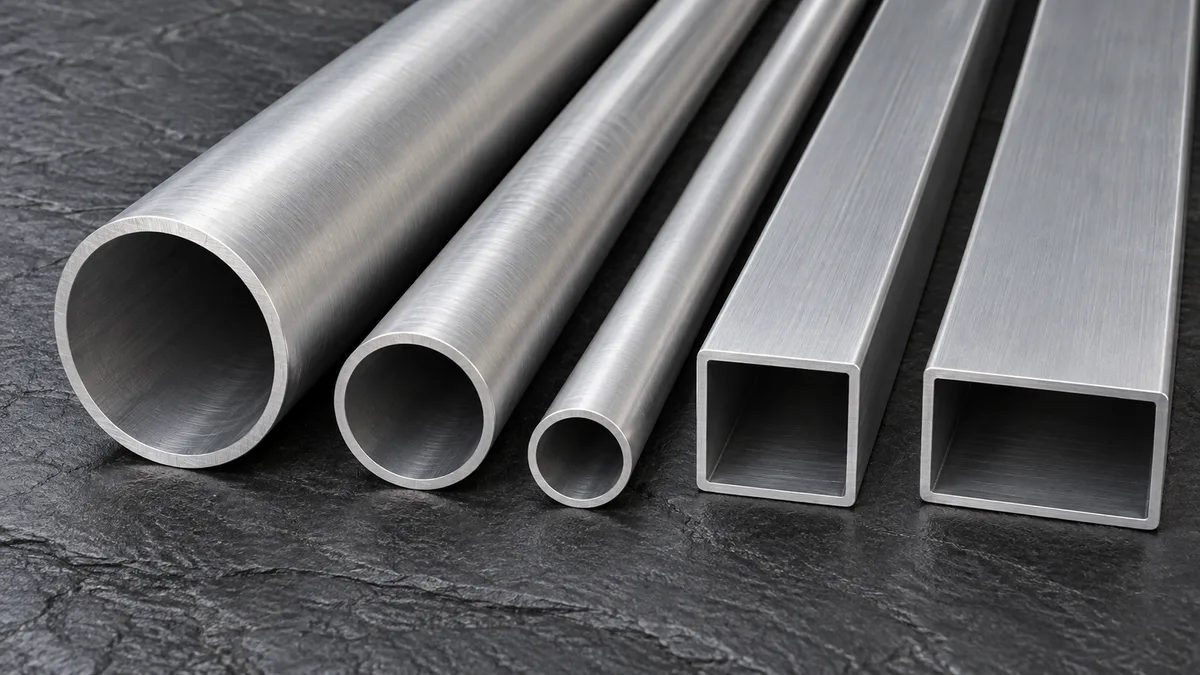
5052 is a medium-strength aluminium alloy with about 2.5 % magnesium and 0.25 % chromium. It cannot be heat treated, so its strength comes from cold drawing; in exchange it is ductile, weldable and very resistant to corrosion, including in marine air.
Aircraft fluid systems need tube that can be bent to tight radii, flared or beaded for fittings, and left in service for decades without corroding inside or out. Annealed 5052-O does this better than almost any other aluminium alloy. It is stronger than 3003, which it largely replaced for fuel and oil lines, yet far more forgiving to form than heat-treated 6061-T6 or 2024-T3. Where pressure is high, as in main hydraulic systems, designers move to 6061-T6, 2024-T3 or titanium and stainless steel; for fuel, oil, vent, drain, pneumatic, instrument and low-pressure hydraulic return lines, 5052-O remains the default.
The same alloy drawn in harder tempers, H32 to H38, is used for light frames, handrails, antenna masts, ducting and fixtures where some strength is needed and the tube is welded or mechanically joined. Compared with high-manganese alloys, 5052 also has better resistance to stress-corrosion cracking, which matters in tubes that are bent and then held under clamp loads.
The page below covers composition, properties by temper, the AMS and ASTM specifications buyers most often quote, sizes and weights, tolerances, fabrication advice, testing, finishes and how 5052 compares with the alternatives.
All 5052 tubing specifications use the same registered composition. Magnesium provides solid-solution strength; chromium controls grain growth during annealing and improves resistance to stress corrosion. Copper is held to 0.10 % maximum, which is one reason the alloy performs so well in corrosive service.
| Element | Minimum | Maximum | Role in the alloy |
|---|---|---|---|
| Silicon (Si) | — | 0.25 | Impurity; kept low for ductility |
| Iron (Fe) | — | 0.40 | Impurity; affects grain size and finish |
| Copper (Cu) | — | 0.10 | Kept low to protect corrosion resistance |
| Manganese (Mn) | — | 0.10 | Residual only |
| Magnesium (Mg) | 2.2 | 2.8 | Main strengthening element (solid solution) |
| Chromium (Cr) | 0.15 | 0.35 | Grain control; improves stress-corrosion resistance |
| Zinc (Zn) | — | 0.10 | Impurity |
| Others, each / total | — | 0.05 / 0.15 | |
| Aluminium (Al) | Remainder | About 96.1 – 97.7 % |
Values follow the Aluminum Association registration used by ASTM B210, B241, AMS 4069/4071 and EN 573-3.
For drawn tube, ASTM B210 sets minimum tensile and yield strength for each temper, with a maximum tensile strength for O so the tube stays soft enough to form. The AMS tubing specifications for 5052-O use comparable limits and add tighter dimensional and inspection requirements.
| Temper (drawn tube) | Tensile strength (specified) | Yield strength 0.2 % (min) | Typical use |
|---|---|---|---|
| 5052-O | 170 – 240 MPa (25 – 35 ksi) | 70 MPa (10 ksi) | Bent and flared fluid lines |
| 5052-H32 | ≥ 214 MPa (31 ksi) | 159 MPa (23 ksi) | Light frames, welded assemblies |
| 5052-H34 | ≥ 234 MPa (34 ksi) | 179 MPa (26 ksi) | Structural tubing, masts, rails |
| 5052-H36 | ≥ 255 MPa (37 ksi) | 200 MPa (29 ksi) | Higher-load straight tube |
| 5052-H38 | ≥ 269 MPa (39 ksi) | Per specification | Maximum-strength straight tube |
Minimums summarised from ASTM B210 for drawn 5052 tube; elongation limits depend on wall thickness and specimen type. Always design to the values in the edition named on your order.
| Temper | Typical tensile | Typical yield | Typical elongation | Shear strength |
|---|---|---|---|---|
| O | 193 MPa / 28 ksi | 90 MPa / 13 ksi | 25 % | 124 MPa / 18 ksi |
| H32 | 228 MPa / 33 ksi | 193 MPa / 28 ksi | 12 % | 138 MPa / 20 ksi |
| H34 | 262 MPa / 38 ksi | 214 MPa / 31 ksi | 10 % | 145 MPa / 21 ksi |
| H38 | 290 MPa / 42 ksi | 255 MPa / 37 ksi | 7 % | 165 MPa / 24 ksi |
Annealed, fully soft. The only temper normally used for aircraft fluid lines that are bent and flared, because it tolerates tight radii and 37° flares without cracking.
Quarter-hard, strain-hardened and stabilised. Balanced strength and workability for welded frames, housings and enclosures.
Half-hard. More strength with moderate formability; used for structural reinforcement tube and medium-duty straight runs.
Three-quarter-hard. Chosen where the tube must resist denting or vibration loads and will be bent only gently, if at all.
Full-hard. Highest strength of the standard tempers; for straight, mechanically fastened tubes and fixed assemblies.
As-extruded. Used for larger extruded tube and pipe that will be machined or welded rather than drawn to close tolerance.
Aircraft drawings usually call an AMS specification; industrial and marine buyers use ASTM or EN. The table lists the documents most often quoted for 5052 tube. Older drawings may cite WW-T-700/4, the federal specification for 5052 tube, which has been superseded and is not recommended for new designs.
| Specification | Product | Notes |
|---|---|---|
| SAE AMS 4069 | Drawn round seamless tube, close tolerance, 5052-O | Wall about 0.25 – 11.4 mm (0.010 – 0.450 in) |
| SAE AMS 4071 | Drawn round seamless hydraulic tube, 5052-O | OD about 3.2 – 76 mm (0.125 – 3.000 in); extra tests for hydraulic service |
| ASTM B210 / ASME SB-210 | Drawn seamless tube | O and H32 – H38 tempers; standard commercial and aerospace use |
| ASTM B241 / ASME SB-241 | Seamless pipe and seamless extruded tube | H112 and O; larger sizes |
| ASTM B221 | Extruded tube (including porthole-die) | Bars, rods, profiles and tube |
| ASTM B483 | Drawn tube for general-purpose applications | Commercial-grade alternative to B210 |
| ASTM B234 | Drawn seamless tube for condensers and heat exchangers | Thin-wall heat-transfer tube |
| WW-T-700/4 (legacy) | Federal spec for 5052 tube | Superseded; noted on older drawings |
| EN 754 / EN 755 + EN 573-3 | Drawn and extruded tube, EN AW-5052 | European orders |
| System | Designation |
|---|---|
| UNS | A95052 |
| EN | EN AW-5052 / AlMg2.5 |
| Werkstoff | 3.3523 |
| ISO | AlMg2.5 |
| JIS | A5052TD (drawn tube) |
| French (legacy) | AG2.5C |
Sizes outside the commonly drawn range are produced to order; tell us the OD, wall, temper and specification.
Weight of round tube in kg per metre is π × (OD − wall) × wall × 2.68 ÷ 1000, with dimensions in millimetres. Use the tube weight calculator for any other size.
| OD (mm) | Wall (mm) | OD × wall (in) | kg per metre | kg per 6 m length |
|---|---|---|---|---|
| 6.35 | 0.71 | 0.250 × 0.028 | 0.034 | 0.20 |
| 9.53 | 0.89 | 0.375 × 0.035 | 0.065 | 0.39 |
| 12.7 | 0.89 | 0.500 × 0.035 | 0.088 | 0.53 |
| 12.7 | 1.24 | 0.500 × 0.049 | 0.120 | 0.72 |
| 15.88 | 1.24 | 0.625 × 0.049 | 0.153 | 0.92 |
| 19.05 | 1.24 | 0.750 × 0.049 | 0.186 | 1.12 |
| 25.4 | 1.65 | 1.000 × 0.065 | 0.330 | 1.98 |
| 31.75 | 1.65 | 1.250 × 0.065 | 0.418 | 2.51 |
| 38.1 | 2.11 | 1.500 × 0.083 | 0.639 | 3.84 |
| 50.8 | 2.11 | 2.000 × 0.083 | 0.865 | 5.19 |
| 63.5 | 3.18 | 2.500 × 0.125 | 1.615 | 9.69 |
| 76.2 | 3.18 | 3.000 × 0.125 | 1.955 | 11.73 |
| 101.6 | 6.35 | 4.000 × 0.250 | 5.092 | 30.55 |
| 152.4 | 6.35 | 6.000 × 0.250 | 7.808 | 46.85 |
Commercial drawn tube follows the standard tolerance tables in ASTM B210 (ANSI H35.2). AMS close-tolerance specifications such as AMS 4069 tighten diameter and wall limits further, which is why they are preferred for flared hydraulic and fuel lines where fit with fittings is critical.
| Specified OD (in) | Specified OD (mm) | Mean OD tolerance (± in) | Mean OD tolerance (± mm) |
|---|---|---|---|
| up to 0.500 | up to 12.7 | 0.003 | 0.08 |
| 0.501 – 1.000 | 12.7 – 25.4 | 0.004 | 0.10 |
| 1.001 – 2.000 | 25.4 – 50.8 | 0.005 | 0.13 |
| 2.001 – 3.000 | 50.8 – 76.2 | 0.006 | 0.15 |
| 3.001 – 5.000 | 76.2 – 127 | 0.008 | 0.20 |
| 5.001 – 6.000 | 127 – 152 | 0.010 | 0.25 |
| 6.001 – 8.000 | 152 – 203 | 0.015 | 0.38 |
| 8.001 – 10.000 | 203 – 254 | 0.020 | 0.51 |
| 10.001 – 12.000 | 254 – 305 | 0.025 | 0.64 |
Typical mean-diameter tolerances for drawn round tube per ANSI H35.2. Tolerances at any single point are wider, especially for annealed tube, which can go slightly oval in handling. Confirm against the edition named on your order.
A first estimate of burst pressure for a thin-walled tube comes from Barlow's formula, P = 2 × S × t ÷ OD, where S is the tensile strength, t the wall and OD the outside diameter. For a 3/8 in × 0.035 in 5052-O line using the 25 ksi minimum tensile strength, estimated burst is about 4,700 psi (32 MPa). Aircraft practice applies a substantial factor of safety, often four, giving a working pressure in the region of 1,100 – 1,200 psi for that size.
That calculation explains why 5052-O is used for fuel, oil, pneumatic and return lines, while 3,000 psi and 5,000 psi hydraulic pressure lines use 6061-T6, 2024-T3, titanium or corrosion-resistant steel. The figures here are only a first estimate; the governing design manual, the fitting manufacturer's data and qualification testing control the final rating.
Use O temper for anything but gentle bends. Draw bending with a mandrel controls ovality; keep tube clean and lubricated to avoid scoring that could start fatigue cracks.
TIG and MIG weld readily with ER5356 filler. In O temper the joint keeps nearly full base strength; in H3x tempers the heat-affected zone softens to near annealed values.
5052 is difficult to braze because magnesium oxide hinders wetting; where brazed joints are required, 3003 or 6063 tube is usually chosen instead.
Soft tempers can be gummy. Sharp, high-rake tools and cutting fluid give clean cut-offs and end preparation.
Cold-worked tube can be returned to O by annealing at about 345 °C with controlled cooling, restoring formability after heavy working.
Lines for fuel, oxygen or hydraulic service are cleaned, capped and bagged to the cleanliness level the system specification calls for.
| Finish | What it does | Typical use |
|---|---|---|
| Mill finish | Natural drawn surface, clean and bright | Fluid lines that are later primed or sealed |
| Sulphuric anodising | Hard, protective oxide; clear or dyed | Frames, rails, visible tube |
| Chromic or boric-sulphuric anodising | Thin, fatigue-friendly anodic film | Aerospace parts under fatigue load |
| Chemical conversion coating | Thin film for paint adhesion and corrosion protection | Lines and parts to be primed |
| Primer and paint / powder coating | Barrier and colour coding | Exterior and ground-equipment tube |
| Mechanical polishing or brushing | Decorative surface | Cabin and interior tube |
Note that colour identification of aircraft fluid lines is normally done with tape or band markings rather than by anodising colour, so the finish should be chosen for protection and fatigue performance first.
A representative case is a light-aircraft fuel system: wing-tank feed lines in 3/8 in × 0.035 in 5052-O tube, bent on a mandrel bender, 37°-flared, joined with anodised aluminium fittings and supported in cushioned clamps. The same alloy in H32 sheet forms the tanks, giving consistent corrosion behaviour across the system.
| Property | 5052-O | 3003-O | 6061-T6 | 5083-O | 2024-T3 |
|---|---|---|---|---|---|
| Typical tensile strength | 193 MPa | 110 MPa | 310 MPa | 290 MPa | 485 MPa |
| Formability (bend, flare) | Excellent | Excellent | Fair | Good | Fair |
| Weldability | Excellent | Excellent | Good | Excellent | Not recommended |
| Corrosion resistance | Very good | Very good | Good | Excellent | Fair |
| Heat treatable | No | No | Yes | No | Yes |
| Typical aircraft role | Fuel, oil, pneumatic lines | Low-load lines, ducts | Hydraulic pressure lines | Rare; cryogenic and GSE | High-pressure hydraulic lines |
3003 is cheaper and slightly more formable but has little more than half the strength, so it is now used mainly for ducting and very low-pressure lines. 6061-T6 and 2024-T3 take over when pressure rises. 5083 is stronger than 5052 but must not run above about 65 °C because of sensitisation, which rules it out of many engine-bay locations.
5052-O, the annealed temper. It bends and flares without cracking and still has enough strength for fuel, oil, vent and pneumatic pressures. AMS 4069 and AMS 4071 both cover 5052-O drawn seamless tube.
Both cover drawn seamless 5052-O tube. AMS 4069 is the close-tolerance general tubing specification; AMS 4071 is written for hydraulic tubing and covers a defined OD range with requirements suited to pressure service.
Usually not for 3,000 psi or higher pressure lines. Those use 6061-T6, 2024-T3, titanium or stainless steel. 5052-O is used for return, case-drain and low-pressure lines where the system design allows it.
On a mandrel bender, centreline radii of about two to three times the OD are routine. Thin walls and harder tempers need larger radii; always follow the bend tables of your design manual.
Aerospace 5052 tube is drawn seamless, made from extruded hollow blooms and cold drawn to size. Porthole-die extruded tube, which has longitudinal weld seams, is not normally accepted for pressure lines.
Weight per metre is π × (OD − wall) × wall × 2.68 ÷ 1000 in kilograms, with sizes in millimetres. A 25.4 × 1.65 mm tube weighs about 0.33 kg per metre.
Yes. Metline ships 5052 tube worldwide with EN 10204 3.1 mill certificates, cut to length and export packed, on EXW, FOB, CIF or DAP terms.
Send OD, wall, temper, specification, lengths and quantities. We will reply with availability, certification and a delivered price.





