6082-O
Annealed for forming. Parts are solution treated and aged after forming to regain strength.



6082 sheet and plate is the European workhorse for structural aluminium parts that are cut, machined, welded or bent rather than deep drawn. In vehicles it is used for battery-enclosure plates and lids, brackets and reinforcements, motor and inverter mounting plates, and the floors, side walls and chassis parts of trucks, vans and trailers. Metline supplies 6082 in O, T4, T6 and T651 to EN 485 and ASTM B209, cut to size and certified, to customers worldwide.
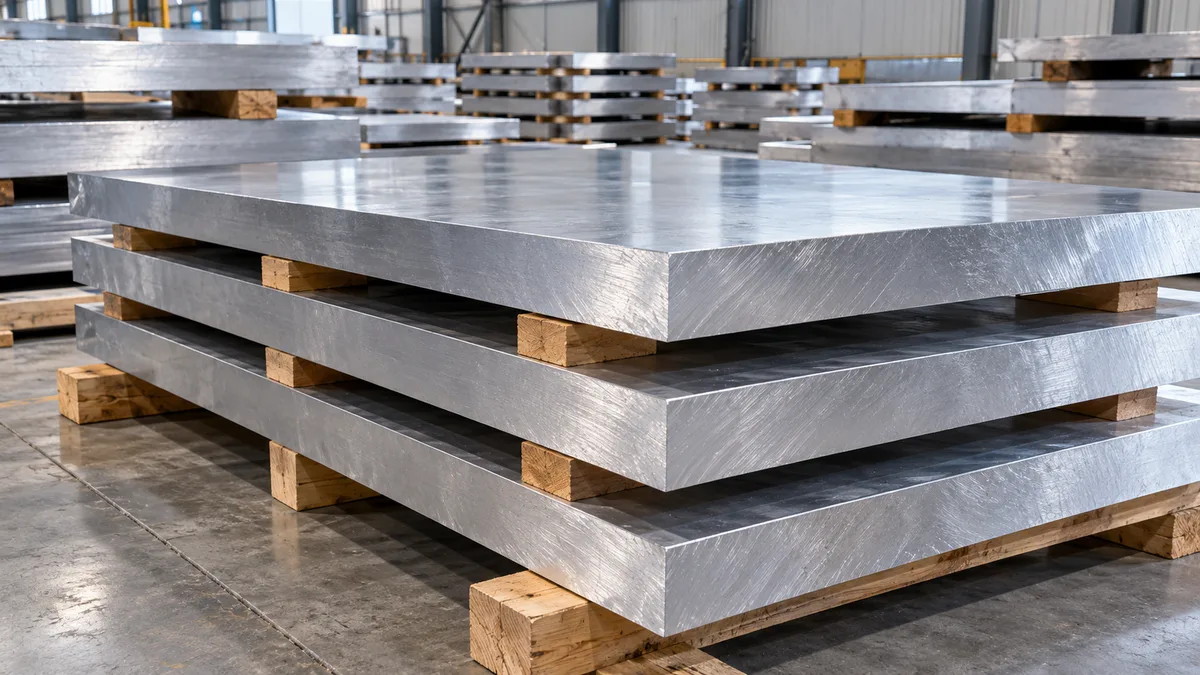
6082 is a heat-treatable Al-Si-Mg-Mn alloy that reaches the highest strength of the common 6xxx sheet and plate grades. In many applications it has replaced 6061, especially in Europe, because it offers equal or slightly higher strength in thick plate, good weldability and corrosion resistance, and wide availability.
On vehicles, 6082 sheet and plate is a structural and engineering material, not an outer-panel alloy. Body skins use bake-hardening grades such as 6016 and 6022, and inner panels use 5182 or 5754. 6082 is chosen when a part needs strength and stiffness in a flat or simply formed shape: battery-enclosure lids and base plates, crash-relevant reinforcements, mounting plates for electric drive units, tipper and truck bodies, trailer chassis parts and loading ramps.
Thicker 6082-T651 plate is machined into fixtures and jigs used on body-in-white lines, and into cooling plates and structural nodes in EV battery systems.
| Element | Minimum | Maximum | Role |
|---|---|---|---|
| Silicon (Si) | 0.7 | 1.3 | Forms Mg2Si; excess Si adds strength |
| Iron (Fe) | — | 0.50 | Impurity |
| Copper (Cu) | — | 0.10 | Kept low for corrosion resistance |
| Manganese (Mn) | 0.40 | 1.0 | Controls grain structure and recrystallisation; raises toughness |
| Magnesium (Mg) | 0.6 | 1.2 | Main strengthening element |
| Chromium (Cr) | — | 0.25 | Grain structure control |
| Zinc (Zn) | — | 0.20 | Impurity |
| Titanium (Ti) | — | 0.10 | Grain refiner |
| Others, each / total | — | 0.05 / 0.15 | |
| Aluminium (Al) | Remainder |
Specified minimums below summarise EN 485-2. Values for T6 and T651 decrease in thicker plate, because the centre cools more slowly during quenching.
| Temper / thickness | Rm min (MPa) | Rp0.2 min (MPa) | Elongation min (%) |
|---|---|---|---|
| O, 0.4 – 25 mm | ≤ 150 | ≤ 85 | 14 – 18 |
| T4, 0.4 – 12.5 mm | 205 | 110 | 12 – 14 |
| T6, 0.4 – 1.5 mm | 310 | 260 | 6 |
| T6, > 1.5 – 3 mm | 310 | 260 | 7 |
| T6, > 3 – 6 mm | 310 | 260 | 10 |
| T651, > 6 – 12.5 mm | 300 | 255 | 9 |
| T651, > 12.5 – 100 mm | about 295 | about 240 | 7 – 8 |
| T651, > 100 – 150 mm | about 275 | about 240 | 6 |
Plate above 12.5 mm is summarised; refer to EN 485-2 or the mill certificate for the exact limit in your thickness band. Typical T6 sheet values are about 330 – 340 MPa tensile and 280 – 300 MPa yield, with hardness around 95 HB.
Annealed for forming. Parts are solution treated and aged after forming to regain strength.
Solution treated and naturally aged. Formable to moderate radii, then aged to T6.
Standard condition for sheet up to about 6 mm, used flat or with generous bends.
Stretched plate for machining. Stays flat as material is removed, so it is the normal choice above 6 mm.
| System | Designation |
|---|---|
| European (EN) | EN AW-6082 / EN AW-AlSi1MgMn |
| German Werkstoff | 3.2315 (formerly AlMgSi1) |
| British (former) | HE30 (extrusions), HP30 / H30 |
| ISO | AlSi1MgMn |
| UNS | A96082 |
| Aluminum Association | 6082 |
Sheet and plate are supplied to EN 485 (properties and tolerances), EN 573-3 (composition), ISO 6361 or ASTM B209 / ASME SB-209 when ordered to US specifications. Note that 6082 and 6061 are close but not identical, so a drawing calling for one should not be filled with the other without approval.
6082 weighs 2.70 kg per m² per millimetre of thickness. Reference weights:
| Thickness (mm) | kg per m² | 1250 × 2500 mm (kg) | 1550 × 3000 mm (kg) |
|---|---|---|---|
| 1 | 2.7 | 8.4 | 12.6 |
| 2 | 5.4 | 16.9 | 25.1 |
| 3 | 8.1 | 25.3 | 37.7 |
| 4 | 10.8 | 33.8 | 50.2 |
| 5 | 13.5 | 42.2 | 62.8 |
| 6 | 16.2 | 50.6 | 75.3 |
| 8 | 21.6 | 67.5 | 100.4 |
| 10 | 27.0 | 84.4 | 125.6 |
| 12 | 32.4 | 101.2 | 150.7 |
| 15 | 40.5 | 126.6 | 188.3 |
| 20 | 54.0 | 168.8 | 251.1 |
| 25 | 67.5 | 210.9 | 313.9 |
| 30 | 81.0 | 253.1 | 376.7 |
| 40 | 108.0 | 337.5 | 502.2 |
| 50 | 135.0 | 421.9 | 627.8 |
Cold-rolled sheet follows EN 485-4 and hot-rolled plate EN 485-3 unless the order states otherwise. Representative thickness tolerances for cold-rolled automotive sheet are below; width tolerances run from +0.3 / 0 mm on narrow slit strip to +6 / 0 mm on 2000 – 2400 mm sheet.
| Thickness (mm) | Width ≤ 1500 mm | > 1500 – 1700 mm | > 1700 – 2000 mm | > 2000 – 2400 mm |
|---|---|---|---|---|
| 0.30 – 0.50 | ± 0.03 | ± 0.04 | — | — |
| > 0.50 – 0.80 | ± 0.03 | ± 0.04 | ± 0.04 | — |
| > 0.80 – 1.20 | ± 0.04 | ± 0.04 | ± 0.05 | ± 0.06 |
| > 1.20 – 2.00 | ± 0.05 | ± 0.05 | ± 0.06 | ± 0.07 |
| > 2.00 – 2.50 | ± 0.06 | ± 0.07 | ± 0.07 | ± 0.08 |
| > 2.50 – 3.00 | ± 0.07 | ± 0.08 | ± 0.08 | ± 0.09 |
| > 3.00 – 3.50 | ± 0.08 | ± 0.09 | ± 0.10 | ± 0.11 |
MIG and TIG weld readily. ER5356 or ER5183 filler gives higher joint strength; ER4043 reduces hot-cracking risk. The heat-affected zone drops to roughly half of T6 strength, which design codes such as Eurocode 9 take into account.
Bend T6 sheet across the rolling direction with inside radii of about 2 – 3 × thickness. For tighter bends, form in O or T4 and age afterwards.
T6 and T651 machine well with short chips; use sharp carbide tools and flood coolant. Higher silicon makes it slightly more abrasive than 6061.
Good resistance in road-salt and humid environments. Anodise or paint for appearance; isolate from steel fasteners.
| Part | Form and temper | Why 6082 |
|---|---|---|
| Battery-enclosure lids and base plates | Sheet or plate, T6 | Strength and stiffness for impact and underbody protection |
| Motor, inverter and charger mounting plates | Plate, T651 | Flat after machining |
| Brackets and reinforcements | Sheet, T6 or formed in T4 | High strength in welded and bolted parts |
| Truck, tipper and trailer bodies and floors | Sheet and plate, T6 | Durable, weldable and corrosion resistant |
| Loading ramps, tail lifts and steps | Plate, T6 | Load capacity at low weight |
| Body-in-white fixtures and jigs | Plate, T651 | Machinable, stable tooling material |
Some trade literature lists 6082 for conductive parts such as generators and batteries. Its conductivity (about 40 – 45 % IACS) is adequate for some structural busbars, but dedicated conductor alloys such as 1350 or 6101 are normally used where conductivity matters.
| Property | 6082-T6 | 6061-T6 | 5083-H111 | 5754-H22 |
|---|---|---|---|---|
| Yield strength (min) | 260 MPa | 240 MPa | 125 MPa | 130 MPa |
| Weldability | Good | Good | Excellent (no HAZ loss) | Excellent |
| Machinability | Very good | Very good | Fair | Fair |
| Formability | Low in T6 | Low in T6 | Good | Very good |
| Typical automotive use | Structural plates, bodies | Brackets, plates | Tanker and tipper bodies | Inner panels, tanks |
Choose 5083 or 5754 when welded strength or forming matters more than base-metal strength, for example in tanker shells and fuel tanks. Choose 6082 or 6061 for machined, bolted and flat structural parts.
EN 485-2 requires 310 MPa tensile and 260 MPa yield for 6082-T6 sheet up to 6 mm, with minimum elongation from 6 to 10 % depending on thickness.
No, but they are close. 6082 has more silicon and manganese and less copper; it is slightly stronger in thick plate and common in Europe. 6061 is the standard in the Americas. Do not substitute one for the other without approval.
Not for outer skins. Those use 6016, 6014 or 6022. 6082 sheet and plate is used for structural parts, battery enclosures, mounting plates and commercial-vehicle bodies.
Yes, with inside radii of roughly 2 – 3 × thickness, bending across the rolling direction. For tight bends, form in O or T4 and age afterwards.
HE30 for extrusions, with H30 and HP30 used for other forms. The current European designation is EN AW-6082 (AlSi1MgMn), Werkstoff 3.2315.
Yes. Metline supplies 6082 worldwide with EN 10204 3.1 certificates and export packing on EXW, FOB, CIF or DAP terms.
Send temper, size, quantity and destination. Our team will reply with availability, certification and delivered pricing.





