Extruded bar
Lowest cost on standard sizes; good straightness and surface.



6082 is the strongest of the common 6xxx alloys used as busbar. Its conductivity is lower (about 42 % IACS in T6, against 55 – 61 % for 6101 and 1350), so it is chosen when the bar must also act as a structural member: long unsupported spans, high short-circuit forces, vibration or bolted frames. This guide shows when that trade-off is worth making and how to size and specify 6082 busbar.
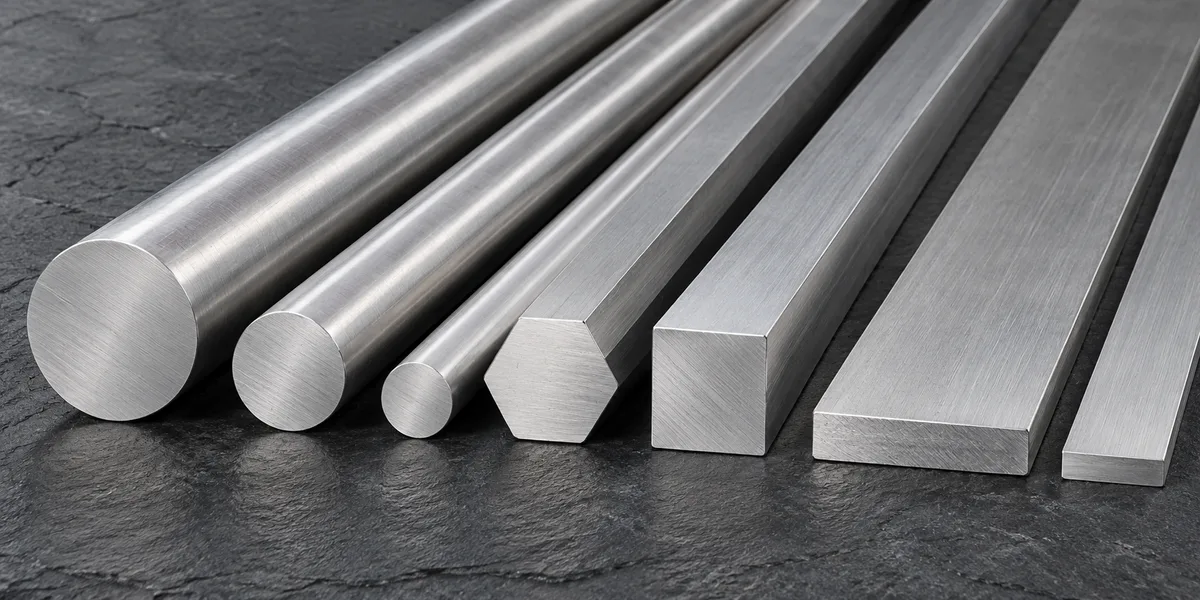
Most busbars are limited by heat, not by strength. 6082 only makes sense when strength or stiffness, rather than temperature rise, is the limiting design requirement.
6082 contains more silicon and magnesium than 6063 or 6101, plus up to 1 % manganese. Manganese refines the grain and gives 6082 its high strength in thick sections, but manganese in solid solution is also one of the most damaging elements for electrical conductivity. That is why a 6082-T6 bar conducts roughly 25 – 30 % less than a 6101-T6 bar of the same size.
In return, 6082-T6 offers roughly 1.5 times the yield strength of 6063-T6 and more than double the minimum for 6101-T61. For a bar spanning between widely spaced insulators, the deflection and stress under short-circuit electromagnetic forces can govern the design, and a stronger bar means fewer supports. In traction, marine and mobile equipment, vibration and shock push in the same direction.
| Element | Minimum | Maximum | Effect |
|---|---|---|---|
| Silicon (Si) | 0.70 | 1.30 | Forms Mg2Si; excess Si adds strength |
| Iron (Fe) | — | 0.50 | Impurity |
| Copper (Cu) | — | 0.10 | Impurity |
| Manganese (Mn) | 0.40 | 1.00 | Grain control and strength; largest conductivity penalty |
| Magnesium (Mg) | 0.60 | 1.20 | Main strengthening element |
| Chromium (Cr) | — | 0.25 | Grain control; lowers conductivity |
| Zinc (Zn) | — | 0.20 | Impurity |
| Titanium (Ti) | — | 0.10 | Grain refiner |
| Others, each / total | — | 0.05 / 0.15 | |
| Aluminium (Al) | Remainder | About 95.2 – 98.3 % |
Limits follow EN 573-3 (EN AW-6082, AlSi1MgMn) and the Aluminum Association registration. Equivalent designations: UNS A96082, Werkstoff 3.2315, former DIN AlMgSi1 and former British HE30.
Mechanical minimums below are from EN 755-2 for extruded bar and profiles in the thickness bands most used for busbar. Values vary with section thickness and product form, so check the band that matches your bar.
| Temper | Product / thickness | Tensile Rm min | Yield Rp0.2 min | Elongation A min |
|---|---|---|---|---|
| T4 | Bar ≤ 25 mm | 205 MPa | 110 MPa | 14 % |
| T5 | Profiles ≤ 5 mm | 270 MPa | 230 MPa | 8 % |
| T6 | Bar ≤ 20 mm | 295 MPa | 250 MPa | 8 % |
| T6 | Profiles 5 – 25 mm | 310 MPa | 260 MPa | 10 % |
| Property (T6, typical) | Value |
|---|---|
| Electrical conductivity | ≈ 42 % IACS (≈ 24 MS/m) |
| Resistivity at 20 °C | ≈ 41 nΩ·m |
| Thermal conductivity | ≈ 160 – 170 W/m·K |
| Brinell hardness | ≈ 90 – 95 HB |
| Density | 2.70 g/cm³ |
| Modulus of elasticity | ≈ 70 GPa |
| Coefficient of thermal expansion | ≈ 23 µm/m·°C |
Conductivity in the T4 and O conditions is higher than in T6, but strength falls with it. If you need a guaranteed minimum (for example ≥ 24 MS/m), write it on the order and ask for a measured value on the certificate.
The table uses density 2.70 g/cm³ and conductivity 42 % IACS (6082-T6) to give mass and DC resistance per metre at 20 °C. Compare with the same sizes in 6063 (≈ 53 % IACS) on our 6063 busbar guide: 6082 has about 25 % more resistance for the same section.
| Size t × w (mm) | Area (mm²) | Mass (kg/m) | DC resistance (µΩ/m) |
|---|---|---|---|
| 3 × 25 | 75 | 0.203 | 547.3 |
| 4 × 40 | 160 | 0.432 | 256.6 |
| 5 × 30 | 150 | 0.405 | 273.7 |
| 5 × 50 | 250 | 0.675 | 164.2 |
| 6 × 60 | 360 | 0.972 | 114.0 |
| 8 × 80 | 640 | 1.728 | 64.1 |
| 10 × 50 | 500 | 1.350 | 82.1 |
| 10 × 80 | 800 | 2.160 | 51.3 |
| 10 × 100 | 1000 | 2.700 | 41.0 |
| 12 × 120 | 1440 | 3.888 | 28.5 |
| 15 × 150 | 2250 | 6.075 | 18.2 |
| 20 × 200 | 4000 | 10.800 | 10.3 |
Because power loss is I²R, a 6082 bar carrying the same current as a 6101 bar of the same section dissipates about 30 % more heat. Either accept a lower rating, increase the section, or use 6082 only for the structural part of the run and a higher-conductivity grade elsewhere.
Lowest cost on standard sizes; good straightness and surface.
Used for very wide or thick blocks, or short runs of unusual sizes; T651 plate keeps the bar flat when machined.
Tapped blocks, clamps and terminals benefit from 6082's machinability and thread strength.
| Grade and temper | Conductivity | Specified minimum yield strength | Relative heat at same current and size |
|---|---|---|---|
| 1350-H111 | ≥ 61 % IACS | 24 MPa | 1.00 |
| 6101-T61 (3.2 – 19 mm) | ≥ 57 % IACS | 103 MPa | 1.07 |
| 6101-T6 (3.2 – 12.7 mm) | ≥ 55 % IACS | 172 MPa | 1.11 |
| 6063-T6 (≤ 10 mm, EN 755-2) | ≈ 53 % IACS typical | 170 MPa | 1.15 |
| 6082-T6 (bar ≤ 20 mm, EN 755-2) | ≈ 42 % IACS typical | 250 MPa | 1.45 |
Relative heat is the ratio of resistance to that of 1350 at 61 % IACS, for the same section and current. Yield values are specified minimums from ASTM B317 (1350, 6101) and EN 755-2 (6063, 6082).
The table shows why 6082 is a specialist choice. If a 6101-T6 bar is strong enough, it will run cooler and waste less energy. Choose 6082 when the bar would otherwise need extra supports or a separate structural member.
About 42 % IACS (around 24 MS/m) in T6, compared with 55 – 59.5 % IACS minimum for 6101 tempers and 61 % for 1350.
It is a good structural conductor but a poor choice where losses and temperature rise dominate. Use it where strength, stiffness or vibration resistance matter more than conductivity.
6101 is designed as a conductor and its conductivity is guaranteed by ASTM B317. 6082 is a structural alloy that is roughly 50 % stronger in T6 but about 25 – 30 % less conductive.
Yes, with generous radii of about 2 – 3 × thickness. For tight bends, form it in T4 and age to T6 afterwards.
EN AW-6082 (AlSi1MgMn), UNS A96082, Werkstoff 3.2315, former DIN AlMgSi1 and former British HE30.
Send the section, span, current and environment. Metline will suggest 6082 or a better-conducting grade and quote accordingly.





