6082-T651 (BS L115)
Solution treated, stretched 1.5 – 3 % and aged. The standard for plate above about 6 mm that will be machined: residual stress is low, so parts stay flat.



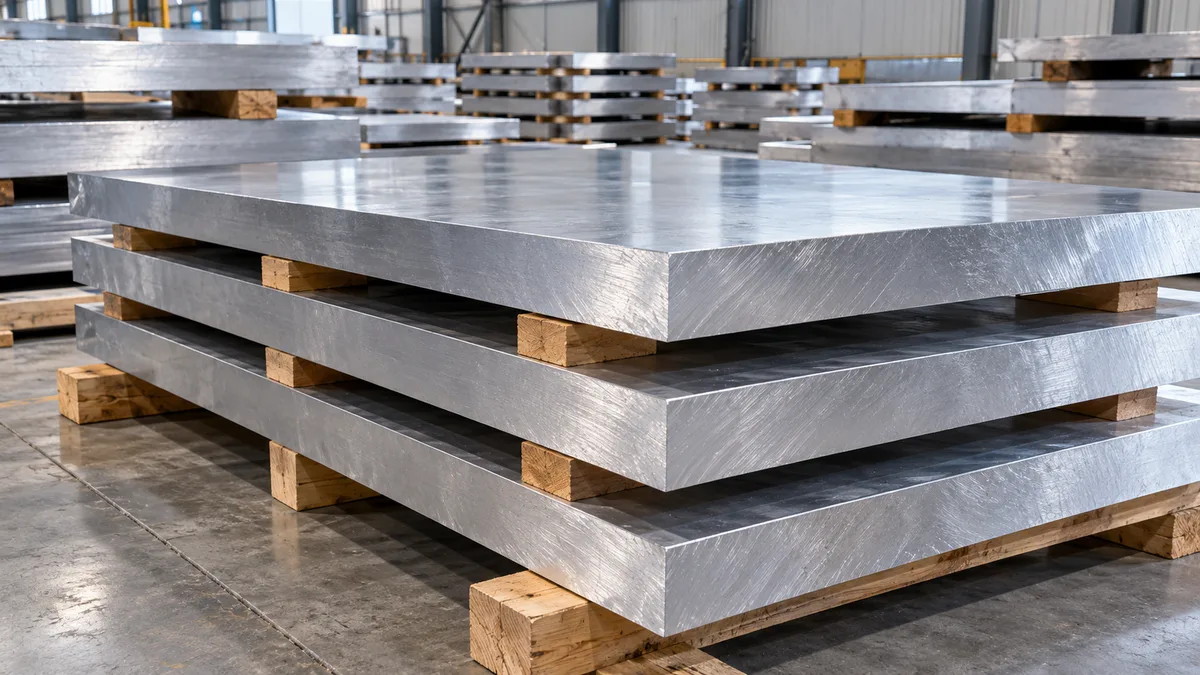
6082 is the strongest of the widely stocked European 6xxx plate alloys and, as BS L113 sheet and BS L115 plate, an established material for aerospace fittings, tooling, ground support equipment and machined parts. T651 plate is stretched to stay flat during heavy machining, and the alloy welds, anodises and resists corrosion well. Metline supplies 6082 sheet and plate in O, T4, T6 and T651, cut to size and certified to aerospace, EN or ASTM standards, worldwide.
6082 is an aluminium-silicon-magnesium-manganese alloy. Its silicon content is higher than the Mg2Si ratio requires, and the excess raises strength after ageing; manganese controls the grain structure and adds a little strength of its own. With copper held at 0.10 % maximum, corrosion resistance is better than 6061.
The alloy was developed in Europe and replaced the older British grade HE30/H30, which is why it is sometimes still called "H30" in workshops. For aerospace use, the British L-series covers 6082 in all main forms: BS L113 for T6 sheet and strip, BS L115 for T651 plate, L111 for bar and sections, L112 for forgings and L114 for tube. Many European aerospace suppliers and MRO shops use these specifications for parts where 6061-class strength is enough.
Typical aerospace plate applications are machined brackets, mounting plates and fittings in secondary structure, avionics and equipment trays, cargo-system and seat components, assembly jigs and tooling plates, and a very wide range of ground support equipment such as stairs, platforms, towbars and engine stands. Primary structure such as wing skins, spars and fuselage frames uses 2024, 7075, 7050 or aluminium-lithium plates, which offer far higher strength and damage tolerance, so treat claims that 6082 is used for wings or fuselage skins with caution.
In general engineering 6082 is sometimes described as having replaced 6061 because of its higher strength. In reality the two are very close: 6082-T651 plate is slightly stronger in thick sizes and more corrosion resistant, while 6061 is more widely stocked outside Europe and has more US aerospace specifications. The choice usually follows the standards system of the drawing.
Limits follow EN 573-3 for EN AW-6082 and the Aluminum Association registration. BS L113 and L115 call the same composition. Note that the magnesium minimum is 0.60 %; data sheets showing 0.06 % contain a typing error.
| Element | Minimum | Maximum | Role in the alloy |
|---|---|---|---|
| Silicon (Si) | 0.70 | 1.30 | Excess Si over the Mg2Si ratio raises aged strength |
| Iron (Fe) | — | 0.50 | Impurity |
| Copper (Cu) | — | 0.10 | Kept low for corrosion resistance |
| Manganese (Mn) | 0.40 | 1.00 | Suppresses recrystallisation and coarse grain; adds strength |
| Magnesium (Mg) | 0.60 | 1.20 | Main strengthening element with Si |
| Chromium (Cr) | — | 0.25 | Grain control |
| Zinc (Zn) | — | 0.20 | Impurity |
| Titanium (Ti) | — | 0.10 | Grain refiner |
| Others, each / total | — | 0.05 / 0.15 | |
| Aluminium (Al) | Remainder | About 95.2 – 98.3 % |
The manganese range is wide. Plate producers usually target the upper half to suppress recrystallisation during solution treatment, which keeps a fine grain structure and higher strength in thick plate.
Values below are minimums from EN 485-2 by thickness band. Minimums fall as plate gets thicker because the centre cools more slowly during quenching. BS L113 sheet quotes 295 MPa tensile and 255 MPa proof stress up to 3 mm and 295 / 240 MPa from 3 to 25 mm; L115 plate follows a similar pattern. Design to the minimums printed on the certificate.
| Temper / thickness | Tensile strength (min) | 0.2 % proof stress (min) | Elongation (min) |
|---|---|---|---|
| O, 0.4 – 25 mm | ≤ 150 MPa (max) | ≤ 85 MPa (max) | 14 – 18 % |
| T4, 0.4 – 12.5 mm | 205 MPa | 110 MPa | 12 – 14 % |
| T6, 0.4 – 1.5 mm | 310 MPa | 260 MPa | 6 % (A50) |
| T6, 1.5 – 3 mm | 310 MPa | 260 MPa | 7 % (A50) |
| T6, 3 – 6 mm | 310 MPa | 260 MPa | 10 % (A50) |
| T6 / T651, 6 – 12.5 mm | 300 MPa | 255 MPa | 9 % (A50) |
| T651, 12.5 – 60 mm | 295 MPa | 240 MPa | 8 % (A) |
| T651, 60 – 100 mm | 295 MPa | 240 MPa | 7 % (A) |
| T651, 100 – 150 mm | 275 MPa | 240 MPa | 6 % (A) |
| T651, 150 – 175 mm | 275 MPa | 230 MPa | 4 % (A) |
Values summarised from EN 485-2; the edition on your order governs. Typical T651 values are about 320 – 340 MPa tensile, 280 – 300 MPa proof stress and 95 – 100 HB.
Solution treated, stretched 1.5 – 3 % and aged. The standard for plate above about 6 mm that will be machined: residual stress is low, so parts stay flat.
Solution treated and aged without stretching. Normal for sheet up to about 6 mm, used flat or lightly formed.
Solution treated and naturally aged. Bend or form, then age to T6 if needed.
Annealed for the deepest forming. Strength is restored by full heat treatment after forming.
These are extrusion tempers. If a plate enquiry mentions them, it usually means T6 or T651; we confirm before quoting.
If flatness matters more than strength, consider cast and milled tooling plate alongside 6082-T651.
| Standard / designation | Scope |
|---|---|
| BS L113 | 6082-T6 sheet and strip, British aerospace series |
| BS L115 | 6082-T651 plate, British aerospace series |
| EN 485-1 / -2 / -3 / -4 | Sheet, strip and plate: delivery conditions, properties and tolerances |
| EN 573-3 | Chemical composition (EN AW-6082, AlSi1MgMn) |
| ASTM B209 / ASME SB-209 | Sheet and plate; 6082 is registered and can be certified to ASTM on request |
| BS 1470 (legacy) | HS30 (sheet) and HP30 (plate); superseded by EN 485 |
| Werkstoff / DIN (legacy) | 3.2315, AlMgSi1 |
| UNS | A96082 |
| ISO | AlSi1MgMn (ISO 6361 for sheet and plate) |
If your drawing quotes HP30 or HS30, those are the older British plate and sheet designations for the same alloy, and EN AW-6082 to EN 485 is the modern replacement. For aerospace parts, keep to the specification named on the drawing; substitution between BS L-series, EN and ASTM certification needs written approval.
Very wide or very thick plate is made to order; send the size early so we can confirm the supply route.
6082 weighs 2.70 kg per square metre for every millimetre of thickness. Metric reference weights:
| Thickness (mm) | kg per m² | 1250 × 2500 mm (kg) | 1500 × 3000 mm (kg) |
|---|---|---|---|
| 1 | 2.70 | 8.4 | 12.2 |
| 1.5 | 4.05 | 12.7 | 18.2 |
| 2 | 5.40 | 16.9 | 24.3 |
| 3 | 8.10 | 25.3 | 36.5 |
| 4 | 10.80 | 33.8 | 48.6 |
| 5 | 13.50 | 42.2 | 60.8 |
| 6 | 16.20 | 50.6 | 72.9 |
| 8 | 21.60 | 67.5 | 97.2 |
| 10 | 27.00 | 84.4 | 121.5 |
| 12 | 32.40 | 101.2 | 145.8 |
| 16 | 43.20 | 135.0 | 194.4 |
| 20 | 54.00 | 168.8 | 243.0 |
| 25 | 67.50 | 210.9 | 303.8 |
| 30 | 81.00 | 253.1 | 364.5 |
| 40 | 108.00 | 337.5 | 486.0 |
| 50 | 135.00 | 421.9 | 607.5 |
| 60 | 162.00 | 506.3 | 729.0 |
| 80 | 216.00 | 675.0 | 972.0 |
| 100 | 270.00 | 843.8 | 1215.0 |
| 150 | 405.00 | 1265.6 | 1822.5 |
| 200 | 540.00 | 1687.5 | 2430.0 |
Imperial reference weights (density 0.0975 lb/in³):
| Thickness (in) | lb per ft² | 48 × 96 in sheet (lb) | 48 × 144 in sheet (lb) |
|---|---|---|---|
| 0.125 | 1.76 | 56.2 | 84.2 |
| 0.25 | 3.51 | 112.3 | 168.5 |
| 0.375 | 5.27 | 168.5 | 252.7 |
| 0.5 | 7.02 | 224.6 | 337.0 |
| 0.75 | 10.53 | 337.0 | 505.4 |
| 1 | 14.04 | 449.3 | 673.9 |
| 1.25 | 17.55 | 561.6 | 842.4 |
| 1.5 | 21.06 | 673.9 | 1010.9 |
| 2 | 28.08 | 898.6 | 1347.8 |
| 2.5 | 35.10 | 1123.2 | 1684.8 |
| 3 | 42.12 | 1347.8 | 2021.8 |
| 4 | 56.16 | 1797.1 | 2695.7 |
| 5 | 70.20 | 2246.4 | 3369.6 |
| 6 | 84.24 | 2695.7 | 4043.5 |
Unless the drawing states otherwise, dimensional tolerances follow EN 485-3 for hot-rolled plate and EN 485-4 for cold-rolled sheet, or ANSI H35.2 when ordered to ASTM B209. Cut-to-size blanks are typically held to ±0.5 – 1 mm; precision-milled plate can be held much tighter.
6082-T651 machines well with carbide tooling at high spindle speeds and flood coolant. Because it contains almost no copper, chips are a little longer and stringier than with 6061, so chip-breaker geometries, high-pressure coolant and good evacuation help on deep pockets.
The main risk in machining plate is distortion. Quenching leaves the surface in compression and the core in tension; removing material unbalances those stresses. T651 stretching reduces them to a low level, so specify T651 for any plate that will lose a large share of its weight to machining. For thin-walled parts, rough-machine both sides, let the part relax, then finish-machine.
Weldable by TIG, MIG and friction stir welding. Use ER4043 for crack resistance or ER5356 / ER5183 for higher strength and better colour match after anodising. The heat-affected zone falls to roughly 50 – 60 % of T6 strength unless re-heat-treated.
Bend O or T4 sheet tightly; T6 needs inside radii of about 1.5 – 3 × thickness. Bend across the rolling direction where possible.
Takes sulphuric, hard and, for aerospace process specifications, chromic or boric-sulphuric anodising. The film is slightly less bright than on 6063.
Very good resistance to atmospheric and marine exposure. Isolate from carbon fibre and stainless or titanium fasteners with sealant and primer.
Keeps useful strength up to about 100 – 150 °C; prolonged exposure above that over-ages the alloy.
Like other 6xxx alloys, strength and toughness hold up well at low temperature.
A typical example is an assembly fixture for a fuselage panel: the base and uprights are cut from 6082-T651 plate, machined flat and anodised, giving a stiff, light fixture that resists corrosion in a humid hangar.
| Property | 6082-T651 | 6061-T651 | 5083-H111 | 2024-T351 | 7075-T651 |
|---|---|---|---|---|---|
| Typical tensile strength | 320 – 340 MPa | 310 MPa | 290 MPa | 470 MPa | 570 MPa |
| Typical yield strength | 280 – 300 MPa | 276 MPa | 145 MPa | 325 MPa | 505 MPa |
| Machinability | Very good | Very good | Fair | Very good | Excellent |
| Weldability | Good | Good | Excellent | Poor | Poor |
| Corrosion resistance | Very good | Good | Excellent | Poor | Fair |
| Typical aerospace role | Fittings, tooling, GSE | Fittings, tooling, GSE | Welded GSE, tanks | Damage-tolerant structure | High-strength structure |
In practice, 6082 and 6061 are close substitutes, but substitution needs approval because they are different designations. Choose 2024 or 7075 when strength or fatigue dominates and the part will not be welded, and 5083 for welded structures that must keep their strength. See our 6061 vs 6082 comparison.
They are British aerospace specifications for 6082: L113 covers T6 sheet and strip and L115 covers T651 plate. Both use the standard 6082 chemistry with minimum properties set by thickness.
Slightly, in most thicknesses: EN 485-2 gives 6082-T651 a minimum of 295 – 300 MPa tensile up to 60 mm, against about 290 MPa for 6061-T651 under ASTM B209. 6082 also resists corrosion better because of its low copper.
Order T651 for plate over about 6 mm that will be machined, because stretching relieves quench stresses and prevents warping. T6 is normal for thinner sheet.
No. Primary structure uses 2024, 7075, 7050 or aluminium-lithium alloys. 6082 plate is used for fittings, equipment mounts, tooling and ground support equipment.
Yes, by TIG, MIG or friction stir welding with ER4043, ER5356 or ER5183 filler. The weld zone loses part of its T6 strength, so welded designs use reduced allowables or post-weld heat treatment.
It weighs 2.70 kg per m² per millimetre of thickness. A 1250 × 2500 × 10 mm plate weighs about 84.4 kg.
Yes. Metline cuts 6082 plate to size by saw or waterjet, protects it with film on request and ships worldwide with an EN 10204 3.1 certificate.
Send the temper, size, quantity, specification and destination. We will reply with availability, certification and a delivered price.





