Machining
Excellent in T451: brittle, short chips and a fine finish. Use sharp carbide or HSS tools, high speeds and coolant. T451 stretching limits distortion during heavy roughing.



2017 and its European counterpart 2017A are the original "duralumin" aluminium-copper alloys: naturally aged to the T4 or T451 temper, they offer about 390 – 430 MPa tensile strength and excellent machinability. Metline supplies 2017A and 2017 plate cut to size for machine parts, fixtures and mechanical components, certified to EN 485 or ASTM B209, worldwide.
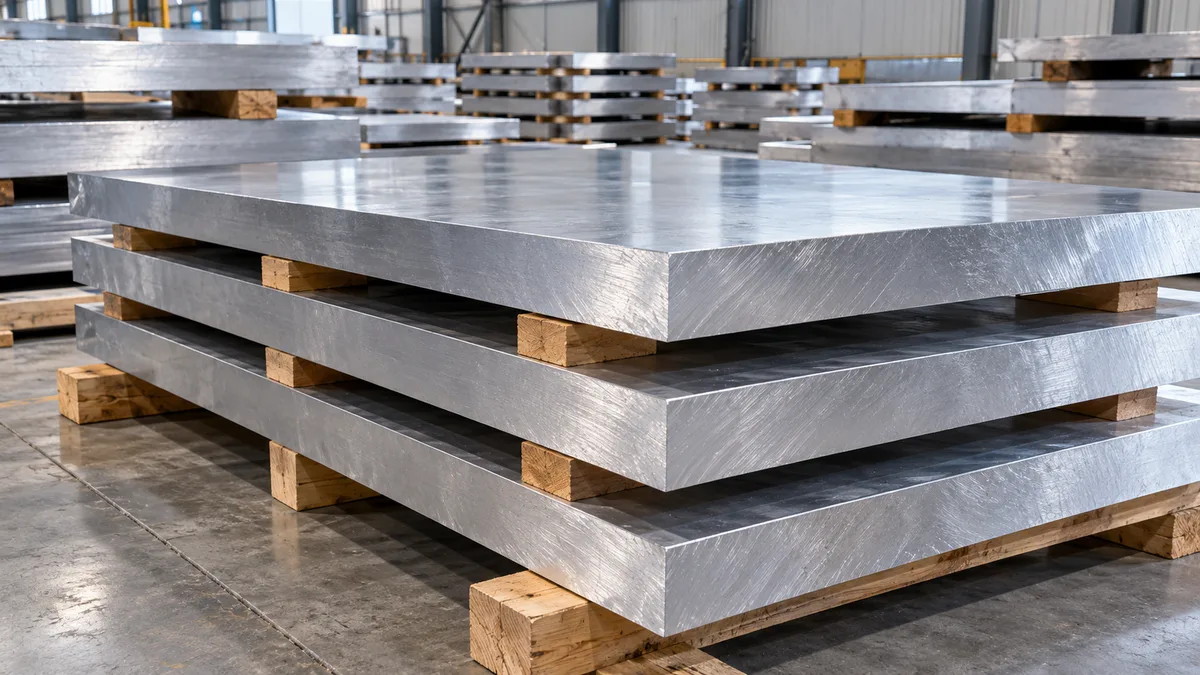
2017 is the alloy that started the high-strength aluminium industry. Its ancestor, duralumin, was discovered in Germany around 1906 when Alfred Wilm noticed that an aluminium-copper-magnesium alloy hardened by itself for days after quenching: natural ageing. 2017 and 2017A are the standardised descendants of that alloy.
Today 2017A plate is used mainly in Europe as a machining material. In the T451 temper it is solution heat-treated, stretched to relieve stress and naturally aged, giving a stable, flat plate with strength well above 6082-T651 and machinability close to free-machining alloys. Typical parts are machine-building components, pneumatic and hydraulic blocks, jigs, fixtures, gears, mould parts and structural parts for defence and transport equipment.
In aerospace, 2017 has largely been replaced by 2024, which is stronger and tougher, but 2017 is still used for rivets and some fittings. Like all copper-bearing alloys, it needs protection in corrosive environments and is not suitable for fusion-welded structures.
| Element | 2017 (AA / ASTM) | 2017A (EN 573-3) |
|---|---|---|
| Silicon (Si) | 0.20 – 0.8 | 0.20 – 0.8 |
| Iron (Fe) | ≤ 0.7 | ≤ 0.7 |
| Copper (Cu) | 3.5 – 4.5 | 3.5 – 4.5 |
| Manganese (Mn) | 0.40 – 1.0 | 0.40 – 1.0 |
| Magnesium (Mg) | 0.40 – 0.8 | 0.40 – 1.0 |
| Chromium (Cr) | ≤ 0.10 | ≤ 0.10 |
| Zinc (Zn) | ≤ 0.25 | ≤ 0.25 |
| Titanium (Ti) / Ti + Zr | ≤ 0.15 | Ti + Zr ≤ 0.25 |
| Others, each / total | 0.05 / 0.15 | 0.05 / 0.15 |
| Aluminium (Al) | Remainder | Remainder |
The two grades overlap almost completely; 2017A allows slightly more magnesium. The mill certificate reports the actual analysis of each lot.
For EN plate, 2017A-T451 minimum values from EN 485-2 fall gradually with thickness: for 6 – 12.5 mm plate the minimums are about 390 MPa tensile and 260 MPa yield, dropping to around 240 MPa yield in the 60 – 120 mm band. Typical values are higher, as shown below.
| Temper | Tensile strength | Yield strength | Elongation | Brinell hardness |
|---|---|---|---|---|
| 2017-O (typical) | 179 MPa / 26 ksi | 69 MPa / 10 ksi | 22 % | 45 HB |
| 2017-T4 / T451 (typical) | 427 MPa / 62 ksi | 276 MPa / 40 ksi | 22 % | 105 HB |
| 2017A-T451 plate 6 – 12.5 mm (EN 485-2 min.) | 390 MPa | 260 MPa | 12 % (A50) | — |
| System | Designation | Plate standard |
|---|---|---|
| European (EN) | EN AW-2017A / AlCu4MgSi(A) | EN 485-1/-2/-3, EN 573-3 |
| German Werkstoff | 3.1325 (AlCuMg1) | DIN EN 485 |
| Aluminum Association / ASTM | 2017 | ASTM B209 (sheet/plate), ASTM B211 (bar) |
| UNS | A92017 | — |
| ISO | AlCu4MgSi | ISO 6361 |
| Japan (JIS) | A2017P | JIS H4000 |
| China (GB) | 2017 / 2A11 (close) | GB/T 3880, GB/T 3190 |
| France (old) | AU4G | — |
Older drawings may call the material "duralumin", "AU4G", "AlCuMg1" or "Dural". All refer to this family; we confirm the exact standard before quoting.
At 2.79 g/cm³, 2017A plate weighs 2.79 kg per m² per millimetre of thickness:
| Thickness (mm) | kg per m² | 1220 × 2440 mm (kg) | 1500 × 3000 mm (kg) |
|---|---|---|---|
| 6 | 16.7 | 49.8 | 75.3 |
| 8 | 22.3 | 66.4 | 100.4 |
| 10 | 27.9 | 83.1 | 125.5 |
| 12 | 33.5 | 99.7 | 150.7 |
| 15 | 41.9 | 124.6 | 188.3 |
| 20 | 55.8 | 166.1 | 251.1 |
| 25 | 69.8 | 207.6 | 313.9 |
| 30 | 83.7 | 249.2 | 376.7 |
| 40 | 111.6 | 332.2 | 502.2 |
| 50 | 139.5 | 415.3 | 627.8 |
| 60 | 167.4 | 498.3 | 753.3 |
| 80 | 223.2 | 664.4 | 1004.4 |
| 100 | 279.0 | 830.5 | 1255.5 |
| 120 | 334.8 | 996.6 | 1506.6 |
| 150 | 418.5 | 1245.8 | 1883.2 |
Excellent in T451: brittle, short chips and a fine finish. Use sharp carbide or HSS tools, high speeds and coolant. T451 stretching limits distortion during heavy roughing.
Limited in T4; form in O or freshly quenched condition. Bend radii of 2 – 3 × thickness or more are prudent in T4.
Not suitable for fusion welding. Use bolting, riveting or adhesive bonding.
Hard anodising and protective anodising are possible but give a less decorative, slightly grey film. Paint or anodise parts used outdoors or in humid conditions.
If you need more strength, step up to 2024-T351 or 7075-T651; if you need weldability or better corrosion resistance, step down to 6082-T651 or 6061-T651.
Yes, 2017A (and 2017) is the standardised form of the original duralumin Al-Cu-Mg alloy. The name is still used on many older drawings.
2017 is the Aluminum Association grade, 2017A the European one. Composition limits are almost identical; 2017A allows up to 1.0 % magnesium instead of 0.8 %.
Yes. 2017A-T451 typically reaches about 400 – 430 MPa tensile against about 310 MPa for 6082-T651, with better machinability but lower corrosion resistance and no practical weldability.
2024-T351 is somewhat stronger and has better fatigue resistance, so it is preferred for aircraft and highly loaded parts. 2017A is a cost-effective choice for general machined components.
Yes, though the copper gives a duller, slightly grey film. Hard anodising is often used for wear surfaces.
Send thickness, sizes, quantity and destination. We will confirm availability, certification and price.





