6061 (T651 plate, T6511 bar)
The default. Good strength, the best corrosion resistance and anodising of the three, easy to machine and widely available in every size. Weldable if a bracket must be added later.



Racing calipers, housings, bearing supports, main caps and brackets are usually CNC-machined from solid aluminium block, plate or bar, the material machinists call "billet". The usual choices are 6061 in stress-relieved tempers for most parts, 7075 where strength and stiffness per gram matter most, and 2024-T351 for high-clamp, fatigue-loaded parts. This guide explains how to pick the alloy and temper, why billet beats castings for these parts, and how to keep machined parts flat and leak-free.
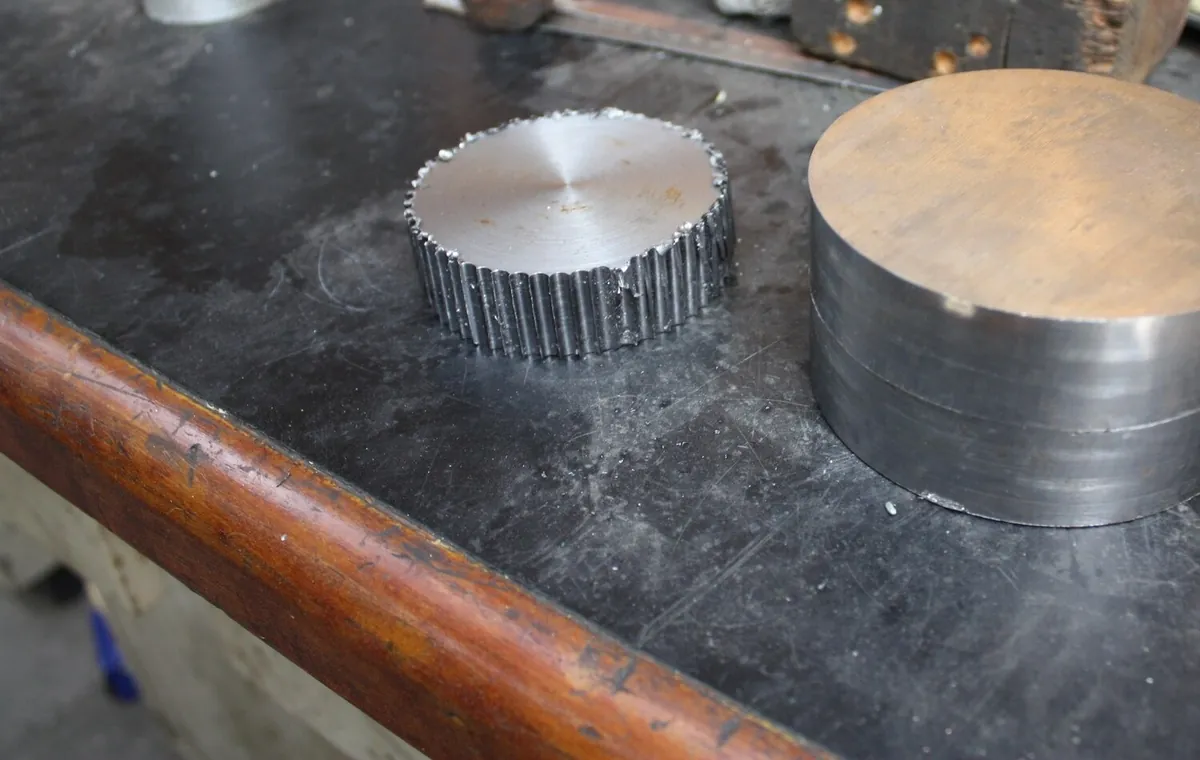
Race parts are made in small batches, changed often and loaded close to their limits. Machining them from solid wrought aluminium avoids pattern and die costs, allows design changes between events, and gives a material with predictable strength and no hidden porosity.
"Billet" in motorsport means wrought stock: rolled plate, extruded or rolled bar, or forged block that has been hot-worked and heat-treated. Hot working closes casting pores and breaks up the cast structure, so the metal is dense and uniform in every direction that matters. A good casting can be excellent too, but its quality depends on the foundry, the gating and how well the part was inspected. For a brake caliper or a hydraulic body, a single pore that breaks into a fluid passage after machining scraps the part or, worse, leaks under pressure.
Wrought tempers also offer controlled residual stress. Plate in T651 and bar in T6511 have been stretched after quenching to relieve stresses, so deep pockets and thin walls stay where the programme put them. That matters on five-axis parts with many datum faces and bearing bores that must line up.
| Part | Typical alloy and temper | Why |
|---|---|---|
| Brake caliper bodies | 6061-T6511 or 6061-T651; 7075 for weight-critical designs | Stiffness, sealing reliability, good anodising; stress-relieved stock keeps bores aligned |
| Master cylinders and hydraulic bodies | 6061-T6511, hard anodised | Uniform, pore-free stock for fluid passages; corrosion resistance with brake fluid |
| Differential and axle housings, gearbox cases | 6061-T651, 6082-T651 or 7075-T7351 | Large blocks with many bores; 7075 where stiffness per weight is critical |
| Bearing supports and pinion supports | 6061-T6511 | Precise bearing seats and circlip grooves, stable after machining |
| Main bearing caps and girdles | 2024-T351 or 7075-T7351 | High strength under heavy bolt clamp and cyclic loads |
| Steering racks and steering boxes | 6061-T6511 | Light, stiff housings with good anodised finish |
| Brackets, mounts, uprights and spacer plates | 6061-T651 or 7075-T651 | Pocketed for weight; 7075 for higher-stress uprights and links |
| Rotor hats and wheel spacers | 6061-T6 or 7075-T6 | Stiff, light parts that see high clamp loads |
These are typical starting points, not rules. Many successful teams use 6061 almost everywhere and reserve 7075 for a few highly stressed parts, because 6061 is cheaper, more corrosion resistant, easier to anodise evenly and more forgiving if a part is damaged.
| Property (typical) | 6061-T651 | 7075-T651 | 7075-T7351 | 2024-T351 |
|---|---|---|---|---|
| Tensile strength | 310 MPa | 572 MPa | 505 MPa | 469 MPa |
| Yield strength | 276 MPa | 503 MPa | 435 MPa | 324 MPa |
| Elongation | 12 % | 11 % | 13 % | 19 – 20 % |
| Brinell hardness | 95 HB | 150 HB | — | 120 HB |
| Fatigue strength (5×10⁸ cycles, rotating beam) | 96.5 MPa | 159 MPa | — | 138 MPa |
| Thermal conductivity | 167 W/m·K | 130 W/m·K | 155 W/m·K | 121 W/m·K |
| Density | 2.70 g/cm³ | 2.81 g/cm³ | 2.81 g/cm³ | 2.78 g/cm³ |
| Stress-corrosion resistance | Very good | Low in short-transverse direction | High | Moderate |
| Anodising appearance | Excellent | Good, slightly darker | Good | Fair, can look patchy |
Typical values from ASM / Aluminum Association data, not design minimums. Design to the minimum values of the order specification (for example ASTM B209 for plate, ASTM B211/B221 for bar) shown on the mill certificate.
The default. Good strength, the best corrosion resistance and anodising of the three, easy to machine and widely available in every size. Weldable if a bracket must be added later.
About 80 % stronger than 6061 for little extra weight. Choose T7351 for thick blocks and parts in damp or salty conditions: it is slightly weaker than T651 but far more resistant to stress-corrosion cracking and has lower residual stress.
High strength with good fatigue and toughness, naturally aged and stretched. Common for caps and highly clamped parts. Needs anodising or coating for corrosion protection and is not weldable.
Heat-treated aluminium is quenched rapidly from about 500 °C. The surface cools first, locking in residual stresses: compressive at the surface and tensile in the core. If you machine away one side of an unrelieved block, those stresses rebalance and the part bows. The "x51" tempers prevent this.
A common mistake is ordering the cheapest T6 or as-rolled block for a thin, pocketed part, then fighting distortion for weeks. The small premium for properly stress-relieved stock is usually repaid in the first batch.
Decorative and protective, typically about 5 – 25 µm, in clear, black or colours. Ideal for 6061 brackets, housings and steering parts.
Thicker, very hard layer (often 25 – 50 µm) for wear surfaces such as piston bores and slides. About half the thickness grows outward and half penetrates, so allow for growth on bores and threads.
Hard anodising impregnated with PTFE for lower friction and better release in brake and hydraulic components.
Mask threads, bearing seats and sealing faces, or machine them with compensation for coating build-up, agreed with your anodiser before machining.
6061 gives the most even colour; 7075 anodises well but slightly darker; 2024 can look mottled and is often hard-anodised or painted instead.
Hard anodic films can reduce fatigue strength of highly stressed parts; designers sometimes limit coating thickness or avoid it on critical fatigue zones.
Metline supplies 6061, 7075, 2024 and other alloys as plate, block, bar and forgings, saw-cut to blank size on request, with lot traceability and mill certificates, to machine shops and race teams worldwide.
No. 7075 is much stronger, but 6061 resists corrosion better, anodises more evenly, costs less and is weldable. Most race parts are 6061; 7075 is reserved for parts where strength or stiffness per gram is the limit.
They are stretched after quenching to relieve residual stress, so thin walls and deep pockets do not warp as material is removed. T6 stock has the same strength but distorts more on complex parts.
For thick blocks and parts exposed to moisture, road salt or sustained stress. T7351 gives up some strength but has far better resistance to stress-corrosion cracking and lower residual stress.
Billet calipers machined from stress-relieved 6061 or 7075 have uniform, pore-free material and can be revised quickly, which suits racing. High-quality castings or forgings are cost-effective for high-volume road parts.
Typically a few millimetres per side for saw-cut blanks, more for long or thick parts. Enough to clean up saw marks and surface layers evenly, but not so much that heavy one-sided removal causes distortion.
Yes. Metline supplies plate, block and bar saw-cut to blank sizes, marked with alloy, temper and lot, with mill test certificates to EN 10204 3.1.
Send your alloy, temper, blank sizes or part drawing and quantities, and our team will reply with options and a delivered price.






