Filler metals
ER5183 is the standard filler for 5083, 5383 and 5059 hulls; ER5356 suits 5086 and 5052. Do not use 4043 or 4047 on alloys above about 3 % Mg, because Mg2Si forms in the weld and makes it brittle.



A plate is not "marine grade" because a catalogue says so. For a hull or offshore structure it must be an approved alloy in a qualified temper, made by a works approved by the classification society, tested for exfoliation and intergranular corrosion, and delivered with traceable certificates. This guide sets out what to specify, which alloys suit which parts of a vessel, and the mistakes that cause plate to be rejected at the yard.
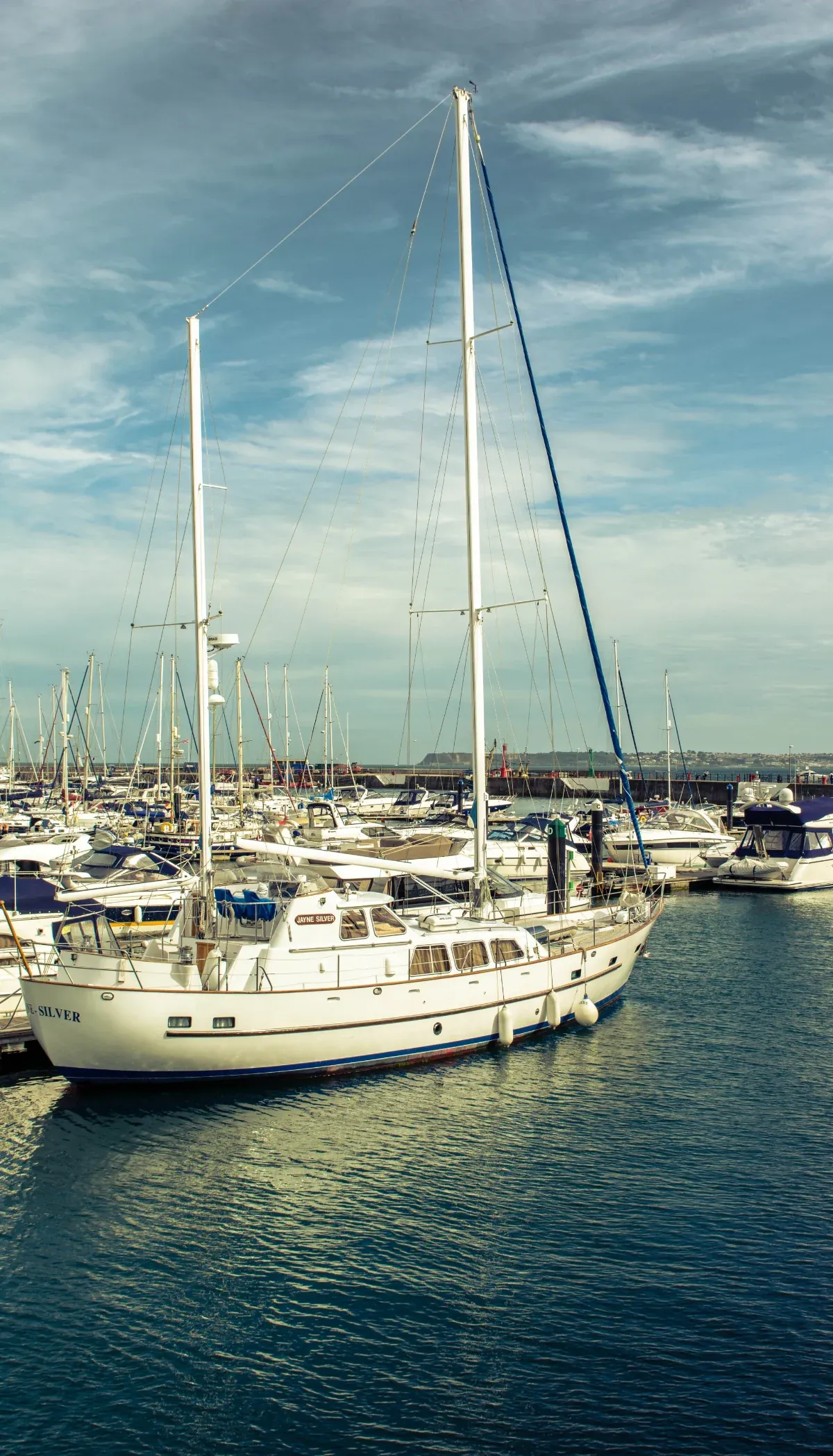
Aluminium hulls, superstructures and offshore modules are designed on the assumption that the metal will keep its strength and corrosion resistance for decades in seawater. That assumption only holds when the alloy, temper and production route are controlled, which is why classification societies regulate marine aluminium far more tightly than general engineering grades.
The non-heat-treatable aluminium-magnesium (5xxx) alloys dominate hull construction. Magnesium in solid solution gives strength without heat treatment, and the alloys keep most of their strength in the welded condition, unlike heat-treatable 6xxx and 7xxx alloys that lose a large share of theirs in the heat-affected zone. They also resist general seawater corrosion very well.
The weak point of the higher-magnesium alloys is sensitisation. When an alloy with more than about 3 % magnesium is held for long periods between roughly 65 °C and 200 °C, or is processed incorrectly at the mill, magnesium-rich beta phase (Al3Mg2) forms along grain boundaries. That continuous film corrodes preferentially, causing intergranular attack and exfoliation that can peel a plate apart in layers. The special marine tempers H116 and H321, and the corrosion tests that accompany them, exist to control exactly this risk.
IACS Unified Requirement W25, which the member societies (ABS, BV, ClassNK, DNV, KR, LR, RINA and others) apply in their own rules, lists the rolled alloys 5083, 5086, 5383, 5059, 5754 and 5456 for hull construction, and the extruded alloys 5083, 5383, 5059 and 5086, plus 6005A, 6061 and 6082 in T5 or T6. The table below shows how they are typically used.
| Part of the structure | Usual alloy and temper | Why |
|---|---|---|
| Bottom and side shell plating | 5083-H116 / H321; 5383 or 5059 for weight-critical craft | Highest welded strength among proven alloys, tested against exfoliation |
| Decks and bulkheads | 5083-H116, 5086-H116, 5083-H111 | Good welded strength, easy to form and fair |
| Superstructure plating | 5083, 5086, 5754-H111 for lightly loaded panels | Lower stress, so formability and cost carry more weight |
| Frames, stiffeners, deck profiles | 5083-H112 extrusions; 6005A-T6 / 6082-T6 profiles | Extruded shapes cut fabrication time; 6xxx sections are protected by paint |
| Fast-ferry and patrol-craft hulls | 5383 and 5059 plate and extrusions | 10 – 30 % higher welded yield lets designers thin the plating |
| Fuel and water tanks | 5083, 5086, 5052 for small craft | Weldable, corrosion resistant, no coating needed inside |
| Fittings, brackets, small parts | 5083 or 5086 bar, 6061-T6 or 6082-T6 machined parts | Machinability balanced against seawater exposure |
| Steel-to-aluminium joints | Explosion-bonded structural transition joint | Avoids direct galvanic contact and bolted joints |
IACS adds an important note: 6005A and 6061 should not be used in direct contact with seawater unless protected by anodes or a paint system. 5052, widely sold as "marine" sheet, is not in the UR W25 list at all; it is excellent for small craft, tanks, fittings and interiors built to recreational-craft rules, but it is not a class-approved hull alloy for ships.
These are the UR W25 minimums for rolled products 3 – 50 mm thick. Individual class rules repeat them, sometimes with additional thickness bands; material over 50 mm is certified to a recognised standard agreed with the society.
| Alloy | Temper | Thickness | Yield Rp0.2 min (MPa) | Tensile Rm (MPa) | Elongation A50 / A5 min (%) |
|---|---|---|---|---|---|
| 5754 | O / H111 | 3 – 50 mm | 80 | 190 – 240 | 18 / 17 |
| 5086 | O / H111 | 3 – 50 mm | 95 | 240 – 305 | 16 / 14 |
| 5086 | H116 | 3 – 50 mm | 195 | 275 | 10 / 9 |
| 5083 | O / H111 | 3 – 50 mm | 125 | 275 – 350 | 16 / 14 |
| 5083 | H112 | 3 – 50 mm | 125 | 275 | 12 / 10 |
| 5083 | H116 | 3 – 50 mm | 215 | 305 | 10 / 10 |
| 5083 | H321 | 3 – 50 mm | 215 – 295 | 305 – 385 | 12 / 10 |
| 5383 | O / H111 | 3 – 50 mm | 145 | 290 | — / 17 |
| 5383 | H116 / H321 | 3 – 50 mm | 220 | 305 | 10 / 10 |
| 5059 | O / H111 | 3 – 50 mm | 160 | 330 | 24 / 24 |
| 5059 | H116 / H321 | 3 – 20 mm | 270 | 370 | 10 / 10 |
| 5059 | H116 / H321 | > 20 – 50 mm | 260 | 360 | — / 10 |
Source: IACS UR W25 Rev.4, Table 2. Elongation A50 applies up to 12.5 mm, A5 above. O and H111 share values but are certified separately because they represent different processing.
For welded design, rules take the strength of the heat-affected zone as roughly the annealed (O/H111) value, whatever temper the plate was delivered in. That is why 5059, with a minimum O-temper yield of 160 MPa against 125 MPa for 5083, allows thinner welded plating.
Rolled 5083, 5383, 5059, 5086 and 5456 in the H111, H112, H116 and H321 tempers intended for hulls, or for parts in frequent contact with seawater, must be corrosion tested. During approval the mill establishes a link between microstructure and corrosion resistance using reference micrographs at 500×. Each production batch of H116 or H321 plate is then accepted either by metallographic comparison or by direct testing.
| Test | What it reveals | Acceptance under UR W25 |
|---|---|---|
| ASTM G66 (ASSET) | Susceptibility to exfoliation (layer corrosion) | No evidence of exfoliation; pitting rating PB or better |
| ASTM G67 (NAMLT) | Intergranular attack, via nitric-acid mass loss | Mass loss not more than 15 mg/cm² |
| Metallography | Continuous beta-phase films at grain boundaries | Matches the approved reference micrograph |
ASTM B928/B928M applies the same idea to US and many international marine plate orders: it covers high-magnesium 5xxx sheet, plate and extruded profiles for marine service and requires corrosion testing of production lots. When an enquiry says "ASTM B209 5083-H116", the buyer is not getting this lot-by-lot test; specify B928 for hull plate.
A mill test certificate to EN 10204 3.1 is enough for many marine fittings, small craft and offshore non-structural parts. For anything the society will inspect as hull or primary structure, ask for the class certificate at enquiry stage; retrospective certification is rarely possible.
ER5183 is the standard filler for 5083, 5383 and 5059 hulls; ER5356 suits 5086 and 5052. Do not use 4043 or 4047 on alloys above about 3 % Mg, because Mg2Si forms in the weld and makes it brittle.
Porosity comes mainly from hydrogen: moisture, oil and hydrated oxide. Clean and brush joints, store wire dry, and protect welding from draughts that disturb the gas shield.
Aluminium is anodic to steel, stainless steel and especially copper alloys. Isolate fasteners with sleeves and washers, keep joints dry, and never let bronze fittings sit in the same bilge water as an aluminium hull.
Explosion-bonded transition strip lets a steel hull carry an aluminium superstructure with welded joints on both sides and no exposed bimetallic crevice.
Keep high-Mg alloys away from sustained service above about 65 °C: engine-room uptakes, exhaust trunks, hot tanks. Use 5454 or 5754 where heat is unavoidable.
Below the waterline aluminium hulls normally carry aluminium-compatible antifouling and zinc or aluminium anodes. Copper-based antifouling is not used on aluminium.
| Form | Typical marine alloys | Notes for the specification |
|---|---|---|
| Sheet and plate | 5083, 5383, 5059, 5086, 5754, 5052 | State class society, ASTM B928 or EN 13195 where relevant, and underthickness tolerance |
| Extruded profiles | 5083-H112, 5383-H112, 6005A-T6, 6082-T6 | Closed profiles need press-weld fusion checks per batch |
| Round, square and hex bar | 5083, 5086, 5052, 6082 | For shafts, pins, fittings; bar is rarely class-certified unless requested |
| Tube and pipe | 5083, 5086, 6061, 6082 | Rails, stanchions, piping; seamless or welded |
| Tread plate | 5052, 5754, 5083 | Deck walkways, engine-room floors, gangways |
| Transition joints | Aluminium / steel bonded strip | Supplied cut to length for superstructure connections |
UR W25 also sets minimum underthickness tolerances for rolled marine plate, from 0.10 mm on 3 – 4 mm plate up to 0.65 mm on 20 – 50 mm plate over 2 m wide. Tighter tolerances can be ordered; looser ones are not acceptable for class.
5083 in H116 or H321 temper is the standard choice for welded hulls: strong, class-approved and resistant to seawater. 5383 and 5059 give higher welded strength for fast craft, and 5086-H116 is a slightly lower-strength alternative that forms more easily.
5052 has very good resistance to marine atmospheres and seawater and is widely used for small boats, tanks and fittings. It is not listed in IACS UR W25, so it is not a class-approved hull alloy for ships; use 5083, 5086 or 5754 where class approval is needed.
Both are strain-hardened tempers controlled so that the plate passes exfoliation and intergranular corrosion tests, and both meet the same minimum strengths in UR W25. H321 includes a final thermal stabilisation; H116 is achieved through controlled rolling. They are certified separately and should be ordered as the drawing specifies.
It can, but only when protected. IACS notes that 6005A and 6061 should not be in direct seawater contact unless protected by anodes or paint, because their copper and silicon content makes them less resistant than 5xxx alloys. 6082 and 6005A extrusions are common above the waterline.
A class certificate, or an EN 10204 3.2 certificate endorsed by the classification society's surveyor, from a mill approved for that alloy and temper, including corrosion test results for H116 and H321 plate.
Yes, where the producing mill holds the relevant approval. State the society and grade in your enquiry and we will confirm the documentation that comes with the material before you order.
Send the drawing references, alloy, temper, sizes and classification requirement. We will reply with what can be supplied and the certificates that come with it.





