H111
Annealed with slight strain hardening from levelling. The standard marine plate temper and the one most often certified to class.



5754 is Europe's workhorse aluminium-magnesium plate: very good seawater resistance, excellent formability and easy welding at a lower cost than 5083. It is one of the rolled alloys named in IACS UR W25 for hull construction and is widely used for superstructures, interiors, tanks and small-craft hulls. Metline supplies 5754 sheet and plate in O, H111, H22, H32 and H112, cut and certified, worldwide.
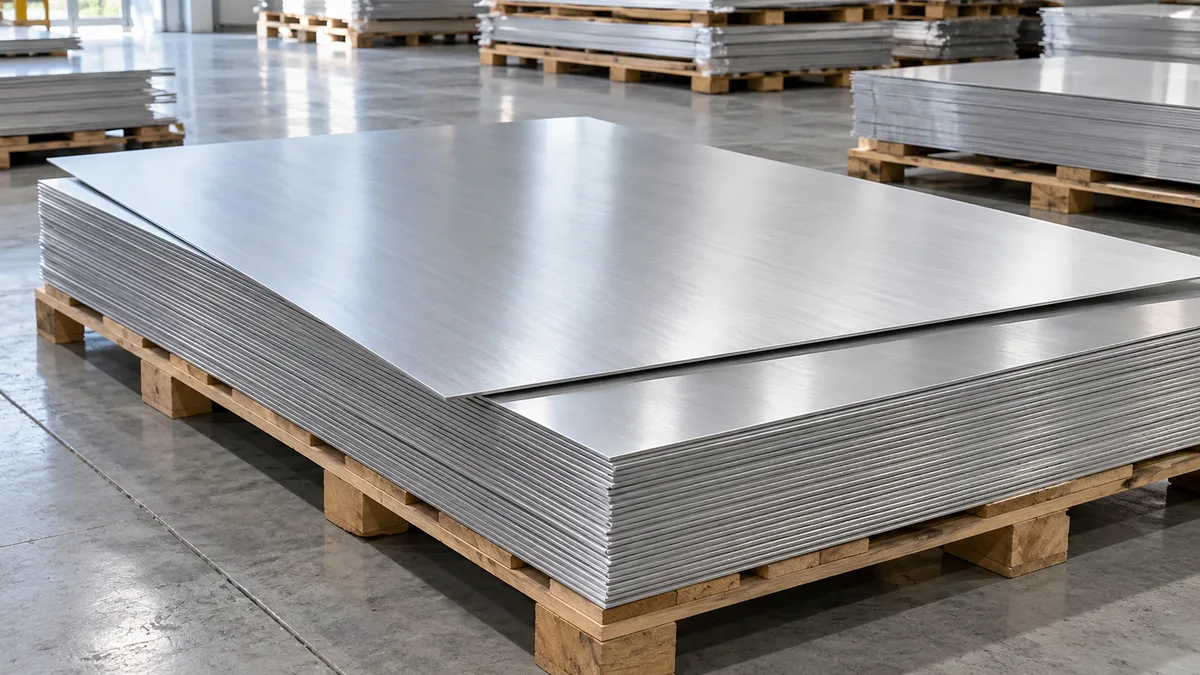
5754 (EN AW-5754, AlMg3) contains 2.6 – 3.6 % magnesium, with manganese plus chromium held between 0.10 and 0.60 %. It sits between 5052 and 5083 in strength and is the most widely stocked Al-Mg plate in European markets.
For marine work its attraction is balance. It is markedly stronger than 5052 and 5005, resists seawater and marine atmosphere almost as well as 5083, bends and presses more easily than 5083, and welds readily with 5xxx fillers. Its lower magnesium also makes it less prone to sensitisation than 5083 or 5456, though long exposure to high temperature should still be avoided.
IACS UR W25 lists 5754 among the rolled alloys for hull construction, in the O and H111 tempers, so classification societies accept it for plating where its strength is enough. In practice 5754 is chosen for superstructures, wheelhouses, decks of smaller craft, bulkheads, interior linings, tanks and the hulls of small boats, while 5083 or 5383 is reserved for highly stressed bottom and side shell plating of larger vessels.
| Element | Minimum | Maximum | Role |
|---|---|---|---|
| Silicon (Si) | — | 0.40 | Impurity |
| Iron (Fe) | — | 0.40 | Impurity |
| Copper (Cu) | — | 0.10 | Held low for corrosion resistance |
| Manganese (Mn) | — | 0.50 | Strength and grain control |
| Magnesium (Mg) | 2.6 | 3.6 | Main strengthening element |
| Chromium (Cr) | — | 0.30 | Grain control, stress-corrosion resistance |
| Mn + Cr | 0.10 | 0.60 | Combined limit specific to 5754 |
| Zinc (Zn) | — | 0.20 | Impurity |
| Titanium (Ti) | — | 0.15 | Grain refiner |
| Others, each / total | — | 0.05 / 0.15 | |
| Aluminium (Al) | Remainder |
Limits from EN 573-3, identical to the values in IACS UR W25 Table 1.
The O and H111 values are the IACS UR W25 requirements for 3 – 50 mm plate, which match EN 485-2. The other tempers are EN 485-2 values for the thickness bands shown. Elongation is on 50 mm gauge up to 12.5 mm and on 5d above.
| Temper | Thickness | Tensile strength Rm | Proof Rp0.2 (min) | Elongation (min) |
|---|---|---|---|---|
| O / H111 | 3 – 50 mm | 190 – 240 MPa | 80 MPa | A50 18 % / A5d 17 % |
| H22 / H32 | up to about 6 mm | 220 – 270 MPa | 130 MPa | about 7 – 11 % |
| H24 / H34 | up to about 6 mm | 240 – 280 MPa | 160 MPa | about 6 – 10 % |
| H112 | 6 – 12.5 mm | ≥ 190 MPa | 100 MPa | 12 % |
| H112 | 12.5 – 50 mm | ≥ 190 MPa | 80 – 90 MPa | 10 – 12 % |
Typical 5754-H111 plate tests at about 210 – 220 MPa tensile and 100 MPa proof with 20 % or more elongation. Because welding returns the heat-affected zone to annealed strength, welded 5754 structures are designed on O-temper values regardless of the temper bought.
Annealed with slight strain hardening from levelling. The standard marine plate temper and the one most often certified to class.
Fully annealed, for deep pressings, spun parts and tight bends.
Quarter-hard sheet for flat panels, linings and tank walls that need more stiffness and dent resistance.
Half-hard sheet for flat, unformed panels and chequer-style deck applications.
As-rolled thicker plate for doublers, brackets and machined parts.
UR W25 lists 5754 in O and H111. Other tempers can be used for non-structural parts or with the society's agreement.
5754 is ordered to EN 485-1 to -4 (sheet and plate), with composition to EN 573-3; Chinese projects use GB/T 3880 or the marine plate standard GB/T 22641. For classed vessels, plate must come from a works approved by the society for 5754, with one tensile test per batch (and per additional 2000 kg) as UR W25 requires. Corrosion testing to ASTM G66 and G67 is required by UR W25 only for the higher-magnesium alloys in H116 and H321, not for 5754.
| System | Designation |
|---|---|
| European | EN AW-5754 / EN AW-AlMg3 |
| German Werkstoff | 3.3535 (AlMg3) |
| UNS | A95754 |
| ISO | AlMg3 |
| Class rules | IACS UR W25 rolled products, O / H111 |
5754 weighs 2.67 kg per m² per millimetre of thickness.
| Thickness (mm) | kg per m² | 1250 × 2500 (kg) | 1500 × 3000 (kg) | 2000 × 6000 (kg) |
|---|---|---|---|---|
| 1 | 2.67 | 8.3 | 12.0 | 32.0 |
| 1.5 | 4.00 | 12.5 | 18.0 | 48.1 |
| 2 | 5.34 | 16.7 | 24.0 | 64.1 |
| 2.5 | 6.67 | 20.9 | 30.0 | 80.1 |
| 3 | 8.01 | 25.0 | 36.0 | 96.1 |
| 4 | 10.68 | 33.4 | 48.1 | 128.2 |
| 5 | 13.35 | 41.7 | 60.1 | 160.2 |
| 6 | 16.02 | 50.1 | 72.1 | 192.2 |
| 8 | 21.36 | 66.8 | 96.1 | 256.3 |
| 10 | 26.70 | 83.4 | 120.1 | 320.4 |
| 12 | 32.04 | 100.1 | 144.2 | 384.5 |
| 15 | 40.05 | 125.2 | 180.2 | 480.6 |
| 20 | 53.40 | 166.9 | 240.3 | 640.8 |
| 25 | 66.75 | 208.6 | 300.4 | 801.0 |
| 30 | 80.10 | 250.3 | 360.4 | 961.2 |
Typical thickness tolerances for hot-rolled 5754 plate, consistent with EN 485-3. Cold-rolled sheet to EN 485-4 is held tighter.
| Thickness (mm) | Width ≤ 1500 mm | Width 1500 – 2000 mm | Width over 2000 mm |
|---|---|---|---|
| 3 – 4 | ±0.10 | +0.17 / −0.15 | +0.23 / −0.15 |
| over 4 – 8 | ±0.20 | +0.23 / −0.20 | +0.28 / −0.25 |
| over 8 – 12 | +0.38 / −0.25 | +0.51 / −0.25 | +0.58 / −0.25 |
| over 12 – 20 | +0.50 / −0.35 | +0.60 / −0.40 | +0.65 / −0.50 |
| over 20 – 50 | +0.65 / −0.45 | +0.75 / −0.50 | +0.90 / −0.65 |
For classed plate, UR W25 refers to the manufacturer's tolerance standard agreed with the society; underthickness limits are especially important because scantlings are calculated on nominal thickness.
MIG and TIG with ER5356 or ER5183 filler. Weld zones fall to O-temper strength (190 MPa minimum), which is already the design basis for H111.
H111 bends to tight radii (about 1 × t for thin plate) and presses well, making it ideal for curved wheelhouse fronts and coamings.
Plasma, waterjet, laser (thin sheet) and saw. Edge-prepare welded joints mechanically.
Degrease, abrade or etch-prime, then apply a marine epoxy system. Avoid copper antifouling on aluminium.
Gives a uniform protective finish for windows, trim and interior panels.
Thin 5754 superstructure panels distort under welding heat; use intermittent welds, jigs and correct sequence.
A typical aluminium fishing vessel might use 5083-H116 for the bottom and side shell, 5754-H111 for the wheelhouse, casing and internal bulkheads, and 6082 extrusions for frames, trimming cost and weight while keeping the structure in compatible alloys.
| Property | 5754-H111 | 5083-H111 | 5052-H32 | 5454-H111 |
|---|---|---|---|---|
| Min tensile | 190 MPa | 275 MPa | 215 MPa | 215 MPa |
| Min proof | 80 MPa | 125 MPa | 160 MPa | 85 MPa |
| Formability | Very good | Good | Very good | Very good |
| Listed in UR W25 (rolled) | Yes | Yes | No | No |
| Service above 65 °C | Use with care | Avoid | Suitable | Suitable |
| Typical role | Superstructure, small hulls | Main hull plating | Small craft, sheet work | Warm tanks |
In North America, 5052 or 5086 is often used where Europe uses 5754. For new classed designs needing more strength, move to 5083-H116 or 5383.
Yes. It resists seawater very well and is one of the rolled alloys listed in IACS UR W25 for hull construction, in O and H111 tempers.
5083 has more magnesium (4.0 – 4.9 %) and is about 40 % stronger in the annealed state, so it is used for main hull plating. 5754 is easier to form, cheaper and less prone to sensitisation, and suits superstructures, interiors and small craft.
Annealed plate given a small amount of strain hardening during levelling. Its UR W25 minimums are 190 – 240 MPa tensile and 80 MPa proof, the same as O temper.
Yes. 5754 is widely used for fuel and water tanks. For tanks that run above about 65 °C, 5454 is the safer choice.
2.67 kg per m² per mm. A 1500 × 3000 × 5 mm plate weighs about 60 kg.
Yes. Metline supplies 5754 sheet and plate cut to size with EN 10204 3.1 certificates and export packing, and arranges class certification from approved works on request.
Send temper, thicknesses, sizes, quantity and the class society. We will reply with availability, certification and a delivered price.





