


ACAR Conductor (Aluminium Conductor Alloy Reinforced)
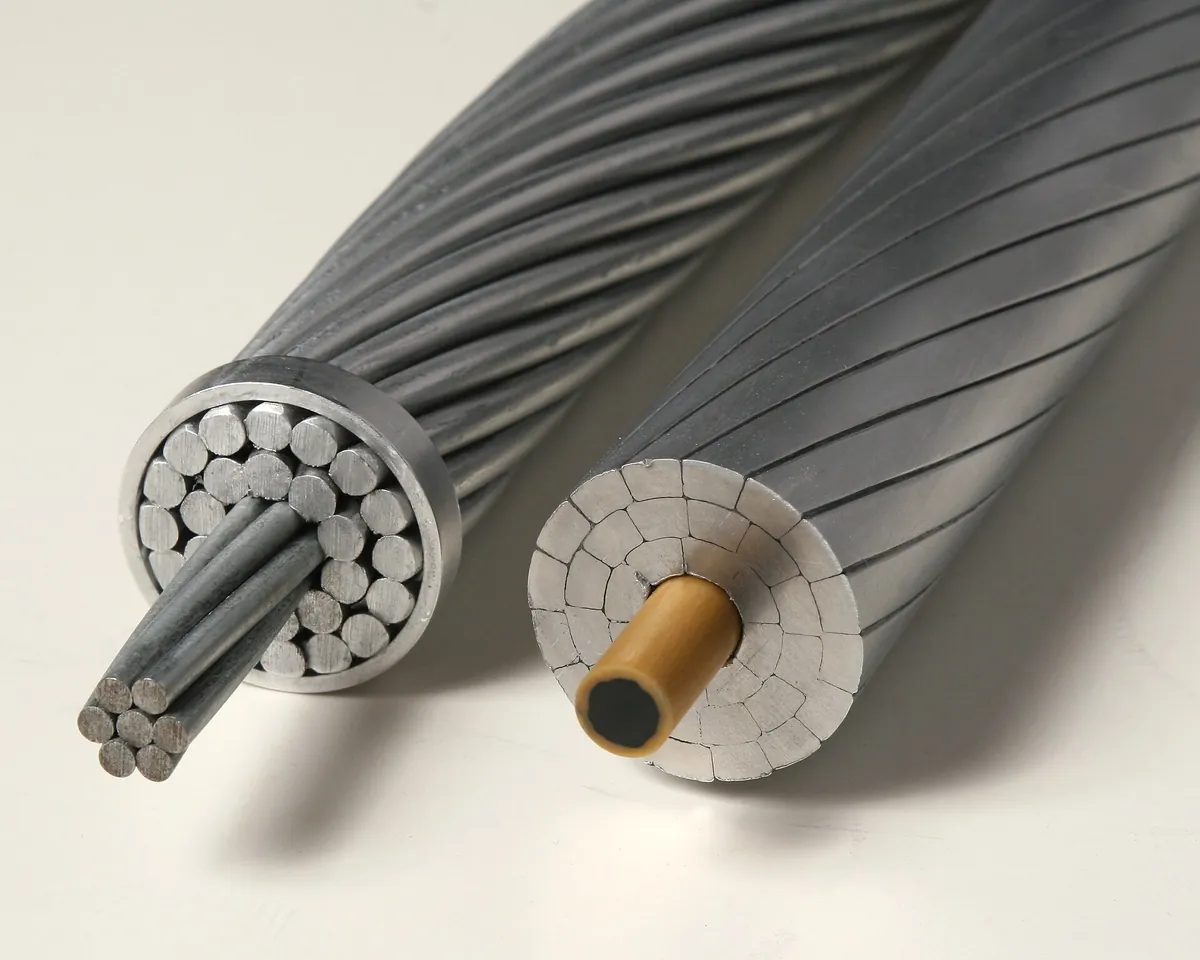
ACAR is a bare overhead conductor stranded from two kinds of aluminium wire: high-conductivity 1350-H19 and high-strength 6201-T81 alloy. By changing the ratio of the two, a designer can tune strength and resistance to the line, with no steel core to corrode or cause magnetic losses. Metline supplies ACAR to ASTM B524 and equivalent IEC-based specifications for utilities and contractors worldwide.
- Wires
- 1350-H19 + 6201-T81
- Standard
- ASTM B524/B524M
- Typical builds
- 12/7, 18/19, 24/13, 30/7, 42/19
- Core
- All aluminium, non-magnetic
How ACAR works
Every overhead conductor balances two jobs: carrying current with low loss and holding mechanical tension across the span. AAC (all 1350) is excellent at the first and weak at the second. AAAC (all 6201) is strong but about 15 % more resistive. ACSR uses a steel core for strength. ACAR blends the two aluminium wires in one concentric construction, so the designer can choose almost any point between AAC and AAAC.
In most ACAR constructions the 6201-T81 wires form the centre and inner layers and the 1350-H19 wires form the outer layers, although ASTM B524 permits other arrangements. Because all wires have the same diameter and the same density, the conductor is geometrically identical to an AAC or AAAC of the same size and uses the same fittings, dampers and stringing practice.
The ACAR concept is popular where utilities want better strength than AAC without introducing steel, for example on coastal distribution and sub-transmission lines, or where a line must be re-conductored on existing structures that cannot carry the weight of a heavier ACSR.
ACAR stranding and wire materials
| Construction (1350 / 6201) | Total wires | Character |
|---|---|---|
| 4 / 3 | 7 | Small conductor with high alloy share; strength-led |
| 15 / 4 | 19 | Conductivity-led, close to AAC |
| 12 / 7 | 19 | Balanced |
| 30 / 7 | 37 | Conductivity-led |
| 24 / 13 | 37 | Balanced |
| 18 / 19 | 37 | Strength-led, close to AAAC |
| 54 / 7 | 61 | Large, conductivity-led |
| 42 / 19 | 61 | Large, balanced |
Examples of common constructions. ASTM B524 tabulates many combinations by size; the designer or utility selects one from the line study.
Wire materials
- Conducting wires
- 1350-H19 to ASTM B230; ≈ 61.0 % IACS minimum
- Strength wires
- 6201-T81 to ASTM B398; 52.5 % IACS minimum
- Density
- ≈ 2.70 g/cm³ for both wires
- Coefficient of linear expansion
- ≈ 23 µm/m·°C (both wires)
- Typical maximum continuous temperature
- 75 – 90 °C, limited by the 6201 wires
How the wire ratio changes resistance
Consider a 37-wire conductor with every wire 3.00 mm in diameter (7.07 mm² each, about 262 mm² in total). Using minimum conductivities of 61.0 % IACS for 1350 and 52.5 % IACS for 6201, the approximate DC resistance at 20 °C, including about 2 % for stranding lay, is:
| Construction | 1350 wires | 6201 wires | Approx. DC resistance (Ω/km) | Strength trend |
|---|---|---|---|---|
| AAC (37 × 1350) | 37 | 0 | ≈ 0.110 | Lowest |
| ACAR 30/7 | 30 | 7 | ≈ 0.113 | Low to medium |
| ACAR 24/13 | 24 | 13 | ≈ 0.116 | Medium |
| ACAR 18/19 | 18 | 19 | ≈ 0.119 | Medium to high |
| AAAC (37 × 6201) | 0 | 37 | ≈ 0.128 | Highest |
Each 6201 wire carries roughly twice the tensile load of a 1350 wire of the same size, so moving from 30/7 to 18/19 raises rated strength markedly while increasing resistance by only about 5 %. Those figures are illustrative; the rated breaking strength, resistance and mass of a real conductor come from the tables of the standard named in the specification.
ACAR compared with AAC, AAAC and ACSR
| Item | AAC | ACAR | AAAC | ACSR |
|---|---|---|---|---|
| Wires | 1350 only | 1350 + 6201 | 6201 only | 1350 + galvanised steel |
| Resistance (same size) | Lowest | Low to medium | About 15 % above AAC | Low (aluminium carries current) |
| Rated strength | Low | Medium to high | High | Highest per diameter |
| Mass | Light | Light | Light | Heavier |
| Core corrosion risk | None | None | None | Present if zinc is consumed |
| Magnetic losses | None | None | None | Small |
| Sag at high temperature | High | High | High | Lower above the knee point |
| Typical use | Short spans, urban lines | Medium spans, coastal or re-conductoring work | Distribution and sub-transmission | Long spans, heavy ice, transmission |
A common misconception is that ACSR has "higher conductivity" than ACAR. It does not: the steel core adds strength but carries almost no current. Two conductors with the same aluminium area have similar resistance, and the ACSR is heavier. ACAR's limitation is strength and high-temperature sag, not conductivity.
Where ACAR is used
- Medium-span transmission and sub-transmission: where AAC would sag too much but steel is not wanted
- Coastal and industrial areas: all-aluminium construction avoids corrosion of a steel core in salt or chemical pollution
- Re-conductoring: raising capacity on existing structures with limited load capacity
- Lines sensitive to losses: no magnetic losses and a chosen balance of resistance and strength
- Industrial and mining networks: long-life overhead distribution where maintenance access is difficult
Standards and specifications
| Standard | Scope |
|---|---|
| ASTM B524/B524M | Concentric-lay-stranded aluminium conductors, aluminium-alloy reinforced (ACAR, 1350/6201) |
| ASTM B230 and B398 | The 1350-H19 and 6201-T81/T83 component wires |
| IEC 61089 / EN 50182 | Round-wire concentric-lay overhead conductors, including combined aluminium and alloy (A1/A3-type) constructions |
| IEC 62641 | Aluminium and aluminium-alloy wires for overhead conductors |
| IEEE 738 | Calculation of current-temperature relationship (ampacity) of bare overhead conductors |
Ampacity depends on conductor resistance, diameter, surface condition, ambient temperature, wind speed and solar radiation; it is calculated for each project using IEEE 738 or CIGRE methods rather than taken from a catalogue table.
Supply, testing and packing
What we supply
- Conductor
- Bare ACAR in standard or project-specific constructions
- Standards
- ASTM B524, IEC 61089 / EN 50182 type constructions, or utility specifications
- Tests
- Wire tensile, elongation and resistivity; conductor diameter, lay ratio, mass per km, DC resistance; breaking load on request
- Documents
- EN 10204 3.1 certificate and test reports; third-party inspection on request
- Packing
- Wooden or steel drums with lagging; drum length agreed to suit the line sections
- Delivery terms
- EXW, FOB, CIF or DAP
References and standards
- ASTM B524/B524M – Concentric-Lay-Stranded Aluminum Conductors, Aluminum-Alloy Reinforced (ACAR, 1350/6201)
- ASTM B398/B398M – Aluminum-Alloy 6201-T81 and 6201-T83 Wire for Electrical Purposes
- ASTM B230 – Aluminum 1350-H19 Wire for Electrical Purposes
- IEC 62641:2022 – Conductors for overhead lines: aluminium and aluminium alloy wires
- IEEE 738 – Standard for Calculating the Current-Temperature Relationship of Bare Overhead Conductors
ACAR conductor: frequently asked questions
What is the main difference between ACAR and ACSR?
ACAR uses 6201 aluminium alloy wires for strength; ACSR uses a galvanised steel core. ACAR is lighter, has no core corrosion and no magnetic losses; ACSR has higher rated strength and lower sag at high temperatures, so it suits long spans and heavy ice loads.
Can ACAR replace AAC or ACSR?
It can replace AAC where more strength is needed on the same structures, and ACSR on moderate spans where corrosion or weight is the concern. A sag-tension and clearance check is needed for the actual spans before substituting.
Why does ACAR have two kinds of wire?
1350-H19 wires give the best conductivity (about 61 % IACS) and 6201-T81 wires give about twice the strength at 52.5 % IACS. Combining them lets the designer set the strength and resistance of the conductor.
Is the aluminum conductor alloy reinforced (ACAR) supplied as finished conductor?
Yes. Metline supplies ACAR as finished bare conductor on drums. The component wires and 6201 or 1350 rod can also be supplied to conductor manufacturers.
Is ACAR available with a covering or insulation?
ACAR is normally bare. Covered or special constructions can be reviewed on request against the project specification.
What standard does ACAR follow?
ASTM B524/B524M in North American-style specifications; IEC 61089 or EN 50182 type combined aluminium/alloy constructions in IEC markets; or the utility's own specification.
Specifying ACAR?
Send the construction, standard, drum lengths and quantity. Our team will reply with technical data and a delivered quotation.






