Stranded conductors
Strands in all-aluminium-alloy and composite conductors where strength above 1350 is needed.



6101 wire is drawn from a conductor-grade aluminium-magnesium-silicon alloy and heat-treated to give more strength than pure EC aluminium wire while keeping good conductivity. It is used for stranded conductors, earthing and lightning-protection conductors, braids and cold-headed parts. This guide covers composition, tempers, sizes and how to write an order.
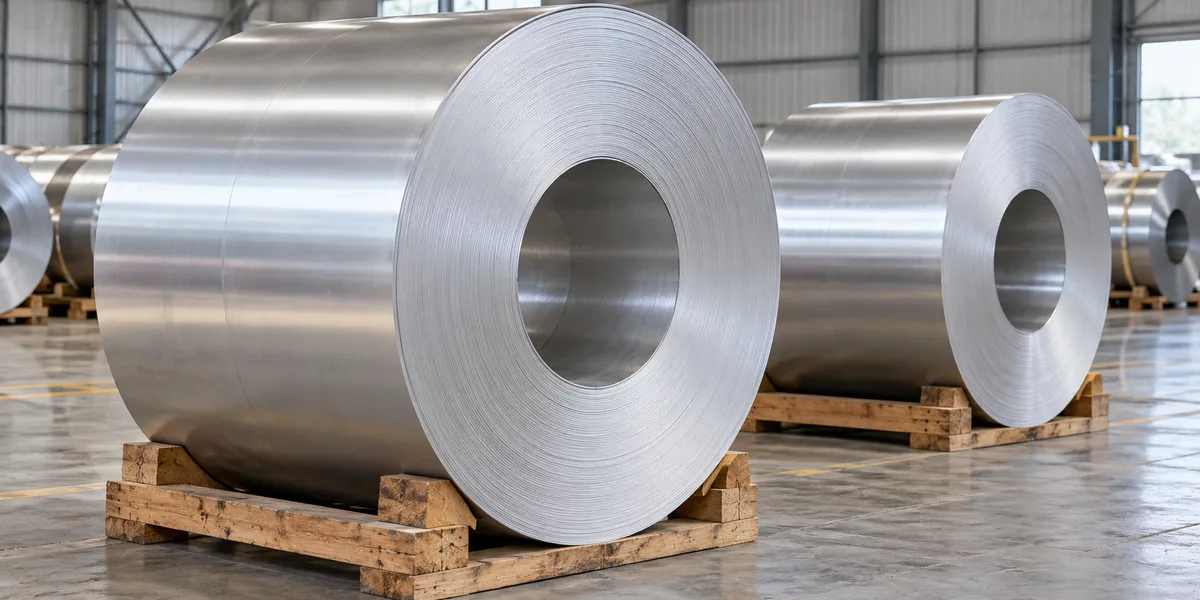
Pure aluminium wire (1350 or 1370) has the best conductivity of any aluminium, but it is soft. When a conductor must carry its own weight over a span, resist abrasion, or hold a crimp or clamp without creeping, a heat-treatable alloy is used instead. 6101 and its close relative 6201 are the two conductor alloys of the 6xxx family.
6101 wire starts as continuously cast and rolled rod in the T4 condition. It is cold-drawn to size, which raises strength, and then artificially aged so that fine Mg2Si particles precipitate. The ageing step also draws dissolved magnesium and silicon out of solution, recovering much of the conductivity lost during alloying. The result is a wire that is several times stronger than annealed EC wire with only a moderate reduction in conductivity.
| Element | Minimum | Maximum | Why it is limited |
|---|---|---|---|
| Silicon (Si) | 0.30 | 0.70 | Forms Mg2Si with magnesium |
| Iron (Fe) | — | 0.50 | Impurity; lowers conductivity |
| Copper (Cu) | — | 0.10 | Impurity |
| Manganese (Mn) | — | 0.03 | Very strong conductivity penalty, so held far below normal 6xxx limits |
| Magnesium (Mg) | 0.35 | 0.80 | Main strengthening element |
| Chromium (Cr) | — | 0.03 | Very strong conductivity penalty |
| Zinc (Zn) | — | 0.10 | Impurity |
| Boron (B) | — | 0.06 | Added to tie up dissolved Ti, V and Cr as borides, raising conductivity |
| Others, each / total | — | 0.03 / 0.10 | Tighter than the usual 0.05 / 0.15 |
| Aluminium (Al) | Remainder | About 97.9 – 99.4 % |
6201, the main alternative for overhead conductor wire, has more magnesium and silicon (Mg 0.6 – 0.9 %, Si 0.5 – 0.9 %), which gives higher strength and somewhat lower conductivity. See the 6201 alloy guide.
Unlike extruded 6101 bar, drawn 6101 wire has no single ASTM product standard with fixed temper limits, so tensile strength, elongation and conductivity are agreed between buyer and producer, and the mill certificate reports measured values for each lot. The useful conditions are:
| Condition | How it is made | Typical use |
|---|---|---|
| T4 (rod) | Solution treated and quenched on the casting-rolling line | Drawing stock; not a final wire temper |
| Drawn, as-drawn | Cold drawn from T4 rod without ageing | Intermediate; high strength, lower conductivity |
| Drawn and aged (T8-type) | Cold drawn, then artificially aged | Conductor wire, earthing wire, braid |
| Aged before drawing (T6 then drawn) | Aged rod drawn to final size | Wire for cold heading and rivets |
| Annealed | Fully softened after drawing | Maximum ductility for forming and winding |
Conductivity of 6101 depends strongly on its ageing condition. As a reference point, extruded 6101 conductor tempers are specified at 55 – 59.5 % IACS minimum under ASTM B317. For wire, state the minimum conductivity (or maximum resistivity at 20 °C) and minimum tensile strength you need on the order.
6101 wire is drawn from rod (usually 9.5 mm) to diameters from a few millimetres down to fine sizes for braiding. Mass per kilometre = π × d² / 4 × 2.70, with d in millimetres:
| Diameter (mm) | Area (mm²) | Mass (kg/km) |
|---|---|---|
| 0.5 | 0.196 | 0.53 |
| 1 | 0.785 | 2.12 |
| 1.5 | 1.767 | 4.77 |
| 2 | 3.142 | 8.48 |
| 2.5 | 4.909 | 13.25 |
| 3 | 7.069 | 19.09 |
| 3.5 | 9.621 | 25.98 |
| 4 | 12.566 | 33.93 |
| 4.5 | 15.904 | 42.94 |
| 5 | 19.635 | 53.01 |
| 6 | 28.274 | 76.34 |
| 8 | 50.265 | 135.72 |
Strands in all-aluminium-alloy and composite conductors where strength above 1350 is needed.
Solid and stranded aluminium-alloy conductors for down conductors and earthing networks; aluminium alloy conductors are covered in standards such as EN 62561-2.
Fine wire braided into flexible connectors and cable screens.
Light-duty rivets, pins and decorative fasteners where conductivity or corrosion resistance matters.
Wire of matching composition for repair or spraying of 6101 conductors.
Base wire for copper-clad or tinned aluminium conductors.
| Aspect | 1350 wire | 6101 wire | 6201 wire |
|---|---|---|---|
| Alloy type | Pure aluminium (99.5 % min) | Al-Mg-Si, lean | Al-Mg-Si, richer |
| Strength | Lowest | Medium | Highest of the three |
| Conductivity | Highest (≈ 61 – 62 % IACS) | Between the two | 52.5 % IACS minimum in 6201-T81 (ASTM B398) |
| Main standards | ASTM B230, IEC 60889 | Agreed specification; EN 573-3 chemistry | ASTM B398, EN 50183, IEC 60104 |
| Typical use | AAC, ACSR, building wire | Earthing, braids, special conductors | AAAC overhead conductors |
Yes. Drawn and aged 6101 wire is several times stronger than annealed 1350 and noticeably stronger than hard-drawn 1350, at the cost of some conductivity.
6201 contains more magnesium and silicon, so it is stronger and slightly less conductive. 6201-T81 is the standard alloy for AAAC overhead conductors under ASTM B398; 6101 is used where a little more conductivity is preferred.
The former German designation is E-AlMgSi0.5, Werkstoff 3.3207. Some catalogues wrongly list 3.2315, which belongs to 6082.
Yes. Wire drawn from aged rod heads well and suits light-duty rivets and pins where conductivity or corrosion resistance matter more than high strength.
In tightly strapped coils or on spools, wrapped against moisture and palletised or cased.
Send the diameter, properties and packing format. Metline will confirm availability and quote with certificates.





