Forming in T4
Allow generous radii (typically 1.5 – 2 × t or more for bends) and avoid sharp draws. Form within the agreed shelf life, as natural ageing raises strength over time.



6013 is one of the strongest 6xxx sheet alloys: in T6 its yield strength approaches 360 MPa, close to that of 2024-T3, yet it remains weldable and far more corrosion resistant. It is used for high-strength body reinforcements, structural brackets and performance-vehicle panels. Metline supplies 6013 sheet and blanks in T4 and T6, certified to AMS 4347 and AMS 4216 or the OEM specification, worldwide.
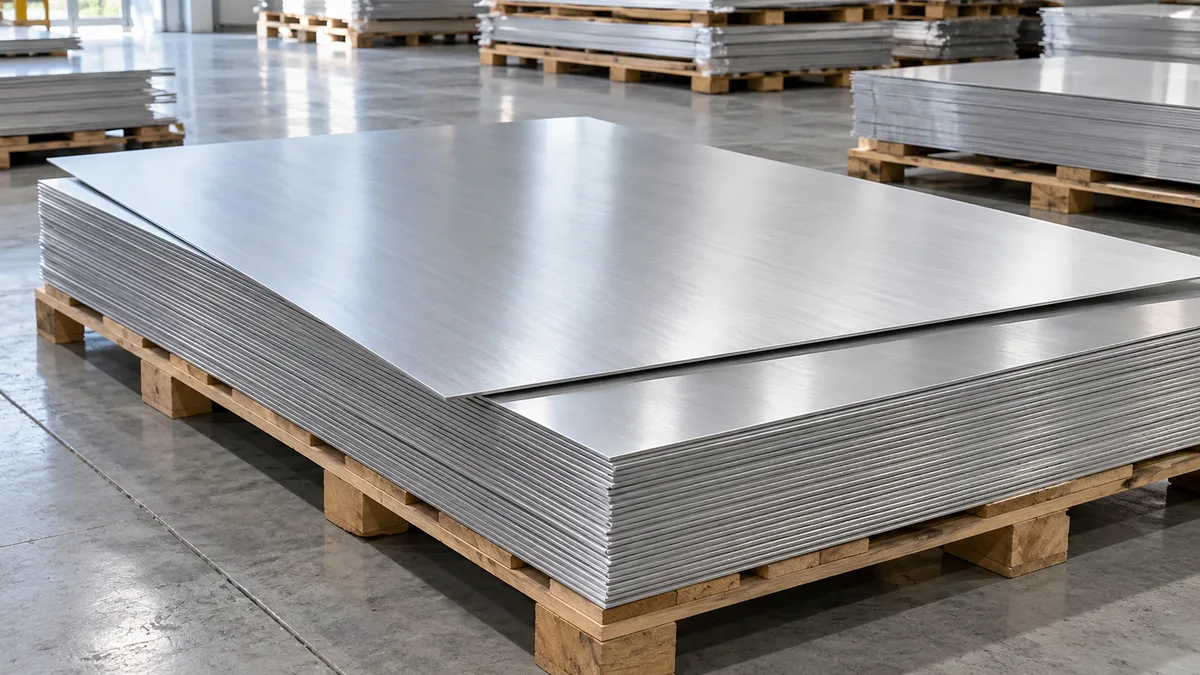
6013 was developed as a 6xxx alternative to 2024 for aircraft fuselage skin: strong, but weldable and with better corrosion resistance. Its high magnesium, silicon and copper content (around 1 % each) and a manganese addition give a large ageing response. In automotive use, that strength lets engineers make thinner, lighter reinforcements and structural parts than with 6016 or 6061.
The trade-off is formability and cost. 6013-T4 is formable, but less so than 6016 or 6014, and its copper content means it is not chosen for visible outer panels on mass-market cars, where filiform corrosion and hemming performance matter. It is a specialist alloy for parts where strength per kilogram justifies the price: door intrusion reinforcements, pillar and roof reinforcements, seat structures, motorsport and premium-vehicle parts.
Parts are usually formed in T4 and then aged. The automotive paint bake gives only part of the strength gain, because the full T6 cycle is longer, so structural parts are often given a separate ageing step after forming.
Registered Aluminum Association limits, also used in AMS 4347 and AMS 4216. Note the copper range of 0.6 – 1.1 %, which is what sets 6013 apart from lean body-sheet alloys. Some supplier tables omit copper altogether; that is not 6013.
| Element | Minimum | Maximum | Role |
|---|---|---|---|
| Magnesium (Mg) | 0.8 | 1.2 | Forms strengthening precipitates with Si |
| Silicon (Si) | 0.6 | 1.0 | Excess Si increases strength |
| Copper (Cu) | 0.6 | 1.1 | Adds strength and ageing response |
| Manganese (Mn) | 0.20 | 0.8 | Grain control and toughness |
| Iron (Fe) | — | 0.50 | Impurity |
| Chromium (Cr) | — | 0.10 | |
| Zinc (Zn) | — | 0.25 | |
| Titanium (Ti) | — | 0.10 | Grain refiner |
| Others, each / total | — | 0.05 / 0.15 | |
| Aluminium (Al) | Remainder | About 94.8 – 97.8 % |
Typical values for thin sheet. Guaranteed minimums are set by AMS 4347 (T4) and AMS 4216 (T6) or by the vehicle maker's specification and appear on the certificate.
| Temper | Tensile strength | Yield strength (0.2 %) | Elongation | Use |
|---|---|---|---|---|
| T4 | about 310 MPa | about 170 MPa | about 22 % | Forming, then ageing |
| T6 | about 380 – 400 MPa | about 340 – 360 MPa | about 8 – 10 % | Finished high-strength parts |
For comparison, 6016 after a typical paint bake reaches a yield of around 200 MPa. 6013-T6 offers roughly 70 % more, which is why a reinforcement can often be made one or two gauges thinner in 6013.
Body sheet is ordered to the vehicle maker's material specification; send it with your enquiry so we can confirm surface class, flatness and certification.
| Surface option | Code | What it does |
|---|---|---|
| Mill finish | MF | As rolled; lowest cost, used for inner and structural parts |
| Electro-discharge textured | EDT | Fine, random texture that holds lubricant in the press and gives a uniform painted look |
| Pre-treated | PT | Thin conversion layer that improves adhesive bond durability and paint adhesion |
| Dry-film lubricant | DFL | Hot-melt lubricant applied at the mill for cleaner, more consistent pressing |
| Oiled | — | Light mill oil for corrosion protection in storage and basic press lubrication |
| Thickness (mm) | kg per m² | 1250 × 2500 mm sheet (kg) |
|---|---|---|
| 0.8 | 2.17 | 6.8 |
| 1 | 2.71 | 8.5 |
| 1.2 | 3.25 | 10.2 |
| 1.5 | 4.06 | 12.7 |
| 2 | 5.42 | 16.9 |
| 2.5 | 6.78 | 21.2 |
| 3 | 8.13 | 25.4 |
Allow generous radii (typically 1.5 – 2 × t or more for bends) and avoid sharp draws. Form within the agreed shelf life, as natural ageing raises strength over time.
Full T6 strength needs a dedicated ageing cycle (several hours at about 190 °C is typical for this alloy class). A paint bake alone gives a partial increase.
Laser, MIG, TIG and friction-stir welding are all used. 4xxx fillers reduce hot-cracking risk.
Self-piercing rivets work but need die settings suited to the higher strength; check joint quality on trials.
Good when painted or e-coated. As a copper-bearing alloy it is more sensitive to filiform corrosion than 6016, so pre-treatment matters.
Machines well in T6 and produces short chips; suitable for machined brackets cut from sheet.
| Part | Why 6013 |
|---|---|
| Door intrusion beams and reinforcements | High yield strength in thin gauge |
| Pillar, roof-bow and sill reinforcements | Strength with weldability |
| Seat frames and seat-back panels | Lightweight, strong formed parts |
| Battery enclosure lids and protective plates | Stiffness and impact resistance |
| Motorsport and premium-vehicle panels | Strength-to-weight where cost is secondary |
| Brackets and mounts | Machined or formed high-strength parts |
A typical use is a door reinforcement stamped from 1.5 mm 6013-T4, aged to T6 after forming, and laser-welded into a 6016 door inner. The higher strength allows a thinner, lighter part than a 6xxx alternative.
| Property | 6013-T6 | 6061-T6 | 6016 (paint-baked) | 2024-T3 |
|---|---|---|---|---|
| Typical yield | about 340 – 360 MPa | about 276 MPa | about 180 – 220 MPa | about 345 MPa |
| Typical tensile | about 380 – 400 MPa | about 310 MPa | about 240 – 270 MPa | about 480 MPa |
| Weldability | Good | Good | Good | Poor |
| Corrosion resistance | Good | Good | Very good | Fair |
| Formability (soft temper) | Fair | Fair | Very good | Fair |
| Typical automotive role | Reinforcements | Brackets, structures | Outer panels | Rare in cars |
Use 6013 for high-strength reinforcements and structural sheet parts. For outer panels choose 6016 or 6014; for general brackets 6061 is cheaper and more widely available.
Typical yield is about 340 – 360 MPa for 6013-T6 versus about 276 MPa for 6061-T6, roughly 25 – 30 % higher, with similar weldability.
Rarely. Its copper content and lower formability make copper-free 6016 or 6014 a better choice for visible skins. 6013 is used for reinforcements and structural parts.
No. A paint bake gives a partial increase. Full T6 needs a dedicated, longer ageing cycle after forming.
Yes. Laser, MIG, TIG and friction-stir welding work well, which is a key advantage over 2024.
AMS 4347 covers 6013-T4 sheet and AMS 4216 covers 6013-T6 sheet and plate; ASTM B209 and OEM specifications are also used.
Yes, with EN 10204 3.1 certificates, interleaving and sealed export packing.
Send temper, gauge, blank size and quantity. Our team will reply with availability and a delivered price.





