6061-O
Fully annealed. Best for deep drawing and tight bends; parts are solution treated, quenched and aged after forming.



6061 sheet and plate is the go-to heat-treatable material for vehicle parts that need more strength than 5xxx sheet: brackets, reinforcements, battery-enclosure plates, cross-members, truck and trailer floors and machined mounting plates. It is formed in the soft O or T4 temper and aged to T6, or used directly as T6 and T651 plate. Metline supplies 6061 sheet, coil, tread plate and plate to ASTM B209 and EN 485, cut to size and certified, to automotive manufacturers worldwide.
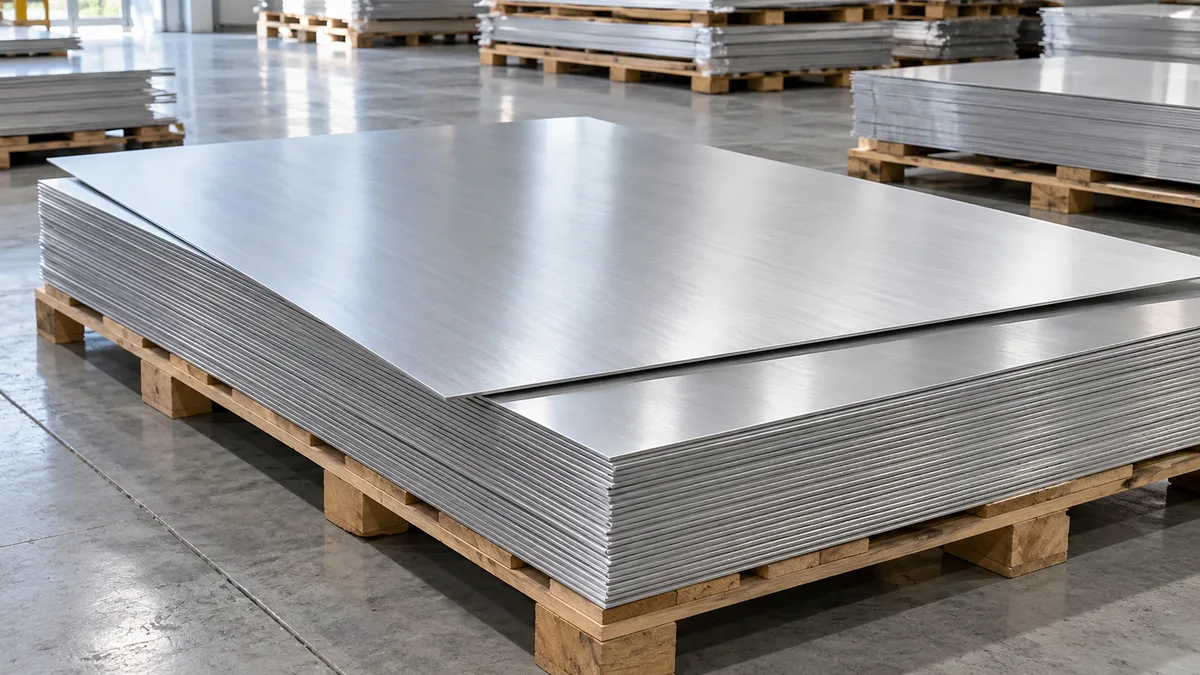
Aluminium body sheet falls into two families. Visible closure panels use bake-hardening alloys such as 6016, 6014 and 6022, and deep-drawn inner panels use 5182 or 5754. 6061 sits alongside them as a structural and engineering sheet: stronger than the panel alloys once fully aged, readily machined and welded, but not designed for A-class painted surfaces or the paint-bake hardening cycle.
That makes 6061 the logical choice for parts that are formed once and then need high strength: brackets, gussets, seat and bumper reinforcements, battery-module end plates and enclosure lids, inverter and motor mounting plates, and floors and side walls of trucks, vans and trailers. Thick 6061-T651 plate is machined into fixtures, jigs and battery cooling plates.
The usual production route is to blank and form the part in the soft O or freshly quenched T4 temper, then solution treat if needed and artificially age to T6. Flat parts can be laser-cut or machined directly from T6 or T651 stock.
| Element | Minimum | Maximum | Role |
|---|---|---|---|
| Silicon (Si) | 0.40 | 0.80 | Forms Mg2Si with magnesium |
| Iron (Fe) | — | 0.70 | Impurity |
| Copper (Cu) | 0.15 | 0.40 | Adds strength; slightly lowers corrosion resistance |
| Manganese (Mn) | — | 0.15 | Grain control |
| Magnesium (Mg) | 0.80 | 1.20 | Main strengthening element |
| Chromium (Cr) | 0.04 | 0.35 | Controls grain structure, improves stress-corrosion resistance |
| Zinc (Zn) | — | 0.25 | Impurity |
| Titanium (Ti) | — | 0.15 | Grain refiner |
| Others, each / total | — | 0.05 / 0.15 | |
| Aluminium (Al) | Remainder |
Registered Aluminum Association and EN 573-3 limits. Zirconium is not a specified element in 6061; tables listing a Zr limit instead of chromium should be checked against the certificate.
Specified values below are from ASTM B209 and EN 485-2 for sheet up to about 6 mm. O-temper limits are maximums (to guarantee formability); heat-treated tempers are minimums.
| Temper | Tensile strength | Yield strength (0.2 %) | Elongation (50 mm) | Typical hardness |
|---|---|---|---|---|
| O (annealed) | ≤ 150 MPa | ≤ 85 MPa | ≥ 14 – 18 % | about 30 HB |
| T4 / T451 | ≥ 205 MPa | ≥ 110 MPa | ≥ 12 – 16 % | about 65 HB |
| T6 / T651 | ≥ 290 MPa | ≥ 240 MPa | ≥ 6 – 10 % by thickness | about 95 HB |
| T6, typical | about 310 MPa | about 276 MPa | about 12 % | 95 HB |
Some trade tables give 6061-O as "≥ 45 MPa tensile, ≥ 20 MPa yield". These are not standard values; the ASTM and EN limits for O temper are maximums, as shown.
Fully annealed. Best for deep drawing and tight bends; parts are solution treated, quenched and aged after forming.
Solution treated and naturally aged; T451 is also stretched. Good formability with moderate strength; can be aged to T6 after forming.
Fully aged sheet. Used flat or with generous bends for brackets, floors and cover plates.
Stretched plate that stays flat during machining. Standard for mounting plates, fixtures and cooling plates.
Weight is 2.70 kg per m² per millimetre: a 2 mm sheet weighs 5.4 kg/m², and a 1220 × 2440 × 3 mm sheet about 24.1 kg. Use the plate weight calculator for other sizes.
Standard tolerances follow ASTM B209 or EN 485-3/-4. Automotive contracts often use the tighter thickness limits below for cold-rolled sheet.
| Thickness (mm) | Width ≤ 1500 mm | > 1500 – 1700 mm | > 1700 – 2000 mm | > 2000 – 2400 mm |
|---|---|---|---|---|
| 0.30 – 0.50 | ± 0.03 | ± 0.04 | — | — |
| > 0.50 – 0.80 | ± 0.03 | ± 0.04 | ± 0.04 | — |
| > 0.80 – 1.20 | ± 0.04 | ± 0.04 | ± 0.05 | ± 0.06 |
| > 1.20 – 2.00 | ± 0.05 | ± 0.05 | ± 0.06 | ± 0.07 |
| > 2.00 – 2.50 | ± 0.06 | ± 0.07 | ± 0.07 | ± 0.08 |
| > 2.50 – 3.00 | ± 0.07 | ± 0.08 | ± 0.08 | ± 0.09 |
| > 3.00 – 3.50 | ± 0.08 | ± 0.09 | ± 0.10 | ± 0.11 |
| Option | Code often used | Purpose |
|---|---|---|
| Mill finish | MF | Standard rolled surface; base for further treatment |
| Electro-discharge textured | EDT | Fine isotropic texture that holds lubricant and improves paint appearance |
| Ti/Zr conversion coating | P | Pretreatment for adhesive bonding and paint adhesion |
| No protection | NP | Clean, untreated surface for immediate processing |
| Dry-film lubricant | DO | Uniform, clean lubrication for deep drawing |
| Electrostatic oiling | EO | Thin, even oil film for forming and temporary corrosion protection |
| Part | Typical form and temper | Reason |
|---|---|---|
| Brackets, gussets and reinforcements | Sheet, formed in T4, aged to T6 | High strength in small formed parts |
| Battery-module end plates and enclosure lids | Sheet or plate, T6 | Strength, flatness and machinability |
| Motor, inverter and charger mounting plates | Plate, T651 | Stays flat when machined |
| Truck, van and trailer floors and side walls | Sheet, plate and tread plate, T6 | Corrosion resistance and load capacity |
| Running boards and steps | Tread plate, T6 | Slip resistance and strength |
| Heat shields and covers (structural) | Sheet, T4 or T6 | Rigid, weldable covers |
6061 is rarely used for exterior skin panels: its surface and hemming behaviour after ageing are not suited to A-class closures. For those, see the bake-hardening body sheet alloys listed below.
| Property | 6061-T6 | 6082-T6 | 5754-O | 6016-T4P |
|---|---|---|---|---|
| Yield strength | ≥ 240 MPa | ≥ 260 MPa | ≥ 80 MPa | about 90 – 130 MPa (≈ 180 – 220 MPa after bake) |
| Formability | Low in T6, good in O/T4 | Low in T6 | Very good | Very good |
| Main automotive role | Brackets, plates, floors | Structural plate (Europe) | Inner panels, structures | Outer closure panels |
| Heat treatment needed | Yes, for T6 after forming | Yes | No | Paint bake only |
Choose 6082 where European standards apply, 5754 for complex drawn structures that do not need T6 strength, and 6016 or 6022 for visible outer panels.
Not for visible outer panels. Those use bake-hardening alloys such as 6016, 6014 and 6022. 6061 sheet is used for structural parts such as brackets, reinforcements, battery-enclosure plates and commercial-vehicle floors.
O temper gives maximum formability; T4 is also formable and needs only artificial ageing afterwards to reach T6. Forming in T6 is limited to generous bend radii.
ASTM B209 and EN 485-2 require at least 290 MPa tensile and 240 MPa yield strength, with minimum elongation between 6 and 10 % depending on thickness.
T451 is solution treated, stretched to relieve stress and naturally aged. It is flatter and more stable than T4 and is often aged to T651 after machining or forming.
Yes, preferably in T4. In T6 the lower ductility can cause cracks on the die side, so joint trials are recommended.
Yes. Metline supplies 6061 sheet and plate worldwide with mill certificates and export packing on EXW, FOB, CIF or DAP terms.
Send temper, size, surface and quantity. Our team will reply with availability, certification and delivered pricing.





