Deep drawing
Aluminium has a lower r-value and modulus than steel, so draw dies need larger radii, slightly different blank-holder forces and allowance for more springback. 5754-O draws well when lubrication is controlled.



5754 in the soft O or H111 temper is the standard aluminium sheet for car body inner panels and structural pressings: it draws deeply, welds well and resists road-salt corrosion without paint-bake hardening. Metline supplies 5754-O sheet, blanks and coil for body-in-white, chassis and heat-shield parts, certified to EN 485 and ASTM B209, to vehicle and component makers worldwide.
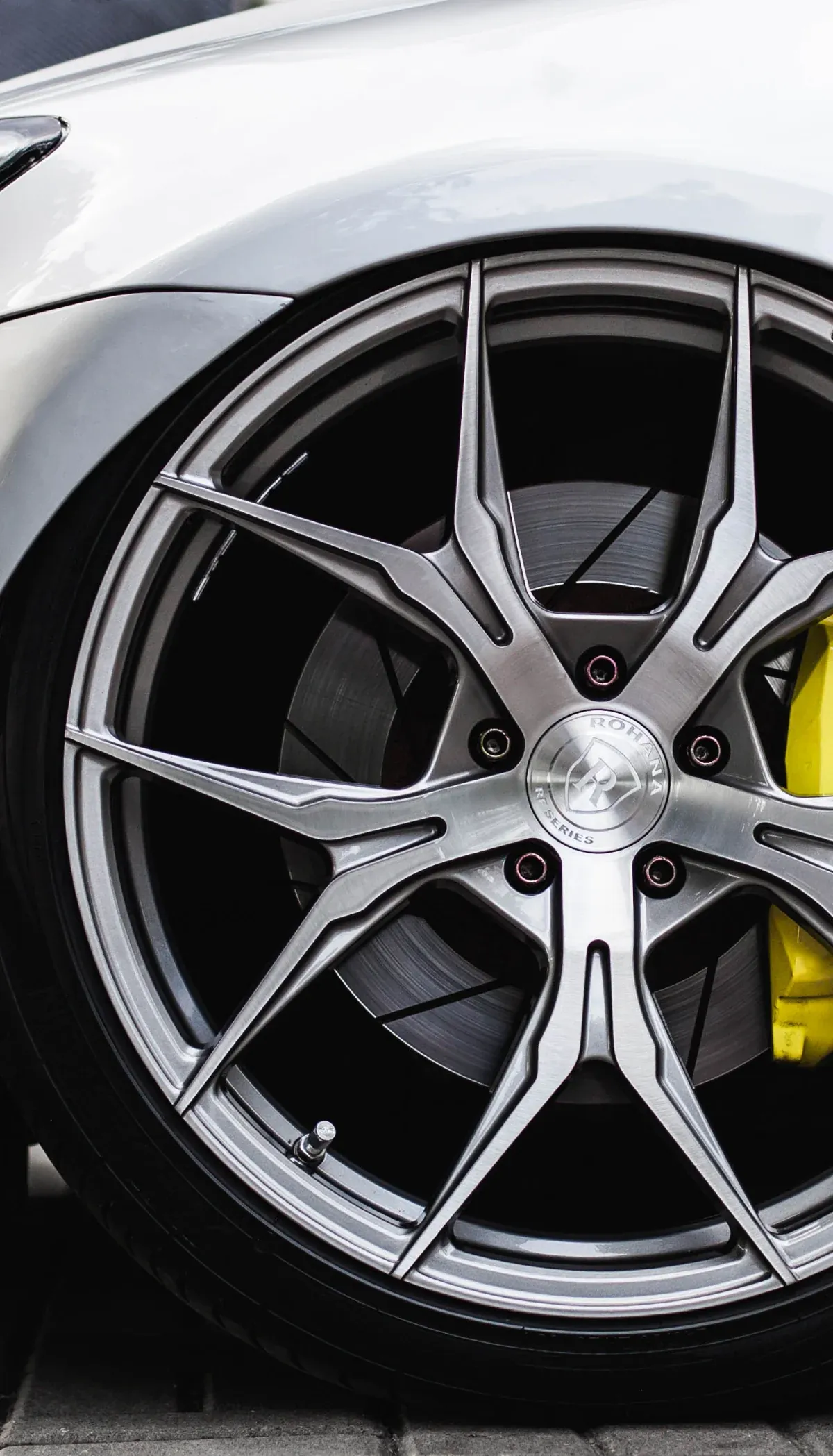
Aluminium body structures use two families of sheet. Heat-treatable 6xxx alloys (6016, 6014, 6111) form the visible outer panels because they harden in the paint oven and resist denting. Non-heat-treatable 5xxx alloys, chiefly 5754 and 5182, form the hidden inner panels and structural parts, where deep drawing, crash energy absorption and corrosion resistance matter more than surface appearance.
5754 contains about 3 % magnesium. That gives it a good balance: strong enough for door inners, floor pans and structural reinforcements, ductile enough for deep draws, and with magnesium below the level where long-term sensitisation (beta-phase grain-boundary precipitation) becomes a serious risk at warm service temperatures. 5182, with about 4.5 % magnesium, is stronger but more susceptible to sensitisation and is therefore kept away from hot zones.
A common drawback of Al-Mg alloys is stretcher-strain marking (Lüders lines) during pressing. In 5754-O this is acceptable on hidden parts, which is exactly where it is used. Outer skins stay in 6xxx alloys that do not show these marks.
Registered limits from the Aluminum Association and EN 573-3 (EN AW-5754, AlMg3). Automotive sheet is often made to tighter internal ranges agreed with the vehicle maker; the certificate reports the actual analysis.
| Element | Minimum | Maximum | Role |
|---|---|---|---|
| Magnesium (Mg) | 2.6 | 3.6 | Solid-solution strength and work hardening |
| Manganese (Mn) | — | 0.50 | Grain control and strength |
| Chromium (Cr) | — | 0.30 | Grain control |
| Mn + Cr | 0.10 | 0.60 | Combined limit |
| Silicon (Si) | — | 0.40 | Impurity |
| Iron (Fe) | — | 0.40 | Impurity; affects formability |
| Copper (Cu) | — | 0.10 | Kept low for corrosion resistance |
| Zinc (Zn) | — | 0.20 | |
| Titanium (Ti) | — | 0.15 | Grain refiner |
| Others, each / total | — | 0.05 / 0.15 | |
| Aluminium (Al) | Remainder | About 94 – 97 % |
Some older data sheets quote 5754 with copper or silicon minimums; the registered alloy has none. Order to the standard limits above or to the OEM's specification.
EN 485-2 sets the same tensile window for O and H111. Elongation minimums rise with thickness. Typical values for automotive gauges sit comfortably above the minimums.
| Property | EN 485-2 requirement (O / H111) | Typical, 1 – 2 mm automotive sheet |
|---|---|---|
| Tensile strength Rm | 190 – 240 MPa | about 210 – 225 MPa |
| Proof stress Rp0.2 | 80 MPa min | about 95 – 110 MPa |
| Elongation A50, 0.5 – 1.5 mm | 14 % min | about 22 – 26 % |
| Elongation A50, 1.5 – 3 mm | 16 % min | about 24 – 28 % |
| Elongation A50, 3 – 6 mm | 18 % min | — |
| Hardness | — | about 52 HB |
Unlike 6xxx outer-panel sheet, 5754 does not gain strength in the paint oven. Its final strength in the part comes from the work hardening introduced during pressing, which can raise local yield strength well above the as-delivered value in heavily drawn areas.
Exact width and gauge combinations depend on the rolling route; send your blank drawing for confirmation.
| Thickness (mm) | kg per m² | 1250 × 2500 mm sheet (kg) |
|---|---|---|
| 0.8 | 2.14 | 6.7 |
| 1 | 2.67 | 8.3 |
| 1.2 | 3.20 | 10.0 |
| 1.5 | 4.00 | 12.5 |
| 2 | 5.34 | 16.7 |
| 2.5 | 6.67 | 20.9 |
| 3 | 8.01 | 25.0 |
| 4 | 10.68 | 33.4 |
Aluminium has a lower r-value and modulus than steel, so draw dies need larger radii, slightly different blank-holder forces and allowance for more springback. 5754-O draws well when lubrication is controlled.
Al-Mg sheet can show stretcher-strain marks at low strain. Use 5754 on hidden parts, or specify a temper or levelling route that reduces the effect if appearance matters.
Resistance spot welding needs higher currents and frequent electrode dressing compared with steel. MIG and laser welding with 5xxx filler (ER5356, ER5183) work well.
Many aluminium body structures combine adhesive with self-piercing rivets or flow-drill screws. A conversion pre-treatment improves long-term bond durability.
Keep sustained service temperatures below about 65 °C where possible. 5754 is far less prone to intergranular attack than 5182, but the rule still applies near exhausts.
Isolate aluminium from steel and carbon-fibre parts with sealants, coatings or insulating fasteners to avoid galvanic corrosion.
| Part | Why 5754-O is chosen |
|---|---|
| Door, bonnet and tailgate inner panels | Deep draws and good spot weldability; hidden from view |
| Floor pans and wheel-house panels | Corrosion resistance in wet underbody zones |
| Structural reinforcements and brackets | Work hardening raises local strength after forming |
| Fuel and fluid tanks | Weldable and corrosion-resistant |
| Heat shields and underbody panels | Formable and stable at moderate temperatures |
| Truck cabs, trailer and bus panels | Weldable sheet with good fatigue behaviour |
| EV battery-box covers and closures | Formability plus corrosion resistance |
A typical aluminium bonnet pairs a 6016-T4 outer skin, which hardens in the paint oven for dent resistance, with a 5754-O or 5182-O inner that is deep drawn into the stiffening pattern. The two are hemmed and bonded together.
| Property | 5754-O | 5182-O | 6016-T4 | 5052-O |
|---|---|---|---|---|
| Magnesium | 2.6 – 3.6 % | 4.0 – 5.0 % | 0.25 – 0.6 % (+ Si) | 2.2 – 2.8 % |
| Typical yield | about 100 MPa | about 130 MPa | about 110 – 120 MPa | about 90 MPa |
| Paint-bake hardening | No | No | Yes | No |
| Sensitisation risk | Low | Higher | None | Low |
| Surface marks when pressed | Lüders lines possible | Lüders lines likely | None | Possible |
| Typical role | Inner and structural panels | High-strength inner panels | Outer skins | General sheet, tanks |
Pick 5754 as the default inner and structural sheet. Move to 5182 only when extra strength is essential and the part stays cool; choose 6016 or 6014 for outer skins that need a perfect painted surface.
5754 draws deeply and resists corrosion, but it can show stretcher-strain (Lüders) marks and does not harden in the paint oven. Those traits are acceptable on hidden inner and structural parts, while 6xxx sheet is used for visible skins.
Both are annealed. H111 receives a small amount of strain from levelling or stretching after annealing. EN 485-2 gives them the same tensile limits, so they are often interchangeable for pressing.
No. It is a non-heat-treatable Al-Mg alloy. Strength in the finished part comes from work hardening during pressing, not from the paint cycle.
Yes. Resistance spot welding works with higher current than steel and regular electrode dressing. Many body structures also use self-piercing rivets and structural adhesive.
For short excursions, yes. For sustained temperatures above about 65 °C, Al-Mg alloys can sensitise over time; 5754 is less prone than 5182, but heat shields or other alloys are preferred in hot zones.
Each lot ships with an EN 10204 3.1 mill test certificate showing chemistry and tensile results, traceable to the coil.
Send gauge, blank size, surface and volume. Our team will reply with availability, certification and a delivered price.





