Riveting
The standard joining method, using 2117-T4 or 2017 rivets. Aircraft-style practice with sealant in faying surfaces works well for race structures.



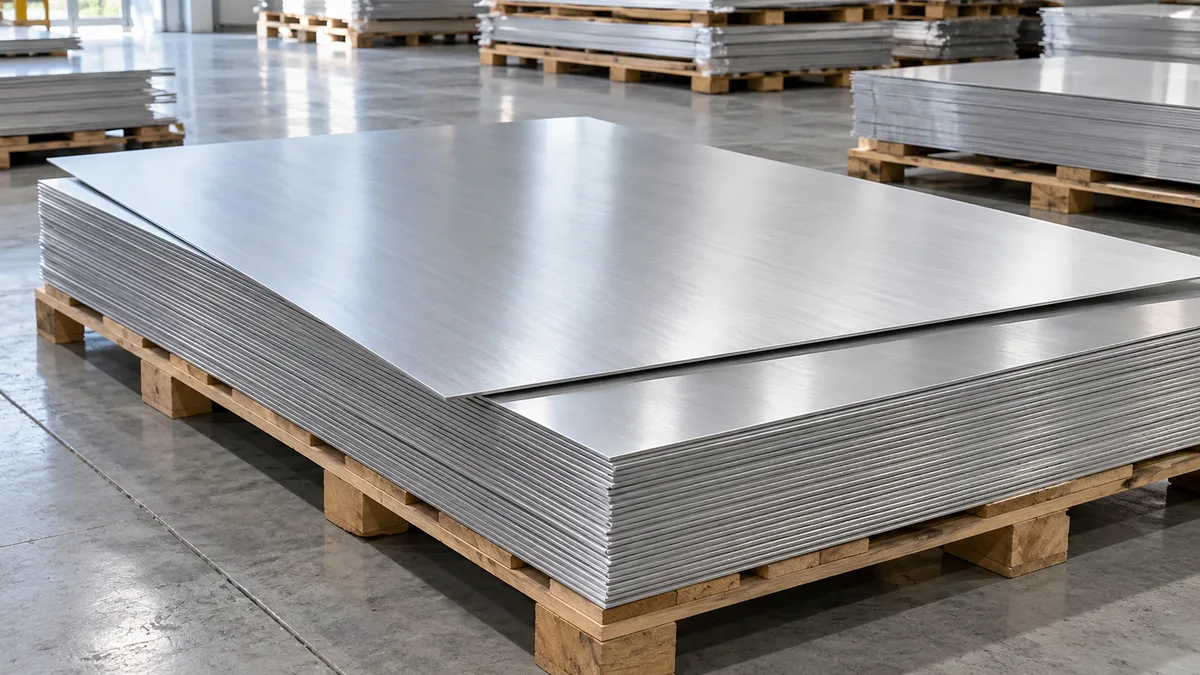
2024 sheet is a high-strength aluminium-copper-magnesium alloy supplied annealed (O) for forming and heat treatment, or solution treated and naturally aged (T3, T4) for maximum strength. In vehicles it is used for highly stressed brackets, panels and motorsport structures rather than mass-produced body panels. Metline supplies bare and clad 2024 sheet to customers worldwide.
Not for mainstream body panels. Production car bodies use 5xxx sheet (5182, 5754) for inner parts and 6xxx sheet (6016, 6111, 6022) for outer skins, because those alloys form well, resist corrosion and can be welded. 2024 is roughly 60 – 70 % stronger than a paint-baked 6xxx panel, but it needs corrosion protection and cannot be fusion welded.
That combination makes 2024 sheet a specialist material in the automotive world. It is used in motorsport monocoques, crash structures and floor panels joined by rivets and adhesives; in high-strength brackets and gussets; in armoured and special-purpose vehicles; and in trailer or race-transport bodies built with aircraft-style riveting.
Two delivery conditions matter. 2024-O is soft and formable; parts are pressed in O, then solution heat-treated, quenched and naturally aged by the user (to T42). 2024-T3 / T4 sheet arrives at full strength and is used flat or with gentle bends.
| Element | Minimum | Maximum |
|---|---|---|
| Silicon (Si) | — | 0.50 |
| Iron (Fe) | — | 0.50 |
| Copper (Cu) | 3.8 | 4.9 |
| Manganese (Mn) | 0.30 | 0.9 |
| Magnesium (Mg) | 1.2 | 1.8 |
| Chromium (Cr) | — | 0.10 |
| Zinc (Zn) | — | 0.25 |
| Titanium (Ti) | — | 0.15 |
| Others, each / total | — | 0.05 / 0.15 |
| Aluminium (Al) | Remainder |
Alclad 2024 sheet carries a thin layer of high-purity aluminium (typically about 2 – 5 % of thickness per side) roll-bonded to each face. The cladding corrodes sacrificially and protects the copper-rich core, at the cost of slightly lower strength.
| Temper / thickness | Tensile strength | Yield strength (0.2 %) | Elongation (min.) | Hardness (typ.) |
|---|---|---|---|---|
| O, 0.4 – 3 mm | ≤ 220 MPa | ≤ 140 MPa (EN) / ≤ 97 MPa (ASTM) | 12 – 13 % | ≈ 47 HB |
| T4, 0.4 – 1.5 mm (EN 485-2 min.) | ≥ 425 MPa | ≥ 275 MPa | 12 % | ≈ 120 HB |
| T4, 1.5 – 3 mm (EN 485-2 min.) | ≥ 425 MPa | ≥ 275 MPa | 14 % | ≈ 120 HB |
| T3, typical | ≈ 483 MPa | ≈ 345 MPa | ≈ 18 % | ≈ 120 HB |
| T42 (heat-treated by user from O), typical minimum | ≈ 425 MPa | ≈ 260 MPa | ≈ 15 % | — |
Values summarised from EN 485-2 and ASTM B209 and rounded; exact minimums depend on thickness band, cladding and standard edition. The certificate gives the guaranteed and measured values.
T3 / T4 sheet has limited formability (inside bend radii of about 2.5 – 4 × thickness, depending on gauge), so complex shapes are better pressed in O.
The standard joining method, using 2117-T4 or 2017 rivets. Aircraft-style practice with sealant in faying surfaces works well for race structures.
Structural epoxies bond 2024 well after anodising or another suitable pretreatment.
Arc welding is not recommended: hot cracking and strength loss. Earlier claims that 2024 sheet is easy to weld are incorrect.
T3 / T4 sheet machines and routes cleanly; O is gummy.
Use Alclad for bare exposure, or anodise and paint bare 2024. Avoid contact with steel or carbon fibre without isolation.
Keep long-term service below about 120 °C for T3 / T4 to avoid over-ageing.
For production hoods, doors, roofs and inner panels, specify 5182, 5754 or 6016 body sheet.
| Property | 2024-T3 | 6016-T4 + paint bake | 5754-O | 7075-T6 |
|---|---|---|---|---|
| Typical yield strength | ~345 MPa | ~180 – 200 MPa | ~100 MPa | ~500 MPa |
| Formability (as delivered) | Low | Good | Very good | Low |
| Weldability | Poor | Good | Excellent | Poor |
| Corrosion resistance | Fair (Alclad good) | Good | Excellent | Fair |
| Typical automotive role | Motorsport, brackets | Outer panels | Inner panels, structure | Bumper beams (extruded), race parts |
It cannot be fusion welded, needs corrosion protection and forms poorly in T3 / T4. 5xxx and 6xxx sheet give adequate strength with far easier production.
O is annealed: soft (under 220 MPa tensile) and formable. T4 is solution treated and naturally aged, with at least about 425 MPa tensile strength.
Yes. Solution treat at about 490 – 495 °C, quench rapidly in water and age naturally for about four days to reach T42.
2024 sheet with a thin pure-aluminium layer bonded to each side for corrosion protection. It is the normal choice when the sheet will be exposed without paint.
By riveting, bolting and adhesive bonding. Arc welding is not recommended.
Yes, bare or clad, cut to size, with EN 10204 3.1 certificates and export packing.
Send the temper, size, cladding and quantity. Our team will reply with availability and a delivered quotation.





